Free Hexagram (Star of David) Grid Generator
Draw an exact hexagram (Star of David) instantly with our 100% free grid generator. Set the six-pointed star with the inner hexagon its crossings enclose, correct by construction over any image, then export SVG or 600 DPI in seconds. No signup, no downloads needed. Trusted by 60,000+ artists worldwide.
Two triangles, opposed
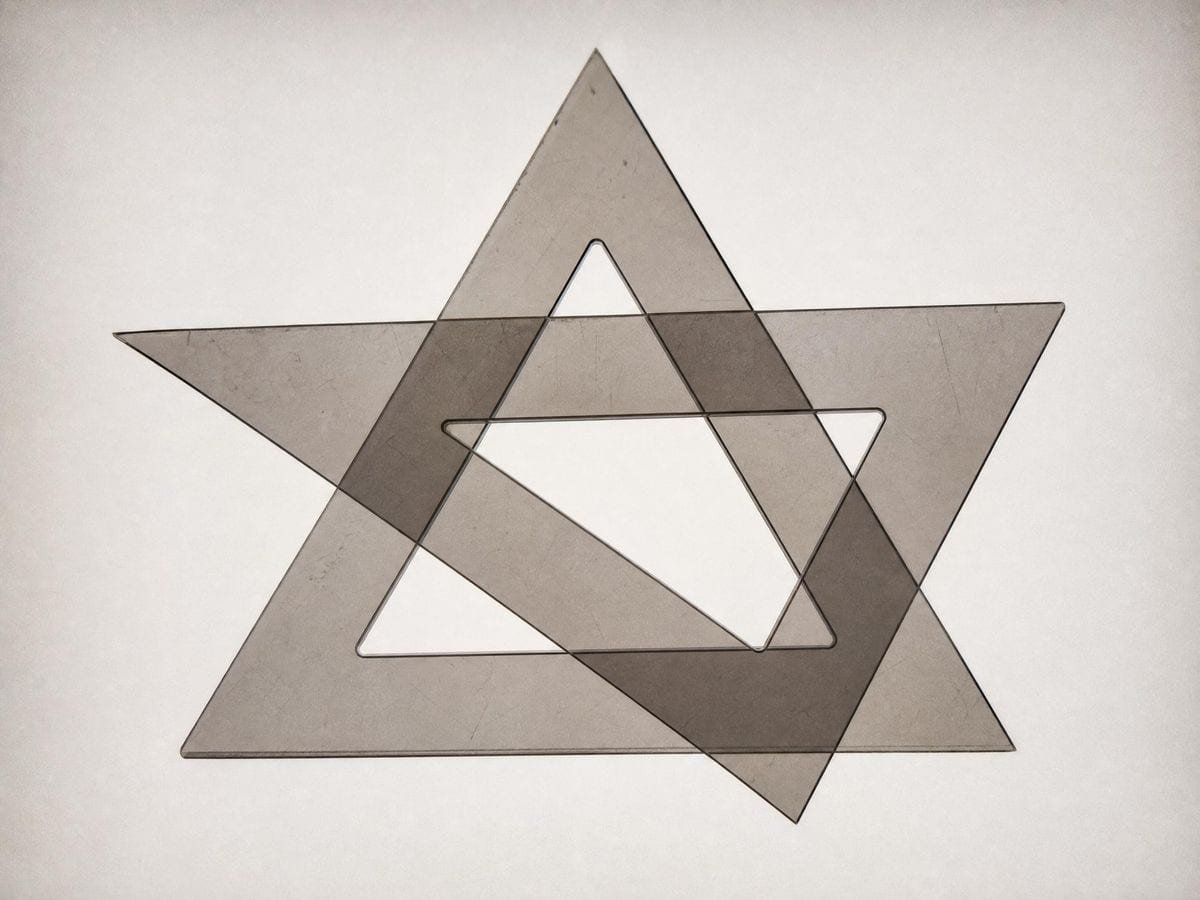
An upward and a downward equilateral triangle overlaid, producing a six-pointed star with a regular hexagon at its centre. All twelve outer points lie on one circle.
4 controls, not a fixed picture
Set size and construction step, toggle inner hexagon and boundary circle. Every one is live on the canvas.
Stacks with sacred geometry & pattern
Overlays combine, each carrying its own transform, so this one can sit under or over flower of life, sri yantra and metatron’s cube, and 15 more in the same set.
Six-fold symmetry, exported exactly
The 60-degree angles stay exact in SVG and remain clean in raster up to 600 DPI. Grid-only on transparency to overlay your own work.
| Ctrl + Z | Undo |
| Ctrl + Y | Redo |
| Esc | Deselect overlay |
| Alt + drag | Free positioning (no snap) |
| Ctrl + scroll | Zoom canvas |
| Ctrl + P | |
| ? | Show this help |
A six-pointed star is the simplest figure in this catalogue and the easiest to draw slightly wrong, because both triangles have to be equilateral and share a centre before anything inside it means anything.
The hexagram generator draws one of the 82 composition overlays in Grid Maker Pro, and the rest stack on the same image.
- 2 triangles
- Hexagon at 0.577
- SVG + 600 DPI export
- Nothing uploaded
What is a hexagram?
The hexagram generator is a free browser tool that draws the six-pointed star over any image or blank canvas. Two equilateral triangles are inscribed in the same circle, one point-up and one point-down, and their edges cross at six points. Those six points are the vertices of a regular hexagon whose circumradius is exactly r/√3 — 0.57735 of the outer circle — and the overlay draws it at that value rather than an approximation. The boundary circle and the inner hexagon can each be shown or hidden.

How to draw an exact hexagram
Two equilateral triangles, one inverted, and the hexagon they enclose — drawn from the construction rather than traced, so all six points are equal.
Open the hexagram
The hexagram opens with both triangles already inscribed in the same circle and sharing a centre, before you touch anything, which is the condition every proportion inside the figure depends on.
JPG · PNG · GIF · WEBP
Decide how much of it you need
The star alone for a mark, plus the hexagon when you are using the figure as a construction, plus the circle when it has to sit inside something round.
Size · Inner hexagon · Boundary circle
Place it and export
Drag, scale and rotate it over your artwork, or work on a blank canvas at your paper size. Export SVG for cutting and plotting, or a raster at up to 600 DPI.
PNG · JPG · PDF · SVG · up to 600 DPI
Three steps, about a minute. No signup, no upload.
What the Hexagram Generator does
Both triangles equilateral, both centred
The hexagram is two equilateral triangles in one circle, and its six crossings form a regular hexagon only when both are exact. Drawn freehand, one triangle comes out slightly larger or off-centre and the hexagon goes with it. Constructed, they are — which is the only reason the inside of the figure is worth anything.
The hexagon at 0.57735
The six crossings sit at exactly r divided by the square root of three. That is a number you can check on the drawing, and it is what makes the hexagram a usable construction rather than a picture of a star.
Circle, star, hexagon — separately
Three parts, three toggles. A pierced or cut version usually needs two of them; a study of the geometry needs all three; a mark usually needs one.
Six-fold, not five-fold
The hexagram is built from thirds of a circle and contains no golden ratio at all — everything in it is √3. That is worth knowing when you are choosing between it and a pentagram for a mark that has to feel a particular way.
Over your own work
Its own transform, so you can rotate the star onto an object in a photograph or scale it into a panel you are laying out without disturbing what is underneath.
Vector out, at real size
SVG export gives true straight lines for a cutter or plotter. Raster export is sized from the paper format and DPI you choose, up to 600.
Hexagram examples: four ways the figure reads
Hexagram vs a downloaded star graphic vs compass and straightedge
| Option | Both triangles equilateral and concentric | Inner hexagon at r/√3 | Vector export | Cost |
|---|---|---|---|---|
| Grid Maker Prothis tool | Yesby construction | Yesdrawn at 0.57735 | SVG + raster to 600 DPI | Free |
| A downloaded star graphic | Usually, unknown provenance | Rarely a separate path | Sometimes | Free or paid |
| Compass and straightedge | Yesthe radius steps six times | By construction | No | Time |
| A drawing program's polygon tool | Yes | Only if you build it | Yes | Subscription |
Who a hexagram is for: six-fold work
How a hexagram works — Two triangles, six crossings, and why everything inside is √3
The hexagram looks like the simplest of the 82 composition overlays and mostly is, which is exactly why the interesting question is not how to draw it but what its crossings produce. Here is the number that governs the whole figure, and how it differs from the star it is most often compared with.
Inscribe an equilateral triangle in a circle. Inscribe a second one rotated by sixty degrees. Their edges cross at six points and the overlap is a regular hexagon; the six pieces sticking out beyond it are the star's points. That is the entire construction, and it needs no measurement — thirds of a circle can be stepped off with a compass at the circle's own radius.
The proportion that falls out is √3. The hexagon's circumradius is the circle's divided by the square root of three — 0.57735 — and the same number governs the triangle's height against its side and the distance from the centre to any edge. Where the pentagram produces φ four times over, the hexagram produces √3 everywhere and φ nowhere.
Six-fold symmetry is what a compass does naturally. Five-fold is what it has to be taught.
Why it is the easy one, and what that costs
The radius of a circle divides its own circumference into exactly six. That single fact makes hexagonal and six-pointed constructions the ones any compass produces almost by accident. That is why they appear in every tradition that has ever used a compass and why hexagonal tiling turns up wherever equal cells are packed.
The cost is that a hexagram carries no irrational surprise. Its proportions are √3 and its symmetry is the plane's most natural — which makes it stable, calm and slightly inert. Compare a pentagram, whose five-fold symmetry cannot tile the plane at all and whose internal ratio never resolves. If you are choosing a mark, that is the actual difference between them, and it is a difference in feel that comes directly from the geometry.
The hexagon is usually the useful part
For design work the inner hexagon does more than the star. It is a regular hexagon at a known, exact size, related to an outer circle you also have — which is precisely the construction a badge, a seal, a tile or a repeating pattern needs.
Turn the star off and the hexagon on and you have that. Turn both on and you have a construction sheet: outer circle, six star points, six hexagon vertices, and every crossing between them. Elements placed on those points relate to each other by construction rather than by eye, which is the whole reason to use a geometric skeleton in the first place.
What this overlay does not claim
The hexagram carries a great deal of cultural meaning, most of it specific to particular traditions and periods, and none of it geometric. Gershom Scholem traced that history in “The Star of David: History of a Symbol” (in The Messianic Idea in Judaism, Schocken Books, 1971), and the hexagram overlay page follows it alongside the other sacred-geometry catalogue. As the Star of David it is a Jewish symbol whose adoption in that role is documented mainly from the medieval period onward; it also appears in Hindu and Buddhist yantra, in Islamic ornament, and in European heraldry, largely independently.
Those histories are real and worth reading, and none of them is evidence about the others. The figure recurs because a compass produces it, not because the traditions borrowed it from one another. This tool draws the geometry; the meaning is yours to bring.
How it differs from the merkaba overlay
The two draw the same pair of triangles and then diverge on the hexagon. The hexagram's hexagon is the inner one, through the six crossings at 0.577 of the radius. The merkaba's is the outer one, through the six triangle vertices at the full radius.
That is not a trivial difference in use. The inner hexagon is the shape the two triangles have in common; the outer one is the shape that contains them. If you are building a mark that sits inside a hexagonal boundary, the merkaba overlay gives you the boundary; if you are working from the overlap outward, the hexagram gives you the core. Both are here, and the choice is which hexagon you actually need.
The construction, and the lattice it belongs to
Set a compass to a circle radius and step it around the circumference. It lands exactly six times, closing on itself, and the six marks are the vertices of a regular hexagon. Join alternate marks for one triangle and the remaining three for the second. No measurement, no protractor, no arithmetic — which is why this figure appears wherever a compass has ever been used.
Extend the same move outward and you get the triangular lattice: every point surrounded by six neighbours at equal distance, which is the densest packing of equal circles in a plane. The hexagram is one cell of that lattice with its diagonals drawn, which is why the figure sits so comfortably inside tiling and pattern work and so awkwardly inside anything asking for five-fold symmetry.
That relationship is also the practical route to a repeat. Place the hexagram, note where its outer points fall, and step the whole figure by twice the inner hexagon radius in each of three directions. The copies interlock without gaps, because the lattice underneath them is the one the construction came from.
One more property is worth having, because it is the one that makes the figure useful for layout rather than for ornament. The six star points and the six inner-hexagon vertices together give twelve positions on a common centre, alternating between two radii — the full radius and 0.577 of it. That is a twelve-position dial with two ring depths, which is exactly the skeleton a clock face, a compass rose or a radial menu needs.
Using it that way means turning off the parts you are not placing to. Keep the two triangles as construction, place your elements on the twelve positions, then hide the triangles and keep the hexagon if you want a visible boundary. What remains is a radial layout that is regular by construction rather than by nudging, and every element sits at a distance from the centre that is either r or 0.577r — never something in between that will look like a mistake later.
And a caution about scale that applies to any nested version. The inner hexagon is 0.577 of the outer radius, so a second hexagram drawn inside it is a little over half the size of the first, and a third is a third of it. That decays far more slowly than the pentagram's 0.382, which is why hexagonal nesting survives several generations in tilework where five-fold nesting does not — a genuine practical difference between the two figures, and one worth knowing before choosing which to build a repeating pattern on. The vesica piscis generator draws the first step of the same compass construction, and the Flower of Life generator the lattice it fills.
Where a hexagram gets used
Tile layout, mostly. The hexagon at an exact ratio to the circle is what lets a repeat close properly instead of drifting by a hair every course.
For pierced metalwork I export the star and the hexagon as separate paths and cut them at different depths. Vector out is not optional for that.
I use it to show why hexagons are everywhere and pentagons are not. Stepping the radius round the circle six times makes the point in one move.
Hexagram: frequently asked questions
The geometry
How big is the hexagon inside the star?
Its circumradius is exactly r divided by the square root of three — 0.57735 of the outer circle. The six crossings of the two triangles land there, and the overlay draws the hexagon at that value rather than an approximation.
Is there a golden ratio in a hexagram?
No. Everything in it is √3. The golden ratio belongs to five-fold symmetry, which is why the pentagram produces it and the hexagram does not. If a design needs φ, this is the wrong figure.
Why are six-pointed stars so common across cultures?
Because a circle's radius steps around its own circumference exactly six times, so any compass produces six-fold symmetry almost by accident. The figure recurs independently rather than being borrowed, which is worth knowing before reading connections into it.
Can I draw just the hexagon?
Yes — turn the star off. A regular hexagon at a known exact size, related to an outer circle you also have, is the construction most six-fold design work actually needs.
Does it draw the Star of David?
It draws the geometry that figure uses. The cultural meanings the hexagram carries — Jewish, Hindu, Buddhist, Islamic, heraldic — are all real and all separate from the construction. This tool draws the shape; the meaning is yours.
Using it
What does the construction-step control do?
It builds the figure up rather than showing it complete: circle, first triangle, second triangle, crossings, hexagon. Useful for teaching and for a diagram that has to explain itself.
Can I rotate it onto something in a photograph?
Yes. The overlay carries its own transform, so drag, scale and rotate it over an object without moving the image beneath.
How do I get just the two triangles without the hexagon?
Turn the inner hexagon off. The hexagon is where the six crossings fall, so it is drawn as a reading of the figure rather than as part of it — the star is complete without it, and cleaner.
Export and print
Can I export it for cutting?
Yes. SVG export gives true vector straight lines, and the parts you have switched on export as separate paths, which is what a cutter or plotter needs. Raster export goes to 600 DPI at your chosen paper size.
What size should I print it for a stencil?
As large as the sheet allows, then reduce. The six points are acute, and acute tips are the first thing to blunt in printing and cutting — working large and scaling down loses less than working small and scaling up.
Choosing a grid
What is the difference between this and the merkaba overlay?
They draw the same two triangles and different hexagons. The hexagram's is the inner hexagon, through the six crossings at 0.577 of the radius; the merkaba's is the outer hexagon, through the six triangle vertices at the full radius. Which you want depends on whether you are working from the overlap outward or from the boundary inward.
Should I use this or the merkaba overlay?
They draw nearly the same figure and mean different things by it. This is the flat six-pointed star; the merkaba generator presents the same two triangles as a flattened star tetrahedron — a 3D solid seen head-on. Choose by what you are going to say about it.
Is a polygon tool's six-pointed star the same?
Mostly not. Most polygon tools build a star by pulling points out of a hexagon, which gives you a spike depth you chose; this crosses two full equilateral triangles, so the inner hexagon and the point lengths are determined by the construction.
Practical matters
Does my image get uploaded?
No. Everything happens in your browser — the image is drawn to a canvas on your own device and never sent anywhere.
Does this draw the Star of David?
It draws the same geometric figure. The Star of David is that hexagram used as a Jewish symbol, a usage that became widespread from the seventeenth century onward; the shape itself is far older and appears in many unconnected traditions.
Can I use it in a printed piece?
The geometry carries no restriction from us — no watermark, no account, and the terms leave your work yours. As with any symbol that carries religious meaning, the judgement about context is yours to make.
Open the tool Hexagram generator
Two triangles, six exact crossings
The hexagram draws exactly, and you keep the parts you need. Export vector or 600 DPI. No signup, nothing uploaded.
Back to the generator →