
Construct
Source geometry becomes a Canvas routine with exact proportions where the method defines them.
Production notes · The standard
This page documents how Grid Maker Pro overlays are constructed, how educational pages are sourced, how similarity and schema are reviewed, and how corrections are handled after publication.
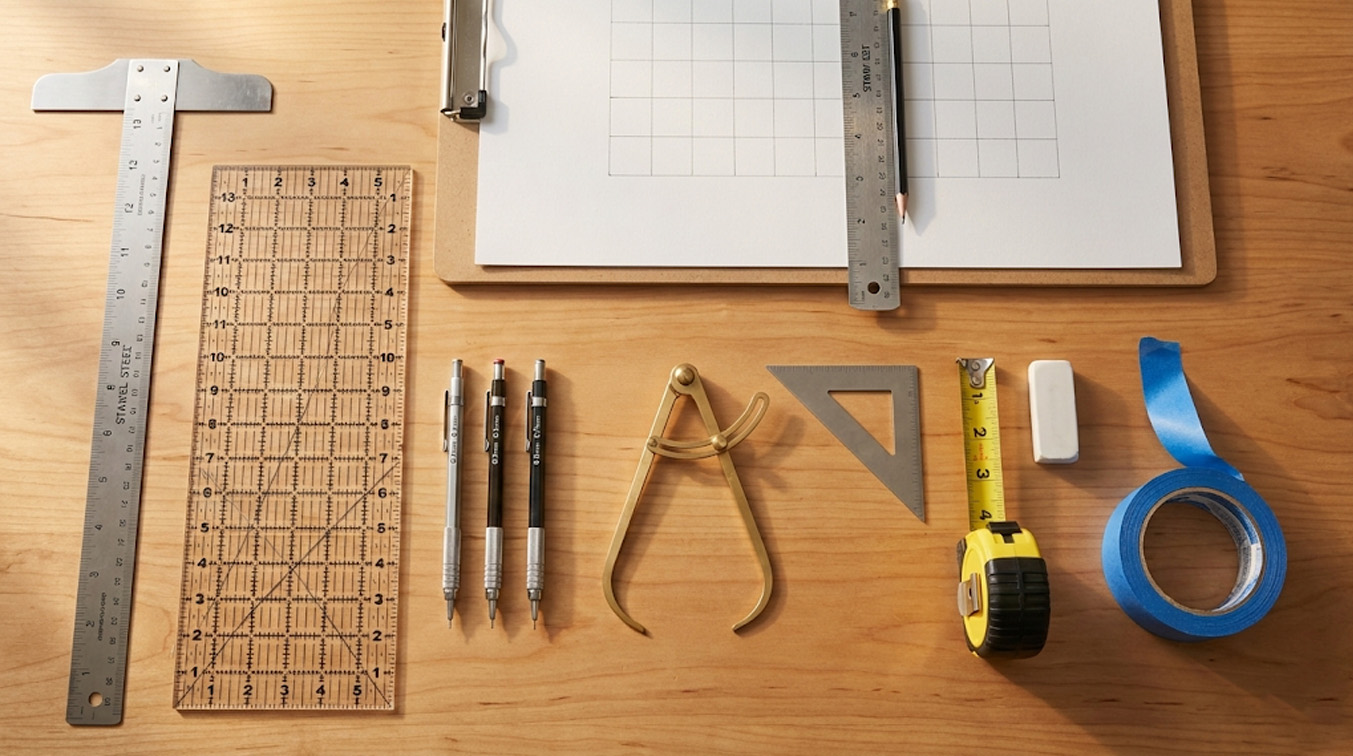
Process map
Every overlay moves from source geometry to real reference checks, then into a page that explains origin, limits, workflow, and citations. The review pass keeps the catalogue specific instead of repetitive.
Source geometry becomes a Canvas routine with exact proportions where the method defines them.
The overlay is checked against heads, landscapes, design layouts, print grids, or platform safe areas.
The visible page explains origin, use cases, limitations, adjacent systems, and the practical workflow.
Schema, citations, similarity, headings, links, image uniqueness, and correction paths are checked.
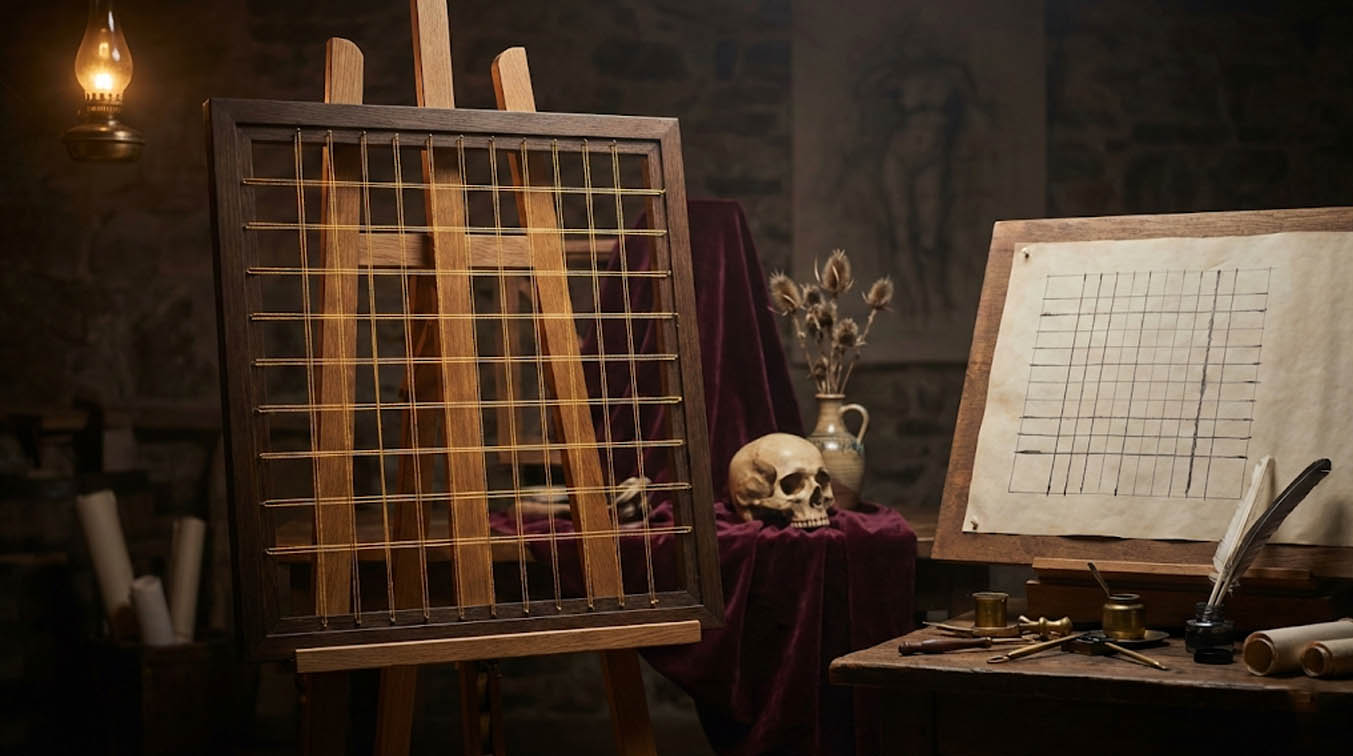
A methodology page should make the quality bar visible. The tool is useful only when the geometry, writing, and correction process can be inspected.
Grid Maker Pro treats methodology as product infrastructure, not a policy page hidden in the footer.§ I · Construction
Each of the 82 overlays in Grid Maker Pro is implemented as a Canvas 2D drawing routine in the hero tool's JavaScript. The geometry is derived directly from canonical sources: Euclid for the Phi rectangle, Hambidge's The Elements of Dynamic Symmetry (1926) for the root rectangles, Loomis's Drawing the Head and Hands (1956) for the head construction, Material Design spec (2014) for the 8pt and icon-keyline systems, ISO 216 (1975) for the Root 2 paper grid, and so on.
Where a published source defines the geometry exactly, the overlay matches it exactly. Where the geometry is interpretive, we follow the published diagrams as the reference. Where the overlay would produce a visually wrong result if we simplified the math, we use the full math.

A Loomis construction is drawn over a photograph of a head and checked by eye and ruler. A golden rectangle is verified against a 1:phi proportion calculated to four decimal places. Hexagonal grid spacing is verified against tabletop miniature bases.
§ II · Sources
Each long-form pillar guide carries at least 4-6 in-text citations to canonical sources. Citations are included when they help the reader verify a method, trace a historical claim, or understand why the overlay is drawn that way.
Durer, Alberti, Pacioli, Hambidge, Loomis, Tschichold, and Bringhurst.
Wolfram MathWorld, vetted Wikipedia articles, and geometric construction references.
Bouleau, Steadman, Hockney, and atelier-tradition books.
Material Design, Apple HIG, ISO standards, Adobe technical bulletins, and current design-system documentation.
Where historical claims are contested, including the Hockney-Falco thesis, dynamic symmetry as Greek practice, or the golden-ratio Parthenon attribution, we flag the debate openly rather than pick a side.
§ III · Quality gates
Bulk content sites fail in predictable ways when pages start to look like each other. Grid Maker Pro prevents that with page-level checks before publication.
Every leaf page is compared against siblings using a 4-word shingle similarity script. Any pair above 35% gets rewritten.
Every leaf has a hero illustration specific to its overlay, not a shared recolored template.
Each leaf has 3-6 questions answered for that specific overlay.
Each origin section is researched for the method, not filled with generic grid-method boilerplate.
Tier-B leaves are 900+ words excluding nav and footer. Tier-C leaves are 600+ words. Every leaf has at least 3 outbound internal links with descriptive anchor text and a self-canonical URL.
§ IV · Schema & speed
Every page ships JSON-LD structured data appropriate to its page type. Overlay leaves use Article, BreadcrumbList, FAQPage, and WebApplication references, with HowTo added when the page documents a step-by-step technique. Category hubs use CollectionPage and ItemList. Pillar guides use Article, Author Person, FAQPage, BreadcrumbList, speakable, and citation data. Author pages use Person with sameAs, alumniOf, jobTitle, and knowsAbout.
Schema validation is run via Google's Rich Results Test and Schema.org's official validator across the full sitemap before any batch ships. Any page with errors or more than two warnings is fixed before publish. The same standard covers presentation: the site ships a single self-hosted typeface, and the reasoning is written up in the typography colophon.
Every page is built on the same shared content system with no per-page JavaScript unless a feature genuinely needs it. The performance target on every page is mobile and desktop PageSpeed Insights 90 or higher, with Core Web Vitals green. The hero tool's Canvas workflow is optimized separately with preloaded canvas dimensions to prevent layout shift.
§ V · Corrections
If we get something wrong - a historical claim that turns out to be unsupported, a citation that misattributes, or a math error in an overlay implementation - we want to know. Email support@gridmakerpro.com with a specific reference and your source, and we will correct the page within a week. Substantive corrections are noted in the changelog; minor typos or copy edits are silent.
Every page carries a last updated date. When a page is materially refreshed, the date is updated and the change shows in the changelog. Refresh cadence: Tier-S landings every 4 months, Tier-A hubs every 6 months, Tier-B leaves every 9 months, Tier-C leaves on an annual sweep - earlier if a correction comes in.
§ VI · Policy
Every page is researched, written, and reviewed by Sujith Puthran with explicit citations to primary sources. Generative AI is not used for body text on any page on the site.
No overlay reference recommends a product because we get a kickback. Product mentions exist only when they are genuinely useful reference material.
Grid Maker Pro is free forever for the entire 82-overlay catalogue. No watermarks, no signup wall, no premium tier, no unlock prompts.
Coda · Accountability
The tool is useful only if the overlays are accurate, the writing is specific, and corrections are easy to send.