Flag of Israel
The most familiar modern use — the culmination of the slow adoption Scholem traced, not an ancient survival.
The hexagram — two interlocking equilateral triangles around a central hexagon — is among the simplest figures in geometry and among the most over-told in history. It is the Seal of Solomon, the Hindu shatkona, and the Jewish Star of David, but the historical record is not what most captions claim. Here is how the figure is built from a single circle, the √3 math behind it, what the great scholar of Jewish mysticism actually established about its age, and how to use the overlay to check two triangles truly lock.
One of the 82 composition overlays every visual artist should know and use.
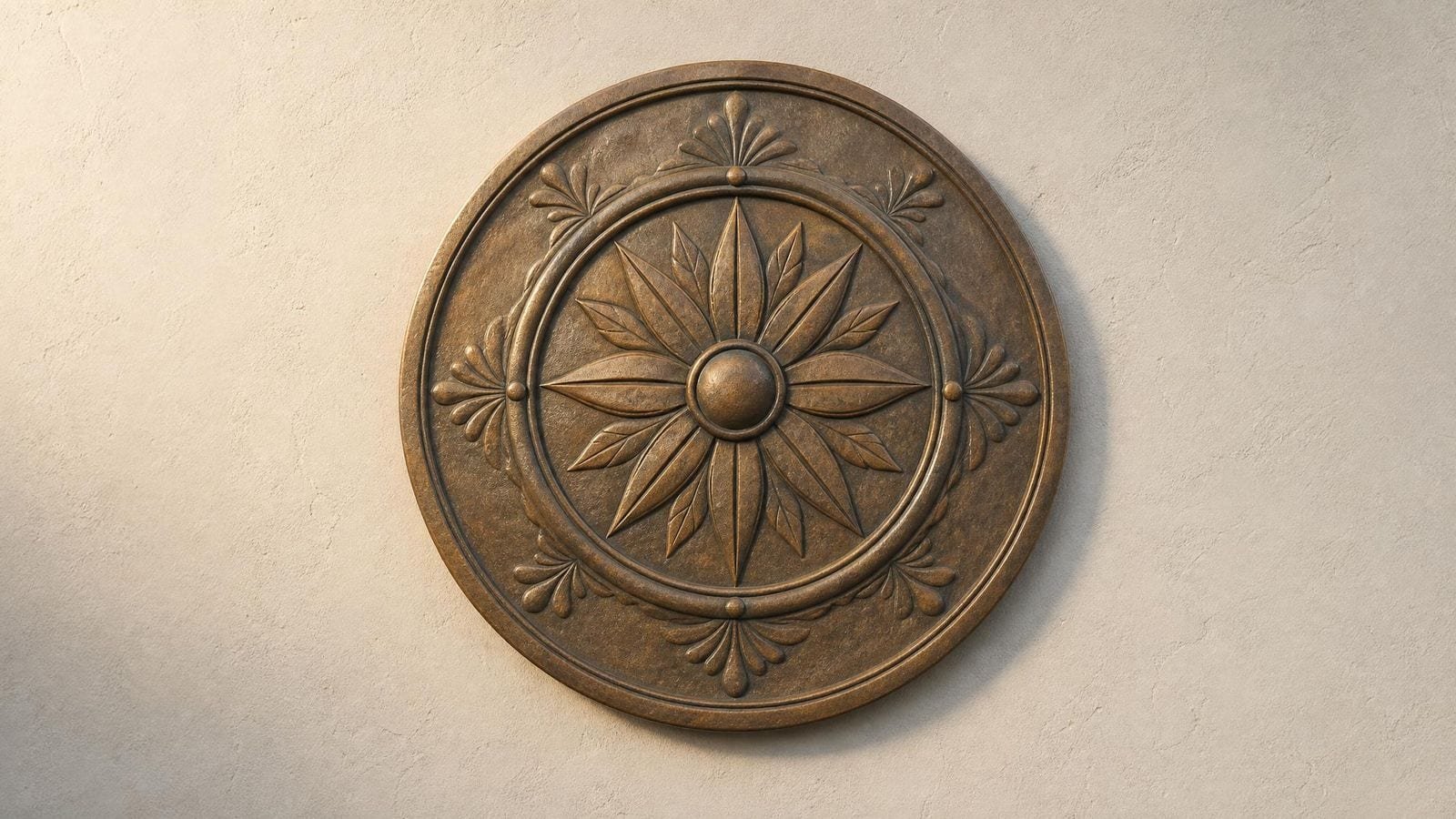
Centre the hexagram on an emblem and the two triangles should land on the same circle. If one triangle is even slightly larger, the central hexagon skews — the overlay catches it before it is cast or printed.
The hexagram overlay draws two equal equilateral triangles inscribed in a single circle — one pointing up, one pointing down — plus the regular hexagon they form at the centre. The six tips are the star points; the hexagon is the shared core. Because both triangles sit on the same circle, the figure is fixed by one compass setting, with no measuring at all.
In Grid Maker Pro the hexagram can be shown as the plain six-pointed star, with the central hexagon emphasised, or extended into the hexagonal lattice that connects it to the Flower of Life. Line weight, colour, and the bounding circle are adjustable. Build the figure on a blank canvas, or lay it over an emblem, window, or yantra to verify the two triangles are genuinely equal.
The hexagram is two equilateral triangles sharing a circle. With the six points on a circle of radius R, each sits 60° from the next:
6 points · two triangles at 60° · √3 ≈ 1.732 · star area = 2 × hexagon
Three properties follow:
The overlay keeps both triangles equal and on the same circle for you. Open it in the live tool and toggle the central hexagon.
A cross-cultural magical sign. Long before it meant any one thing, the six-pointed star was a general protective and decorative mark — the Seal of Solomon — used across Islamic, Jewish, and European magic, often interchangeably with the five-pointed star. Its appearance in Islamic ornament is documented in Keith Critchlow's analytical studies.4
An independent Hindu tradition. The same figure is the shatkona in Hindu and tantric symbolism — the union of Shiva and Shakti — arising on its own rather than by borrowing. As Miranda Lundy notes, a figure this simple recurs wherever people interlock two triangles.7
The Jewish symbol has a datable history. The great historian of Jewish mysticism, Gershom Scholem, traced how the hexagram became the Magen David (Shield of David): a slow medieval adoption, formal use by the Prague Jewish community from the 17th century, and only then a near-universal Jewish emblem carried into the Zionist movement and onto the flag of Israel in 1948.12
"The ancient shield of King David." Scholem found no evidence that the biblical King David used the hexagram, and the "Shield of David" name attaches to the symbol only much later. The figure is genuinely old as geometry; its identification with David is a later tradition, not a documented fact.1
"A uniquely Jewish symbol." The hexagram's Islamic, Hindu, and European uses are at least as old as its Jewish one. Treating it as the property of a single tradition erases the shatkona and the Seal of Solomon — and the plain reality of convergent geometry.7
"It encodes a secret cosmology." The "as above, so below" reading is a real and beautiful symbolic tradition, but it is meaning assigned to the figure, not information stored in the triangles. The geometry is the same whatever story is told over it.
| If you want to... | Use the hexagram | Don't use it for... | Difficulty |
|---|---|---|---|
| Set out an emblem or seal | Two equal triangles read as instantly balanced and legible | A mark that must avoid religious or national reading | Beginner |
| Build a yantra or mandala centre | The shatkona is a natural, balanced hub for radial design | Asymmetric, expressive compositions (use a free canvas) | Beginner |
| Teach equilateral-triangle construction | Two triangles in one circle is an ideal first lesson | Lessons on proportion and ratio (use the φ grid) | Beginner |
| Verify a tattoo or pendant is true | Overlay exposes any inequality between the triangles | Freehand organic motifs with no triangle grid | Beginner |
| Link six-fold motifs across a panel | The √3 hexagon ties it to the hexagonal circle grid | Five- or eight-fold patterns (use those overlays) | Intermediate |
Six settings where the hexagram is documented — with an honest note where the history needs care.
The most familiar modern use — the culmination of the slow adoption Scholem traced, not an ancient survival.
As a talisman the hexagram crossed cultures freely, often swapped with the pentagram — the figure's oldest documented role.
At the heart of yantras the up-and-down triangles mark the union of masculine and feminine — an independent tradition of the same shape.
Prague's Jewish community adopted the hexagram as a formal emblem — a key documented step toward its modern meaning.
Six-pointed stars fill rose windows and tiled panels as pure ornament — the hexagram as decoration, no symbolism required.
The clean six-fold mark recurs in logos and tattoos, frequently paired with the Merkaba — its three-dimensional cousin.
Captioning the hexagram as King David's personal symbol states a tradition as a fact. The geometry is old; the Davidic identification is medieval-to-modern, as Scholem documented.
The flat hexagram and the three-dimensional star tetrahedron share a silhouette but are different figures. Treating the 2D star as a 3D solid muddles both.
If the two triangles are different sizes the points stop matching and the central hexagon turns irregular — the classic tell of a hexagram drawn by eye.
Presenting the figure as exclusively Jewish, or exclusively anything, ignores the shatkona, the Seal of Solomon, and centuries of plain ornament.
The hexagram is a frequent request, and the symmetry is unforgiving on skin and metal — a triangle even slightly off shows immediately. Drop the overlay on the placement or the casting model, centre it, and confirm both triangles share the circle before you commit. For pieces that pair it with the Merkaba, switch overlays to check the flat and three-dimensional versions line up.
The six-pointed star reads as balanced and resolved, but it carries strong religious and national associations — use it deliberately, not by default. As a construction layer it gives a clean radial framework: derive a mark from the triangle intersections, keep the hexagon as negative space, then strip the scaffolding. Be aware of the contexts where the symbol will be read as more than geometry.
Six-fold geometry suits screens, railings, and window tracery, where the hexagram tiles into a hexagonal field without gaps. As an analysis tool the overlay reveals the triangle grid behind a historic rose window; for new work it offers a disciplined, repeatable module that details cleanly in metal, stone, or glass.
Two triangles in one circle is an ideal early compass lesson, demonstrating equilateral construction, six-fold symmetry, and the √3 area relationship between star and hexagon. It is also a model case for teaching how symbols acquire meaning over time — comparing the geometry's age with the documented history of the Star of David is a lesson in evidence.
"That which is above is like that which is below."
The Emerald Tablet of Hermes, Hermetic tradition6

Illustrative composites of how the tool gets used in practice — not quotes from named individuals.
On a fine-line wrist piece a triangle a hair too big is obvious forever. I drop the overlay on the stencil photo and only ink once both triangles share the circle.
I cast the shatkona for yantra pendants. The hexagon at the centre has to be regular or the setting won't sit — the construction grid is how I check the wax before I pour.
When we teach symbols I show the same star three ways — Seal of Solomon, shatkona, Magen David. One overlay, three histories. Students never forget that geometry and meaning are separate.
Drop a reference image. The hexagram overlay applies in one click. Free, in your browser.
Launch Grid Maker Pro →You can use the Hexagram overlay here for nothing, today and always. What a browser still can't do is get the picture itself onto paper — that needs a camera. The Grid Maker Pro AR app floats your reference over the real page through your phone so you trace the outlines straight onto the surface, then build on them with the same overlays you use here.
Meet the AR tracing app → Free web tool, free forever · AR tracing is the separate paid app