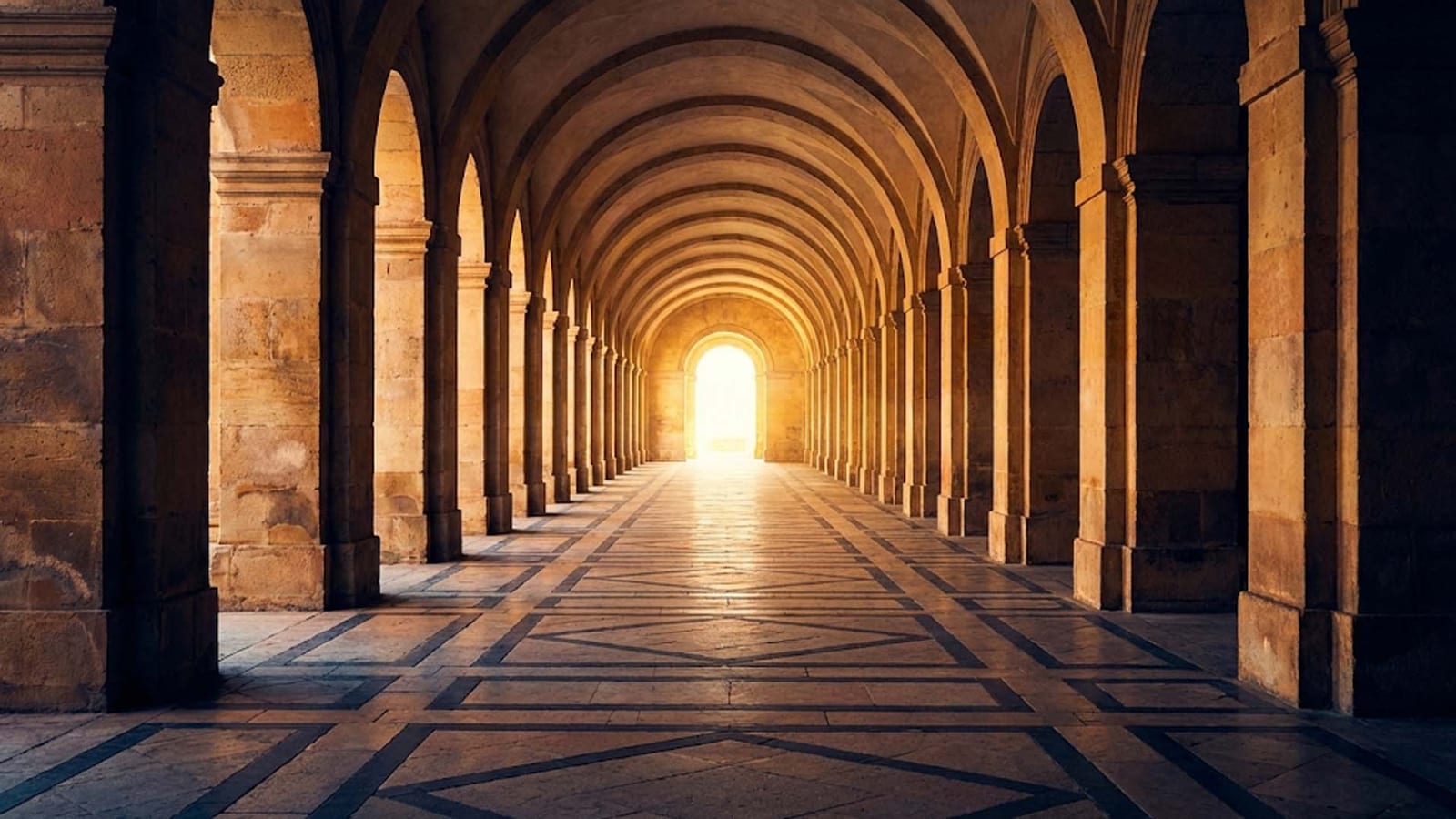
Alhambra tilework, Granada
The azulejo mosaics of the Alhambra are a textbook of eight-fold star-and-cross tiling — the surface Owen Jones drew and measured for The Grammar of Ornament.
The eight-pointed star — two equal squares laid one at forty-five degrees to the other — is the signature motif of Islamic geometric ornament, cut into tile, stucco, and carved wood from Córdoba to Samarkand. It needs nothing but a compass and straightedge, and it carries the silver ratio (1 + √2) in its bones. Here is how the star is built, the documented architecture that genuinely uses it versus the cosmic meanings layered on later, and how to drop the overlay over tilework to check an eight-fold rosette is true.
One of the 82 composition overlays every visual artist should know and use.
Lay the star over a tiled wall and the two-square construction snaps to the joints. If the overlay's eight tips don't land on the tile's own points, the pattern was set out by eye, not by compass.
The eight-point star overlay draws two equal squares inscribed in a single circle, one upright and one rotated forty-five degrees, plus the regular octagon they form where they cross. The eight tips of the combined figure are the star points; the octagon at the centre is the seed cell from which a whole tiling can grow. Because both squares share one circle and one radius, the figure is fixed by a single compass setting — there is no measuring.
In Grid Maker Pro the star can be shown as the plain two-square khātim, as the sharper {8/3} star octagon, or repeated across a surface as an eight-fold lattice. Line weight, colour, and the bounding circle are adjustable. Build the motif on a blank canvas, or lay it over a photograph of tilework or carving to test whether the original geometry locks.
The star is two squares sharing a circle. With the eight star points on a circle of radius R, each point sits 45° from the next, and the two squares are simply the even and odd points joined:
8 points · two squares at 45° · silver ratio 1 + √2 ≈ 2.414
Three properties follow from that arrangement:
The overlay enforces equal squares and a true 45° rotation for you. Open it in the live tool and switch between the {8/2} and {8/3} stars.
A documented architectural motif. The eight-pointed star is among the most thoroughly attested figures in Islamic ornament, appearing in tile, stucco, and woodwork across the medieval Islamic world. Its construction methods survive in pattern catalogues and, most directly, in the late-15th-century Topkapı Scroll — a working architect's reference of geometric layouts studied in detail by Gülru Necipoğlu.3
Compass-and-straightedge construction. The star is one of a family of patterns generated from a circle and a few radii. Jules Bourgoin recorded hundreds of these constructions from surviving monuments in his 1879 catalogue, and Eric Broug has reconstructed the same step-by-step methods for the modern reader — the two-square octagram is among the first patterns in any such sequence.42
A textual symbol too. Beyond decoration, the eight-pointed star serves as the rub el hizb, the marker that divides the Qur'an into reading sections — so the figure carries a defined liturgical use, not only an ornamental one.
"A secret cosmological code unique to Islam." The contemplative reading of the geometry — unity, infinity, the divine order — is a genuine strand of thought, but the most-cited cosmological interpretation is Keith Critchlow's 1976 thesis, and it should be presented as his interpretation rather than as documented medieval doctrine.1
"It belongs to Islam alone." The same two-square octagram is the Star of Ishtar in ancient Mesopotamia and the Star of Lakshmi in Hindu tradition. As Miranda Lundy notes, figures this simple arise wherever people draw with a fixed compass — this is convergent geometry, not a transmitted secret.7
The "Seal of Solomon" magic. Later European folklore reframed eight- and six-pointed stars as talismans of Solomon. That magical tradition is real as folklore, but it is a much later overlay on a figure whose first job was always to tile a wall cleanly.
| If you want to... | Use the eight-point star | Don't use it for... | Difficulty |
|---|---|---|---|
| Set out a tiled panel or floor | The octagon-and-star pair tiles the plane with no gaps | Five- or ten-fold patterns (use a pentagonal layout) | Beginner |
| Check restored tilework is accurate | Overlay exposes any tip that misses its true 45° point | Freehand arabesque with no underlying grid | Beginner |
| Design a logo or emblem | The star reads strongly and scales cleanly at any size | Organic, asymmetric marks (use a free canvas) | Beginner |
| Teach compass construction | Two squares in one circle is an ideal first lesson | Lessons on proportion and ratio (use the φ grid) | Beginner |
| Build a complex girih panel | The eight-fold rosette is one node in a larger network | A quick rough layout — the full grid is overkill | Advanced |
Six settings where the eight-pointed star is documented or in everyday use — with an honest note where attribution or meaning is contested.
The azulejo mosaics of the Alhambra are a textbook of eight-fold star-and-cross tiling — the surface Owen Jones drew and measured for The Grammar of Ornament.
Illuminated Qur'an openings often centre on a radiating eight-point star rosette — the sharper {8/3} form, here surrounded by gold interlace.
Interlacing arches and screen panels build eight-fold figures from overlapping squares — early Andalusi geometry that later Mudéjar craftsmen carried into Christian Spain.
The same octagram serves as a textual divider in the Qur'an and appears on national flags and emblems — a defined, non-decorative use of the figure.
The eight-pointed star of the goddess Inanna/Ishtar predates Islam by millennia. The shared shape is convergent geometry — cite it as parallel, not as ancestry.
The clean eight-fold mark reads instantly at small sizes, which is why it recurs in logos, tile collections, and packaging — the construction is the design.
If the two squares are drawn at different sizes, the eight points stop being identical and the central octagon turns lopsided. It is the most common tell of a star set out by eye.
The two-square star (right-angled points) and the continuous star octagon (45° points) are different figures. Mixing their proportions produces a star that belongs to neither.
Captioning the figure as a uniquely Islamic invention erases its appearance as the Star of Ishtar and the Star of Lakshmi, and overstates a clean cultural origin the geometry doesn't have.
Stating the cosmological meanings as established medieval doctrine. The geometry is documented; the specific cosmic readings are largely modern interpretation.
Set out the eight-fold rosette as the repeat unit, then extend the octagon-and-star tiling across the surface before committing to glaze or cut. The overlay confirms that every star tip meets its neighbour's at a true 45°, which is exactly where hand-laid panels drift. For restoration, lay the figure over a photograph of the original to recover the construction the maker used.
The eight-point star is a strong, culturally legible mark that scales from a favicon to a façade. Use it as a construction layer: derive a logo from the square intersections, keep the octagon as negative space, then strip the scaffolding. Its eight-fold symmetry tiles seamlessly, so the same mark doubles as a background pattern.
The octagram underlies a great deal of screen, paving, and ceiling design. As an analysis tool, the overlay reveals the governing grid behind a mashrabiya screen or a tiled floor; for new work it offers a disciplined way to lay out roundels and panels with locked, repeatable proportions that detail cleanly in stone, plaster, or wood.
Two squares in one circle is an ideal first compass lesson — it produces a satisfying figure with no measurement and demonstrates eight-fold symmetry, the silver ratio, and plane tiling at once. It also makes a clean critical-thinking exercise: separating the documented architecture from the modern cosmological claims is a lesson in reading sources carefully.
"God is beautiful and loves beauty."
Prophet Muhammad, narrated in Ṣaḥīḥ Muslim, Book of Faith6

Illustrative composites of how the tool gets used in practice — not quotes from named individuals.
I set the rosette out on screen before I cut a single zellij piece. The overlay catches a tip that's a degree off, which on a four-metre wall becomes a finger's width by the corner.
For an identity built on the khātim I work straight from the two squares. The deep-link reopens with the exact star configured, so I can keep the construction grid beside the logo file.
Free and in the browser means my students all open the same construction in seconds. We build the octagon-and-star tiling together before anyone touches plaster.
Drop a reference image. The eight-pointed star overlay applies in one click. Free, in your browser.
Launch Grid Maker Pro →You can use the Islamic eight-pointed star overlay here for nothing, today and always. What a browser still can't do is get the picture itself onto paper — that needs a camera. The Grid Maker Pro AR app floats your reference over the real page through your phone so you trace the outlines straight onto the surface, then build on them with the same overlays you use here.
How AR tracing works → Free web tool, free forever · AR tracing is the separate paid app