Kepler's stella octangula
Where the figure enters the mathematical record by name — Kepler's compound of two tetrahedra, the genuine root of the geometry.
The Merkaba is the star tetrahedron — two interpenetrating tetrahedra whose outer points form a cube and whose shared core is an octahedron. Geometers call it the stella octangula; its flat shadow is the hexagram. The name comes from the Hebrew merkavah, the chariot-throne of Ezekiel's vision, and there is a real ancient mysticism behind that word — but the familiar "counter-rotating energy field" reading is modern. Here is the geometry, the documented history, and an honest line between the two.
One of the 82 composition overlays every visual artist should know and use.
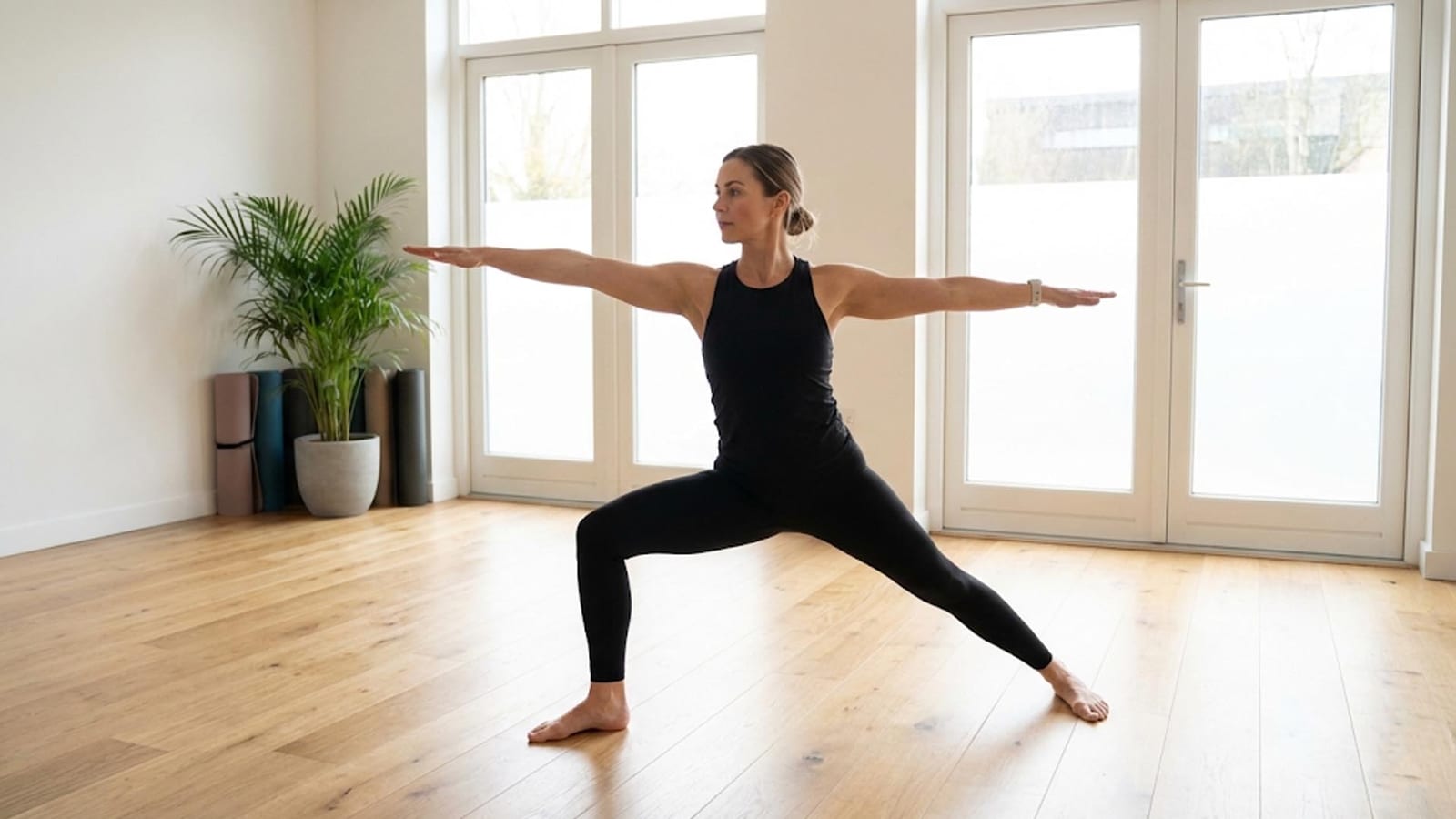
Centred on a standing figure, the two tetrahedra frame the body the way the Melchizedek meditation imagines them. As geometry, the overlay simply checks the star tetrahedron is symmetric.
The Merkaba overlay draws the star tetrahedron: two equal triangles in the plane, read as the bases of two tetrahedra that interpenetrate in three dimensions. One tetrahedron points "up and away," the other "down and toward" — together they make an eight-pointed solid whose flat outline is the six-pointed hexagram. The overlay can show the plain 2D star, an isometric wireframe, or a perspective view of the full solid.
In Grid Maker Pro you can switch between these modes, emphasise the cube that the eight points define, or highlight the octahedron at the core. Line weight, colour, and the bounding circle are adjustable. Build the figure on a blank canvas, or lay it over a figure, pendant, or model to check the two tetrahedra are genuinely identical and centred.
The Merkaba is the compound of two regular tetrahedra — the simplest regular compound polyhedron:
stella octangula · hull = cube · core = octahedron · 8 vertices
Three properties make it geometrically central:
The overlay keeps the two tetrahedra equal and centred for you. Open it in the live tool and rotate the wireframe.
Real geometry, well documented. The star tetrahedron is genuine, classical geometry. Kepler named it the stella octangula in 1619, and it sits in the standard literature on regular solids and compounds — there is nothing speculative about the figure itself.53
Real mysticism behind the name. The Hebrew merkavah ("chariot") refers to the chariot-throne of God in Ezekiel's vision. It gave rise to merkavah mysticism, an early Jewish visionary tradition — the Hekhalot literature — documented and dated by Gershom Scholem from roughly the 1st century BC onward.12
A long geometric-philosophical interest. Renaissance figures including Leonardo, illustrating Luca Pacioli's work, drew stellated solids, situating the star tetrahedron in the tradition of geometric philosophy that Robert Lawlor surveys.8
"The ancient merkavah was a star tetrahedron." It was not. The classical merkavah texts describe wheels, creatures, and a throne — not a counter-rotating tetrahedral field. The geometric interpretation is a 20th-century innovation, developed by Drunvalo Melchizedek in The Ancient Secret of the Flower of Life (1998–2000).7
"Activate your Merkaba field." The idea of two counter-rotating energy fields around the body — sometimes called a "light spirit body" — spun by breath and meditation, is Melchizedek's modern practice. It has a large following and is worth knowing as a contemporary phenomenon, but it is not ancient doctrine and is contested by classical kabbalists.7
"A secret of the pyramids / lost civilisations." These framings borrow the figure's genuine geometric elegance to dress up unsupported history. The geometry is real and old; the lost-civilisation narrative is not evidence-based.
| If you want to... | Use the Merkaba | Don't use it for... | Difficulty |
|---|---|---|---|
| Design a 3D pendant or sculpture | The star tetrahedron is a clean, strong physical object | A purely flat motif (use the hexagram instead) | Intermediate |
| Frame a figure for meditation art | The two tetrahedra wrap a standing body symmetrically | Compositions needing asymmetric balance | Beginner |
| Teach compound polyhedra | Cube hull and octahedron core are visible at once | A first compass lesson (start with two triangles) | Advanced |
| Check a tattoo or model is true | Overlay exposes any inequality between the tetrahedra | Freehand organic motifs with no solid grid | Intermediate |
| Build a sacred-geometry set | It links the tetrahedron, cube, and octahedron together | Five- or twelve-fold work (use those overlays) | Intermediate |
Six settings for the star tetrahedron — with an honest note on what is geometry and what is modern interpretation.
Where the figure enters the mathematical record by name — Kepler's compound of two tetrahedra, the genuine root of the geometry.
Leonardo illustrated stellated solids for Luca Pacioli — the star tetrahedron within the Renaissance study of proportion.
The counter-rotating-field meditation — clearly labelled here as a contemporary practice, not an ancient one.
A popular wearable form, often in brass or silver — the figure as a physical object where symmetry must be exact.
A clear demonstration of how the tetrahedron, cube, and octahedron relate — the cube hull shown around the star.
Frequently paired with the Flower of Life; the wireframe star reads strongly at any size.
Treating the Merkaba as the six-pointed star throws away its whole point — it is a three-dimensional solid, and the flat version is just its shadow.
Stating that ancient merkavah mystics practised the counter-rotating-field meditation. They did not — that reading is Melchizedek's, from the 1990s.
If the two tetrahedra differ in size or are off-centre, the eight points no longer form a cube and the figure stops being a true stella octangula.
Mixing up the cube (the outer hull) with the octahedron (the inner intersection) garbles the figure's real and elegant relationship to the Platonic solids.
The Merkaba is a frequent request, usually as a wireframe star tetrahedron. The depth lines are where designs go wrong, so set the overlay to perspective and confirm the two tetrahedra are equal before you stencil or cast. For pieces that combine it with the flat hexagram or the Flower of Life, switch overlays to check the 2D and 3D versions register cleanly.
The star tetrahedron gives an identity a sense of depth and structure that the flat star can't. Use the cube hull as a bounding box for layout, derive a mark from the wireframe, and keep the octahedron core as a focal point. As with the hexagram, be aware that the figure carries spiritual associations many viewers will read into it.
For 3D-printed or fabricated objects, the overlay is a planning aid: align the model so the eight points form a true cube and the joints meet at the octahedral core. Getting the compound symmetric is the whole craft of the piece, and a quick check against the construction grid saves a failed print or a re-cast.
The Merkaba is an unusually rich teaching object: it shows compound polyhedra, the relationship between three Platonic solids, and the difference between a figure and its projection. It is also a clean case study in sources — comparing the documented merkavah tradition with the popular Merkaba narrative teaches students to ask when a claim actually dates from.
"Their appearance and their work was as it were a wheel in the middle of a wheel."
The vision of the chariot, Ezekiel 1:166

Illustrative composites of how the tool gets used in practice — not quotes from named individuals.
A wireframe star tetrahedron on a forearm lives or dies on the depth lines. I work in perspective mode and only ink once both tetrahedra read equal from the front.
I cast brass Merkaba pendants. If the eight points don't form a clean cube the piece looks cheap, so I check the model against the cube hull before I make the mould.
I teach it as one figure with three solids inside. Students rotate the wireframe and suddenly the tetrahedron, cube, and octahedron all click together — no New Age required.
Drop a reference image. The Merkaba overlay applies in one click. Free, in your browser.
Launch Grid Maker Pro →Merkaba is free to use here and will stay that way. When the plan on screen needs to become marks on paper, the browser reaches its limit — there's no camera to register the image to your page. The Grid Maker Pro AR app adds exactly that: hold the phone over the paper and trace your reference directly, then keep working with the same overlay set.
Get the AR tracing app → Free web tool, free forever · AR tracing is the separate paid app