Free Merkaba Grid Generator
Draw the merkaba flat instantly with our 100% free grid generator. Set two interlocked triangles with the hexagon through their six vertices, exact over any image or canvas, then export SVG for print, craft and laser work in seconds. No signup, no downloads needed. Trusted by 60,000+ artists worldwide.
A star tetrahedron, drawn flat
Two interlocking tetrahedra projected to the plane, one pointing up and one down. In two dimensions it reads as a hexagram with interior lines, which are the edges the projection keeps.
4 controls, not a fixed picture
Set size and construction step, toggle inner hexagon and boundary circle. Every one is live on the canvas.
Stacks with sacred geometry & pattern
Overlays combine, each carrying its own transform, so this one can sit under or over flower of life, sri yantra and metatron’s cube, and 15 more in the same set.
Keeps the interior edges
The lines that make it read as solid rather than flat are the ones that suffer most in a low-resolution export. SVG keeps them exact; raster to 600 DPI.
| Ctrl + Z | Undo |
| Ctrl + Y | Redo |
| Esc | Deselect overlay |
| Alt + drag | Free positioning (no snap) |
| Ctrl + scroll | Zoom canvas |
| Ctrl + P | |
| ? | Show this help |
Two interlocking triangles, plus the hexagon that passes through all six of their points — the boundary the figure sits inside, drawn at exact radius rather than sketched around it.
The merkaba generator draws one of the 82 composition overlays in Grid Maker Pro, and the rest stack on the same image.
- 2 triangles
- Hexagon at full r
- SVG + 600 DPI export
- Nothing uploaded
What is the Merkaba?
The merkaba generator is a free browser tool that draws the star tetrahedron as a flat figure: two equilateral triangles inscribed in the same circle, one point-up and one point-down, interlocking. It also draws the hexagon that passes through all six triangle vertices — the figure's outer boundary, at the full radius — which is what distinguishes it from the hexagram overlay, where the hexagon drawn is the small inner one at 0.577. The boundary circle is available and off by default.

How to draw a merkaba
The two-dimensional projection of two interlocking tetrahedra, bounded and sized on the canvas, with the inner hexagon shown or hidden as the work needs.
Open the merkaba
Both triangles are inscribed in the same circle and share a centre from the first frame, so the six points are genuinely equally spaced rather than approximately so.
JPG · PNG · GIF · WEBP
Add the hexagon if you need the boundary
The hexagon runs through all six points, giving you the outline the figure occupies. Add the circle too when the piece has to sit inside something round.
Size · Inner hexagon · Boundary circle
Place it, then export
Drag, scale and rotate it over your artwork or work on a blank canvas at your paper size. Export SVG for a cutter or plotter, or a raster at up to 600 DPI.
PNG · JPG · PDF · SVG · up to 600 DPI
Three steps, about a minute. No signup, no upload.
What the Merkaba Generator does
Six points, genuinely equal
Sketched, one triangle is nearly always a little larger or a little rotated, and the six points stop being equally spaced. Constructed, they are — which is the condition every measurement you take off the figure depends on.
The outer hexagon, at full radius
The hexagon here passes through the six triangle points rather than through their crossings. It is the shape that contains the figure, which is what you want when the merkaba has to fit a panel, a pendant or a tile.
Circle off by default
Unlike the hexagram overlay, the boundary circle starts hidden here, because a merkaba is usually drawn as a figure in its own right rather than as something inscribed. Turn it on when you need the construction visible.
Flat, and honest about it
The star tetrahedron is a three-dimensional object. This is its standard two-dimensional representation — the silhouette you get looking down a threefold axis — not a projection with hidden edges. That is the figure people actually draw, and the page says so.
Over your own work
Its own transform, so the figure can be rotated onto an object in a photograph or scaled into a layout without disturbing what is beneath it.
Vector out, at real size
SVG export gives true straight lines for cutting, engraving or plotting. Raster export is sized from your paper format and DPI, up to 600.
Merkaba examples: four ways the figure reads
Merkaba vs a downloaded merkaba graphic vs compass and straightedge
| Option | Both triangles equilateral | Outer hexagon at full radius | Vector export | Cost |
|---|---|---|---|---|
| Grid Maker Prothis tool | Yesby construction | Yesthrough all six points | SVG + raster to 600 DPI | Free |
| A downloaded merkaba graphic | Usually, unknown provenance | Rarely a separate path | Sometimes | Free or paid |
| Compass and straightedge | Yesthe radius steps six times | By construction | No | Time |
| Drawing it freehand | Almost never | No | No | Time, and a redraw |
Who the Merkaba is for: work that has to fit a boundary
How the Merkaba works — A solid drawn flat, the hexagon that bounds it, and what the name actually covers
The merkaba is the one of the 82 composition overlays whose usual drawing is a picture of something else — a three-dimensional solid represented by a two-dimensional star. That is worth being clear about, because it changes what the drawing can and cannot tell you.
The object is a star tetrahedron: two regular tetrahedra interpenetrating, one pointing up and one down, sharing a centre. It is a genuine polyhedral compound, the three-dimensional analogue of the hexagram, and its outline has real geometric properties — the eight points of the two tetrahedra sit on the vertices of a cube.
What almost everyone draws, including this overlay, is the flat figure: two interlocking equilateral triangles. That is what the solid looks like viewed along one of its threefold axes, with every edge collapsed onto the picture plane. It is the standard representation and the one people mean by merkaba, and it is a silhouette rather than a projection — no edges are hidden, no depth is implied.
The flat star is not a wrong drawing of the solid. It is a different object that the solid casts.
The hexagon, and why this one is the outer
Two overlapping triangles produce two hexagons, and which one a tool draws is a real decision rather than a detail. The inner hexagon is where the triangle edges cross, at 0.57735 of the radius — that is the one the hexagram generator draws. The outer hexagon runs through the six triangle points at the full radius, and that is the one here.
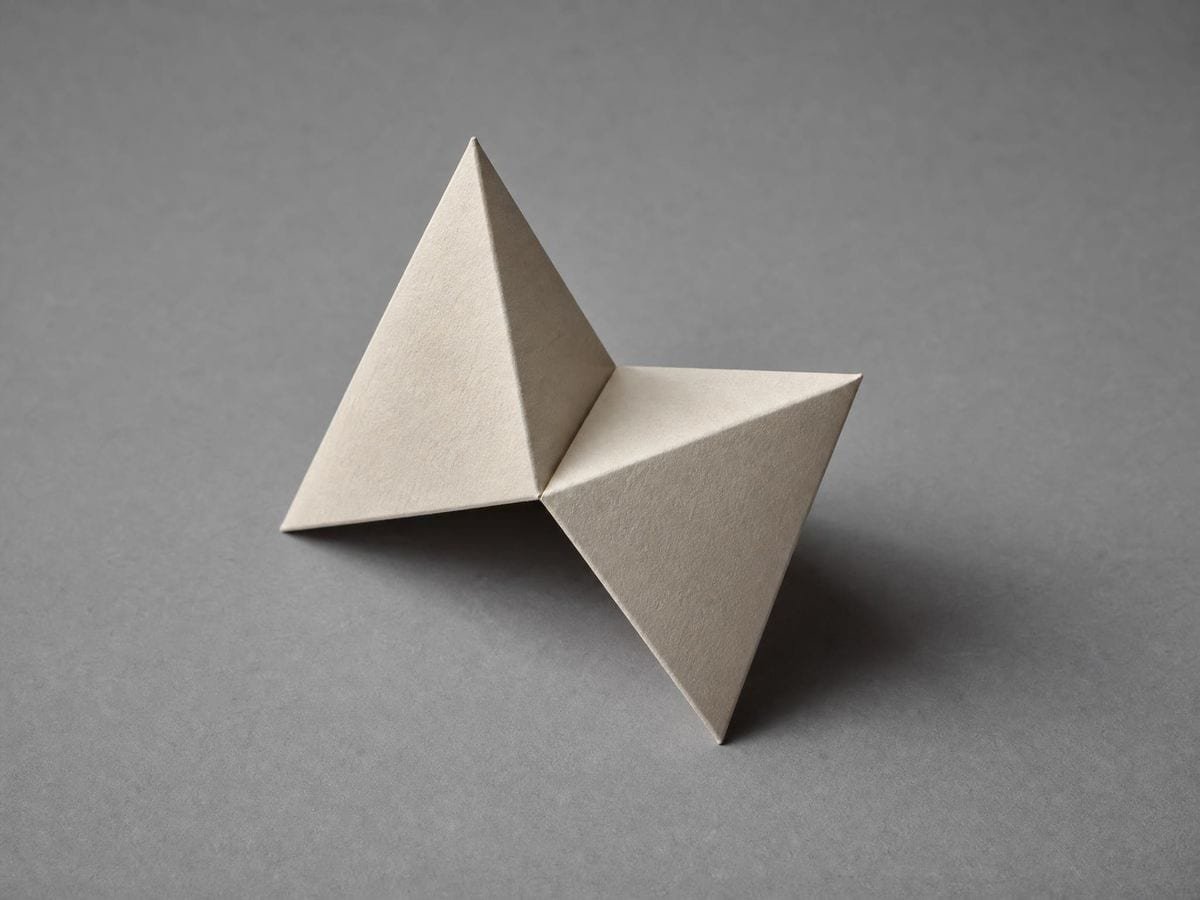
The outer is the more useful of the two for making things. It is the boundary the figure occupies, so it tells you what size blank a pendant needs, how much panel a carved merkaba will take, whether the figure fits the tile. The inner hexagon is about the geometry's interior; the outer is about the object's footprint.
Both are in the tool, on two different overlays. If you want the pair together, activate both — they share a centre and a radius, so the two hexagons nest correctly, and the ratio between them is √3 exactly.
Everything in it is √3, and nothing is φ
The figure is built from thirds of a circle, so its proportions are all square roots of three: the triangle's height against its side, the outer hexagon against the inner, the centre-to-edge distance against the centre-to-point. There is no golden ratio anywhere in it, and claims otherwise usually come from confusing it with the pentagram.
For anyone working with a compass rather than a screen, this also makes it easy to construct by hand. A compass set to the circle's radius steps around the circumference exactly six times, and joining alternate marks gives you both triangles with no measurement at all. If you are teaching the figure, that construction is the lesson.
The name, and where the history actually goes
The word comes from Hebrew and appears in the visionary chariot of the Book of Ezekiel; merkavah mysticism is a documented strand of early Jewish esoteric literature. What that literature describes is a chariot-throne, and it does not describe a star tetrahedron. The merkaba overlay page separates the two at length, as the rest of the sacred-geometry category do for their own figures.
The association between the word and this geometric figure is twentieth-century and belongs to New Age synthesis rather than to the older tradition. That is not an argument against using the figure — it is a very old and widely drawn shape, and the geometry is exactly as real either way. It is an argument for not attributing the geometry to a text that does not contain it.
Making things from it
For cut and carved work, export SVG with the parts you want as separate paths: the two triangles for the piercing, the hexagon for the outline, the circle for a bezel. Vector matters more here than on most overlays because a star tetrahedron's points are acute, and a raster edge at a sharp point turns into a rounded stub at any real cutting size.
For drawing, work on the blank canvas at the sheet size you will use and export at 300 or 600 DPI. The construction-step control is worth using while you learn the figure — the six compass marks, the first triangle, the second, then the hexagon — because once you have built it by hand twice you will not need the overlay again except to check.
The cube hiding in it, and sizing for a blank
The star tetrahedron has a property worth knowing before you cut anything: its eight points sit exactly on the vertices of a cube — which is why it turns up beside the cube in the platonic solids generator. Two interpenetrating tetrahedra, four points each, and every one of those eight lands on a cube corner — which is why the compound is also called the stella octangula, and why it feels more solid than a decorative star has any right to.
In the flat drawing that cube is invisible, but its consequence is not. It means the figure is genuinely three-dimensionally regular rather than a flat pattern given depth, so a physical merkaba — wire, cast or folded — has real symmetry rather than approximate symmetry, and someone holding one will feel the difference without being able to name it.
For sizing a blank, use the outer hexagon rather than the triangles. The star points reach the full radius, so a circular blank has to be at least twice the radius across; a hexagonal blank can be tighter, because the figure fits a hexagon of exactly the radius and wastes far less material. On costly stock that difference decides how many pieces come off a sheet.
A note on orientation, because it is the one thing people get wrong when transferring the figure to an object. The flat drawing has a triangle pointing up and one pointing down, and it is symmetric under a half turn — so rotating the whole figure by sixty degrees swaps which triangle is which without changing anything else. On a flat piece that is invisible. On a physical star tetrahedron it is not, because the two tetrahedra can be distinguished once the object has a front and a back.
Where the Merkaba gets used
Pendants. I need the outer hexagon to know the blank size before I cut anything, and the two triangles as separate paths for the piercing.
It is a common request and the freehand version always looks slightly drunk. Having both triangles genuinely equilateral is the difference between a design and a sketch.
I use it as the step after the hexagram — same triangles, different question about which hexagon you care about. Students see immediately that a figure contains more than one shape.
Merkaba: frequently asked questions
The geometry
Is the merkaba a 3D shape or a 2D one?
The object is three-dimensional — a star tetrahedron, two interpenetrating regular tetrahedra whose eight points sit on the vertices of a cube. What is almost always drawn, including here, is the flat figure it casts when viewed along a threefold axis: two interlocking equilateral triangles. That is a silhouette, not a projection, and no edges are hidden.
Is there a golden ratio in it?
No. Everything in the figure is √3, because it is built from thirds of a circle. Claims of φ in a merkaba usually come from confusing it with the pentagram, which is the five-fold figure where φ genuinely lives.
How would I construct it by hand?
Set a compass to a circle's radius and step it around the circumference — it lands exactly six times. Join alternate marks for the first triangle and the remaining three for the second. No measurement is involved, which is why the figure appears in every tradition that used a compass.
Does the name come from the Hebrew Bible?
The word does — merkavah, the visionary chariot of Ezekiel, and a documented strand of early Jewish esoteric literature. That literature describes a chariot-throne and not a star tetrahedron; the link between the word and this figure is twentieth-century. The geometry is real either way, but it should not be attributed to a text that does not contain it.
Can I use both hexagons at once?
Yes, by activating the merkaba and the hexagram together. They share a centre and a radius, so the two hexagons nest correctly, and the ratio between them is exactly √3.
Using it
Why is the boundary circle off by default here?
Because a merkaba is drawn as a figure in its own right rather than as something inscribed in a circle, where a hexagram is the other way round. Turn it on whenever you want the construction visible or the piece has to sit inside something round.
What does the construction-step control do?
It builds the figure up rather than showing it complete. Worth using while you are learning to draw it by hand, since the six compass marks and the two triangles are the whole method.
How do I lay it over a photograph of an object?
Scale so the outer triangle points sit on the object's own extremities, then rotate through the six symmetric positions. A shape with genuine six-fold symmetry settles at one of them; anything else will look close at one rotation and wrong at the next.
How do I use both hexagons at once?
Switch the inner hexagon on and scale a second copy of the overlay to the outer crossings — the two hexagons are the flattened solid's equatorial sections, and showing both is what makes the drawing read as two interpenetrating tetrahedra rather than as a flat star.
Export and print
Can I export the parts separately for cutting?
Yes. Whichever parts you have switched on export as separate SVG paths — triangles for the piercing, hexagon for the outline, circle for a bezel. Vector matters more here than usual because the points are acute and a raster edge rounds them off at any real cutting size.
Can I export the two triangles separately for cutting?
Not as separate files, but they separate trivially in a vector program — they are two closed triangles, unlinked in the export. Cut them apart there if you are making a physical star tetrahedron from two pieces.
What do I export for a pendant or engraving?
SVG, at the largest size you intend to work at. Six acute points and two crossing triangles is a shape whose tips define it, and vector paths keep those tips where a raster rounds them off.
Choosing a grid
How is this different from the hexagram overlay?
The two triangles are identical; the hexagon differs. This draws the OUTER hexagon, through the six triangle points at the full radius — the figure's boundary. The hexagram overlay draws the INNER one, through the crossings at 0.577 of the radius. Use this when you need the footprint, that when you need the core.
Is this a 3D shape or a 2D one?
The star tetrahedron is genuinely three-dimensional — two tetrahedra interpenetrating. What this draws is its flat projection seen along an axis of symmetry, which is the form nearly every merkaba illustration uses. For a rotatable solid you want 3D software.
Practical matters
Does my image get uploaded?
No. Everything happens in your browser — the image is drawn to a canvas on your own device and never sent anywhere.
Can I use it for a printed or physical piece?
Yes — the geometry is two interlocking triangles and carries no restriction from us, with no watermark on exports and the terms leaving your work with you. Take the SVG for anything that will be cut or engraved.
Open the tool Merkaba generator
Two triangles, and the boundary they fill
The merkaba draws exactly, hexagon and all. Take the outer hexagon for your blank size and export vector or 600 DPI. No signup, nothing uploaded.
Back to the generator →