
Free Platonic Solids Grid Generator
Draw all five Platonic solids as construction diagrams instantly with our 100% free grid generator. Set the tetrahedron, cube, octahedron, icosahedron and dodecahedron flat and measurable, then export SVG for teaching and study in seconds. No signup, no downloads needed. Trusted by 60,000+ artists worldwide.
The five regular solids, projected
Tetrahedron, cube, octahedron, dodecahedron and icosahedron — the only five solids whose faces are all identical regular polygons — drawn as flat projections with their edges shown.
3 controls, not a fixed picture
Set size and construction step, toggle solid name label. Every one is live on the canvas.
Stacks with sacred geometry & pattern
Overlays combine, each carrying its own transform, so this one can sit under or over flower of life, sri yantra and metatron’s cube, and 15 more in the same set.
Edges as paths, ready to build from
SVG export gives the edge geometry directly, which is what a net or a model needs. Raster up to 600 DPI for reference sheets.
| Ctrl + Z | Undo |
| Ctrl + Y | Redo |
| Esc | Deselect overlay |
| Alt + drag | Free positioning (no snap) |
| Ctrl + scroll | Zoom canvas |
| Ctrl + P | |
| ? | Show this help |
Tetrahedron, cube, octahedron, icosahedron, dodecahedron — each as its conventional flat schematic, at an exact size, over your own canvas or reference.
The platonic solids generator draws one of the 82 composition overlays in Grid Maker Pro, and the rest stack on the same image.
- 5 solids
- 4·6·8·12·20 faces
- SVG + 600 DPI export
- Nothing uploaded
What are the Platonic solids?
The Platonic solids generator is a free browser tool that draws each of the five regular polyhedra as a flat construction diagram. One control selects the solid — tetrahedron with 4 faces, cube with 6, octahedron with 8, dodecahedron with 12, icosahedron with 20 — and each is drawn as the schematic conventionally used to represent it rather than as a rendered projection. The two five-fold solids are built on nested pentagons at 1/φ and 1/φ², which is where their real geometry lives. An optional label names the figure.

How to draw the Platonic solids
Any of the five solids as a flat construction diagram, built up step by step, at the size you want to draw or print it.
Choose the solid
One control cycles through all five. Each is drawn at the same overall radius, so switching between them compares them at a consistent size rather than at whatever scale each happened to be drawn.
JPG · PNG · GIF · WEBP
Size and label it
Set the size and turn the name label on if the diagram has to stand alone. The construction-step control builds the figure up if you are demonstrating rather than illustrating.
Size · Solid name label · Construction step
Place it, then export
Drag, scale and rotate it over your work or onto a blank sheet at your paper size. Export SVG for a plotter or cutter, or a raster at up to 600 DPI.
PNG · JPG · PDF · SVG · up to 600 DPI
Three steps, about a minute. No signup, no upload.
What the Platonic Solids Generator does
All five, at one size
Switching between the solids keeps the overall radius fixed, so a set of five diagrams is genuinely comparable. Drawn separately they end up at five different scales, which is the usual problem with a printed set.
φ where φ belongs
The icosahedron and dodecahedron schematics are built on pentagons nested at 0.618 and 0.382 of the radius — 1/φ and 1/φ². That is not decoration: five-fold solids are golden-ratio objects, and the diagram reflects it.
A schematic, not a render
These are the conventional flat diagrams — a cube as a square with two skewed faces, an octahedron as a diamond with both diagonals. They are what people draw, not orthographic projections with hidden edges, and the page says so rather than implying more.
Every one at an exact radius
Each figure is generated from a single radius rather than traced, so the polygons are genuinely regular. On a five-fold solid, a pentagon that is a degree out is visible immediately in the zigzag between rings.
Over your own work
Its own transform, so a solid can be scaled into a page you are laying out or rotated onto an object in a photograph without moving what is underneath.
Vector out, at real size
SVG export gives true straight lines for cutting and plotting. Raster export is sized from the paper format and DPI you choose, up to 600.
Platonic solids examples: four ways the diagrams read
Platonic solids vs downloaded diagram sets vs a 3D modelling program
| Option | All five at one radius | Pentagons at exact φ ratios | Vector export | Cost |
|---|---|---|---|---|
| Grid Maker Prothis tool | Yesone size control | Yesat 1, 1/φ and 1/φ² | SVG + raster to 600 DPI | Free |
| Downloaded diagram sets | Rarely — five sources, five scales | Unknown | Sometimes | Free or paid |
| A 3D modelling program | Yesand true projections | Yes | Yes | Time, or a subscription |
| Drawing them by hand | Only with care | Hard for the five-fold pair | No | Time |
Who the Platonic solids is for: figures that have to be regular
How the Platonic solids works — Five solids, why there are exactly five, and what a flat diagram can honestly show
The Platonic solids are the one piece of sacred geometry with a proof attached: there are exactly five, and the reason is elementary. It is the only argument among the 82 composition overlays that settles a question rather than opening one, and Euclid closes the Elements with it, in Book XIII (trans. T.L. Heath, Cambridge University Press, 1908). Here is that argument, what each diagram in this overlay actually draws, and where a two-dimensional figure stops being able to tell you the truth about a three-dimensional object.
A Platonic solid is a convex polyhedron whose faces are all the same regular polygon and whose vertices are all alike. There are exactly five: the tetrahedron with 4 triangular faces, the cube with 6 squares, the octahedron with 8 triangles, the dodecahedron with 12 pentagons and the icosahedron with 20 triangles.
Exactly five, and the proof takes a paragraph. At any vertex you need at least three faces, and their angles must total less than 360° or the vertex would lie flat. Equilateral triangles have 60° angles, so three, four or five fit — giving the tetrahedron, octahedron and icosahedron. Squares have 90°, so only three fit: the cube. Regular pentagons have 108°, so only three fit: the dodecahedron. Hexagons have 120°, and three of those make exactly 360° — flat, no solid. Every larger polygon is worse. That is the whole list.
Five is not a mystical number here. It is what is left after you check which corners can close.
What each diagram in this overlay is
The tetrahedron is a triangle with its centre marked and joined to the three corners — the figure seen down one face, with the far vertex projected onto the middle. The octahedron is a square standing on a corner with both diagonals drawn, which is the same solid seen down a fourfold axis. The cube is the familiar square with a skewed top face and a skewed right face, the drawing everyone makes without being taught.
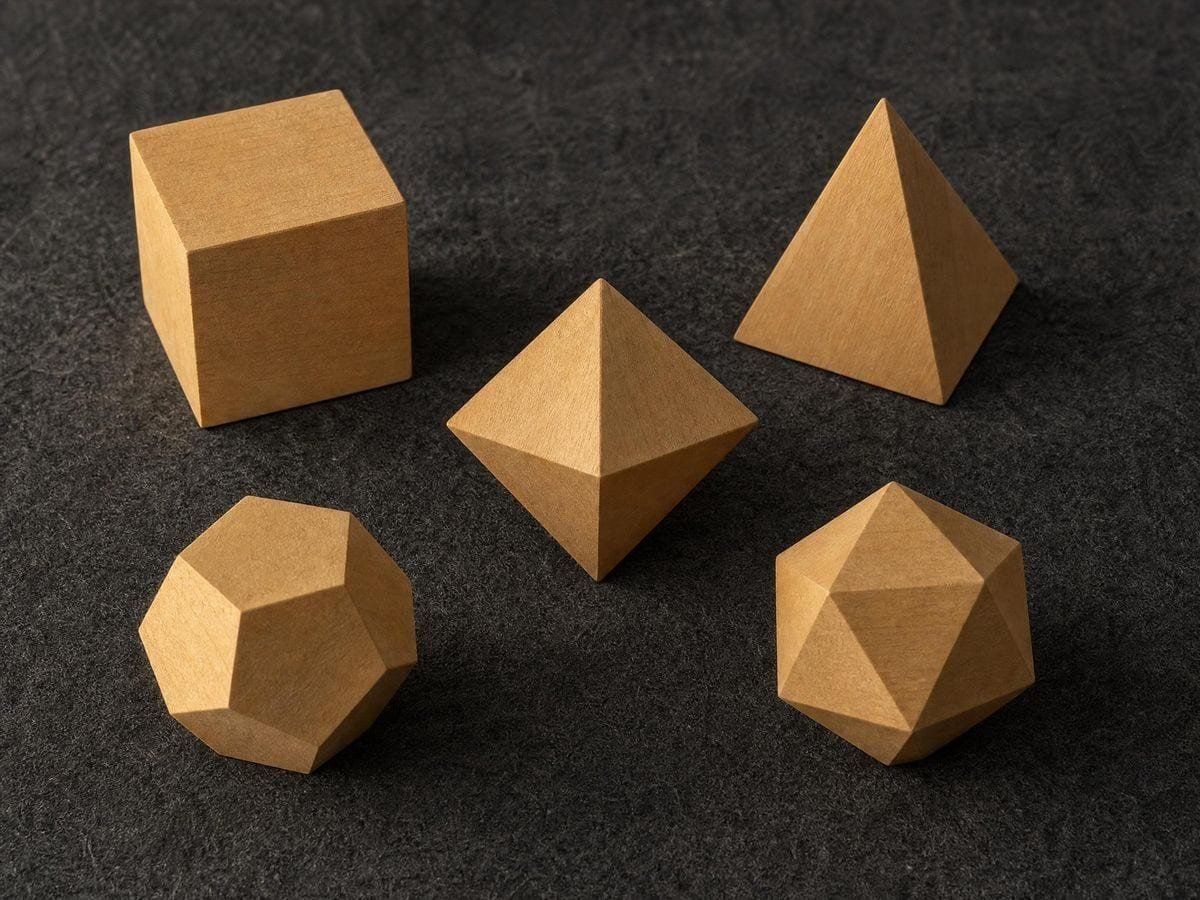
The icosahedron is an outer pentagon with a smaller pentagon at 0.382 of the radius, rotated a fifth of a turn, with each outer point joined to two inner ones — the zigzag antiprism band that is the solid's actual structure. The dodecahedron adds a third ring: pentagons at 1, 0.618 and 0.382 of the radius, with two sets of zigzags between them.
Those pentagon radii are 1, 1/φ and 1/φ². That is the honest part of the five-fold diagrams — the icosahedron's twelve vertices genuinely sit at the corners of three mutually perpendicular golden rectangles, and the nesting at powers of φ is a real consequence of that rather than a chosen aesthetic.
Where a flat diagram stops being honest
None of these is a rendered projection. There are no hidden lines, no depth cues and no consistent viewing direction between them — each is the schematic that convention uses for that solid, which is the drawing people actually make and recognise. That is the right thing for a construction overlay and the wrong thing for a geometry proof.
So do not measure edge lengths off these diagrams and expect them to correspond to the solid's edges. The tetrahedron's three spokes are not the same length as its triangle's sides in three dimensions; the cube's skew is a convention, not a projection angle. Use the diagrams for placing, sizing and laying out. For a true net or a measured projection, you want a modelling tool, and this page would rather say so than pretend.
Plato, Kepler, and what the association really is
The solids are named for Plato because the Timaeus assigns four of them to the classical elements — tetrahedron to fire, cube to earth, octahedron to air, icosahedron to water — with the dodecahedron left for the cosmos as a whole. The merkaba generator draws the compound of two tetrahedra, and the Metatron's cube generator the figure all five are traditionally read out of. He did not discover them — the platonic solids overlay page sets out what the record supports, and the other sacred-geometry figures treat every figure that way; Theaetetus is generally credited with the first complete treatment, and Euclid's Elements ends with their construction.
The more instructive episode is Kepler's. In Mysterium Cosmographicum (1596; trans. A.M. Duncan as The Secret of the Universe, Abaris Books, 1981) he proposed that the orbits of the six known planets were spaced by the five solids nested inside one another, which is a beautiful idea and simply wrong. He spent decades on it, kept checking it against Tycho Brahe's observations, and eventually let the data destroy it — which is how he arrived at elliptical orbits. The solids are worth drawing; they are not worth defending against measurement.
Making things from them
For laid-out work — a poster, a plate, a set of five diagrams — hold the size constant and switch between the solids. Consistent radius is what makes a set read as a family, and it is the thing hardest to achieve when the five are drawn or sourced separately.
For cut and engraved work, export SVG. The five-fold figures in particular carry a lot of short segments meeting at shallow angles, and a raster version of an icosahedron schematic loses the zigzag at any size a cutter cares about. And turn the label off before exporting unless you want it engraved too.
Duals, and the formula that checks every one
The five fall into pairs. Put a vertex at the centre of each face of a cube and join them, and you get an octahedron; do it to the octahedron and the cube comes back. The dodecahedron and icosahedron are the same kind of pair, and the tetrahedron is its own dual — the operation returns another tetrahedron. That is why the face and vertex counts swap between partners: the cube has 6 faces and 8 vertices, the octahedron 8 faces and 6 vertices.
There is also a single equation every one of them satisfies, and it is the fastest sanity check on any diagram. Vertices minus edges plus faces equals two. Cube: 8 − 12 + 6 = 2. Icosahedron: 12 − 30 + 20 = 2. Dodecahedron: 20 − 30 + 12 = 2. It holds for every convex polyhedron rather than only these five, which makes it genuinely useful when someone hands you a solid and a claim about it.
The duality is practical for drawing too. If you can construct one member of a pair you get the other free by joining face centres, which is often easier than building the second from scratch — particularly for the icosahedron, whose twelve vertices are far more awkward to place than the dodecahedron's twenty face centres are to find.
Where the Platonic solids gets used
A set of five at one radius, as a plate. Sourcing them separately meant five different scales and five different line weights every time.
The icosahedron zigzag is the one I cannot draw cleanly by hand. Having the two pentagons at exact ratios is what makes the band regular.
I use the construction step to show why there are five and not six. Building the vertex angles up is more convincing than stating the result.
Platonic solids: frequently asked questions
The geometry
Why are there exactly five?
Because of what has to happen at a vertex. At least three faces must meet there and their angles must total under 360°. Triangles at 60° allow three, four or five — tetrahedron, octahedron, icosahedron. Squares at 90° allow only three — the cube. Pentagons at 108° allow only three — the dodecahedron. Three hexagons make exactly 360° and lie flat. There is nothing left.
Are these true projections of the solids?
No, and the distinction matters. They are the conventional flat schematics — a cube as a square with two skewed faces, an octahedron as a diamond with both diagonals. There are no hidden lines and no consistent viewing direction between them. Use them for placing and sizing, not for measuring edge lengths.
Why do the icosahedron and dodecahedron use pentagons at 0.618 and 0.382?
Because those are 1/φ and 1/φ², and the five-fold solids are genuinely golden-ratio objects — an icosahedron's twelve vertices sit at the corners of three mutually perpendicular golden rectangles. The nesting reflects real structure rather than a chosen look.
Did Plato discover them?
No. The Timaeus assigns four of them to the classical elements and the fifth to the cosmos, which is why they carry his name, but Theaetetus is generally credited with the first complete treatment and Euclid's Elements ends with their construction.
What was Kepler's theory about them?
That the orbits of the six known planets were spaced by the five solids nested inside one another. It is a beautiful idea and it is wrong; he checked it against Tycho Brahe's observations for decades and eventually let the data destroy it, which is how he reached elliptical orbits.
Can I get all five at the same size?
Yes, and it is the main reason to use one tool rather than five sources. The size control is shared, so switching solids keeps the overall radius fixed and, on a sheet where all five are drawn at once, the set reads as a family.
Can I get a net to fold?
No. These are flat schematics of the assembled solids rather than unfolded nets. A net needs a modelling tool, and this page would rather say so than imply otherwise.
Using it
How many faces does each have?
Tetrahedron 4, cube 6, octahedron 8, dodecahedron 12, icosahedron 20 — all shown in the selector. The cube and octahedron are duals of each other, as are the dodecahedron and icosahedron; the tetrahedron is its own dual.
Should I leave the name label on?
On a teaching sheet, yes — five similar-looking diagrams with no labels is a quiz rather than a reference. On a single print, off: the figure is the subject and the word is furniture.
What does the construction step control show?
The diagram assembling rather than arriving complete, in the order you draw it: outer boundary first, then the internal structure. It is the setting for teaching, and for a print where you want the construction visible rather than only the result.
Export and print
Can I export them for cutting?
Yes. SVG export gives true vector lines, which the five-fold figures particularly need — an icosahedron schematic has many short segments meeting at shallow angles, and a raster version loses the zigzag at cutting size. Turn the name label off first unless you want it cut too.
Can I export them for cutting or engraving?
SVG, and think about what you actually want cut. These are flat construction diagrams, so a cutter will follow the lines you see — which makes a nice engraved plate and does not make a model. There are no fold nets here.
Can I print the set as a teaching sheet?
Yes — export each at the same size with its name label on, and lay them out in your own program. At 300 DPI on A3 all five sit comfortably on one sheet with room for the face and vertex counts underneath.
Choosing a grid
Should I use 3D software instead?
If you need to rotate them, yes: these are flat diagrams and remain so. Use this when you want the construction drawn in the plane, which is what a diagram in a book or on a wall is, and what a 3D render is not.
Practical matters
Does my image get uploaded?
No. Everything happens in your browser — the image is drawn to a canvas on your own device and never sent anywhere.
Can I use the diagrams in a textbook or a course?
Yes, with no watermark, no account and no attribution required. The five solids and their construction are about as far out of copyright as geometry gets, and the terms leave whatever you export with you.
Open the tool Platonic solids generator
Five solids, one radius
The platonic solids share one size control, so they switch between each other at a fixed radius. Place them on your own page and export vector or 600 DPI. No signup, nothing uploaded.
Back to the generator →