
Free Vesica Piscis Grid Generator
Draw the Vesica Piscis instantly with our 100% free grid generator. Set two circles through each other's centres forming the root-3 lens behind Gothic windows and the ichthys over any image, then export SVG or 600 DPI for design and glass work in seconds. No signup, no downloads needed. Trusted by 60,000+ artists worldwide.
Two circles, each through the other's centre
The lens where they overlap is the vesica. Its height to width is the square root of three to one, which is where the root-3 rectangle and much of six-fold geometry begin.
4 controls, not a fixed picture
Set construction step and circle radius, toggle axes and equilateral triangle guides. Every one is live on the canvas.
Stacks with sacred geometry & pattern
Overlays combine, each carrying its own transform, so this one can sit under or over flower of life, sri yantra and metatron’s cube, and 15 more in the same set.
A 1:1.732 proportion you can measure
Print at 300 or 600 DPI and the lens measures root 3 across its axes. SVG for exact paths at any size.
| Ctrl + Z | Undo |
| Ctrl + Y | Redo |
| Esc | Deselect overlay |
| Alt + drag | Free positioning (no snap) |
| Ctrl + scroll | Zoom canvas |
| Ctrl + P | |
| ? | Show this help |
Two equal circles, each passing through the other's centre, and the pointed lens between them. It is the simplest construction in the family and the one that hands you an irrational proportion without any measuring. The Vesica Piscis is one of the 82 composition overlays in the app, and it stacks with the rest.
- 2 circles
- √3 : 1 lens
- SVG + 600 DPI export
- Nothing uploaded
What is the Vesica Piscis?
The Vesica Piscis generator is a free browser tool that draws the figure on a blank canvas or over any reference image you load. The figure is two circles of equal radius positioned so each passes through the other's centre, and the pointed lens, or mandorla, that their overlap encloses. Because the circles are placed exactly one radius apart rather than by eye, the lens carries its true proportion: its height is √3 times its width, an irrational ratio the construction produces without any measurement. It is part of Grid Maker Pro and exports as SVG or at up to 600 DPI.

How to make a Vesica Piscis
Two circles, each through the other's centre, and the almond between them. The proportion that generates the rest of the sacred-geometry set, drawn to measure.
Open the Vesica Piscis overlay
Open the tool with the Vesica Piscis already selected. The two circles are placed exactly one radius apart, so the lens between them carries its true √3 proportion before you adjust anything.
JPG · PNG · GIF · WEBP
Size it to your surface
Work on the blank canvas, or drop in a reference image and scale, rotate and drag the figure over it. The overlay carries its own transform, so the artwork underneath stays where it is.
Construction step · Circle radius · Axes
Style it, then export
Set line colour, width and opacity for the surface you are working on, then export SVG for a plotter or cutter, or a raster at up to 600 DPI sized to your paper.
PNG · JPG · PDF · SVG · up to 600 DPI
Three steps, about a minute. No signup, no upload.
What the Vesica Piscis Generator does
One radius apart, exactly
The vesica piscis depends entirely on its two centres being exactly r apart. Placed by eye that distance is approximate, and every proportion you take off the lens inherits the error.
√3 without measuring
The lens is √3 times taller than it is wide. Take that proportion straight off the construction instead of typing 1.732 into a calculator.
Over your own reference
Load a photograph, a window elevation or a layout in progress and lay the figure over it with an independent transform.
Stacks with what it builds
Run it with the Seed of Life or the Flower and you can see the lens sitting inside the lattice it generates.
Vector out, not just pixels
SVG export gives true circles for a plotter, cutter or clean scaling. Raster export runs to 600 DPI, sized to paper from A5 to A2.
Nothing is uploaded
The geometry is drawn in your browser and any reference is read locally. No signup, and no server that could receive the image.
Vesica Piscis examples: four ways the figure gets used
Vesica Piscis vs standalone sacred-geometry generators vs downloaded template images
| Option | Centres exactly r apart | Over your own image | Vector export | Cost |
|---|---|---|---|---|
| Grid Maker Prothis tool | Yesplaced by construction | Yeswith independent transform | SVG + raster to 600 DPI | Free |
| Standalone sacred-geometry generators | Yes | Norenders on its own ground | Varies by tool | Free or paid |
| Downloaded template images | Whatever the original had | Only in a separate editor | Rarely | Free or paid |
| Compass and dividers | Yesif the setting does not shift | On the surface itself | No | Time |
Who the Vesica Piscis is for: work that needs a proportion, not a picture
How the Vesica Piscis works — Two circles that hand you an irrational number, and why the spacing has no tolerance
The Vesica Piscis is the least impressive-looking construction in sacred geometry and quietly one of the most useful, because it converts a compass into a source of exact proportion.
The construction is two steps. Draw a circle. Put the compass point anywhere on its circumference, keep the same radius, and draw a second. The two circles overlap in a pointed almond shape — the vesica, also called the mandorla — bounded by two arcs. That is the whole figure, and it is the first proposition of Euclid's Elements: the construction he uses to produce an equilateral triangle, because joining the two centres to either tip of the lens gives three lengths that are all exactly one radius.
What makes it valuable is the proportion that falls out. Because the centres are one radius apart and the lens tips sit where the circles cross, the lens's long axis is √3 times its short axis — approximately 1.732, an irrational number produced by nothing more than a compass held at a fixed setting. You get an exact ratio without measuring anything, which is precisely why the figure survives in architectural and decorative traditions that predate convenient arithmetic.
The vesica is a compass that has been taught to output an irrational number. Everything else it is famous for follows from that.
Where the error enters
The figure has exactly one error to make: the distance between the two centres. It must be exactly one radius. Closer and the lens fattens; further and it narrows, and in both cases the proportion stops being √3 and becomes some arbitrary number that looks similar. Because the shape still reads as a vesica either way, the error is invisible — you cannot tell a true lens from a near one by looking, only by construction.
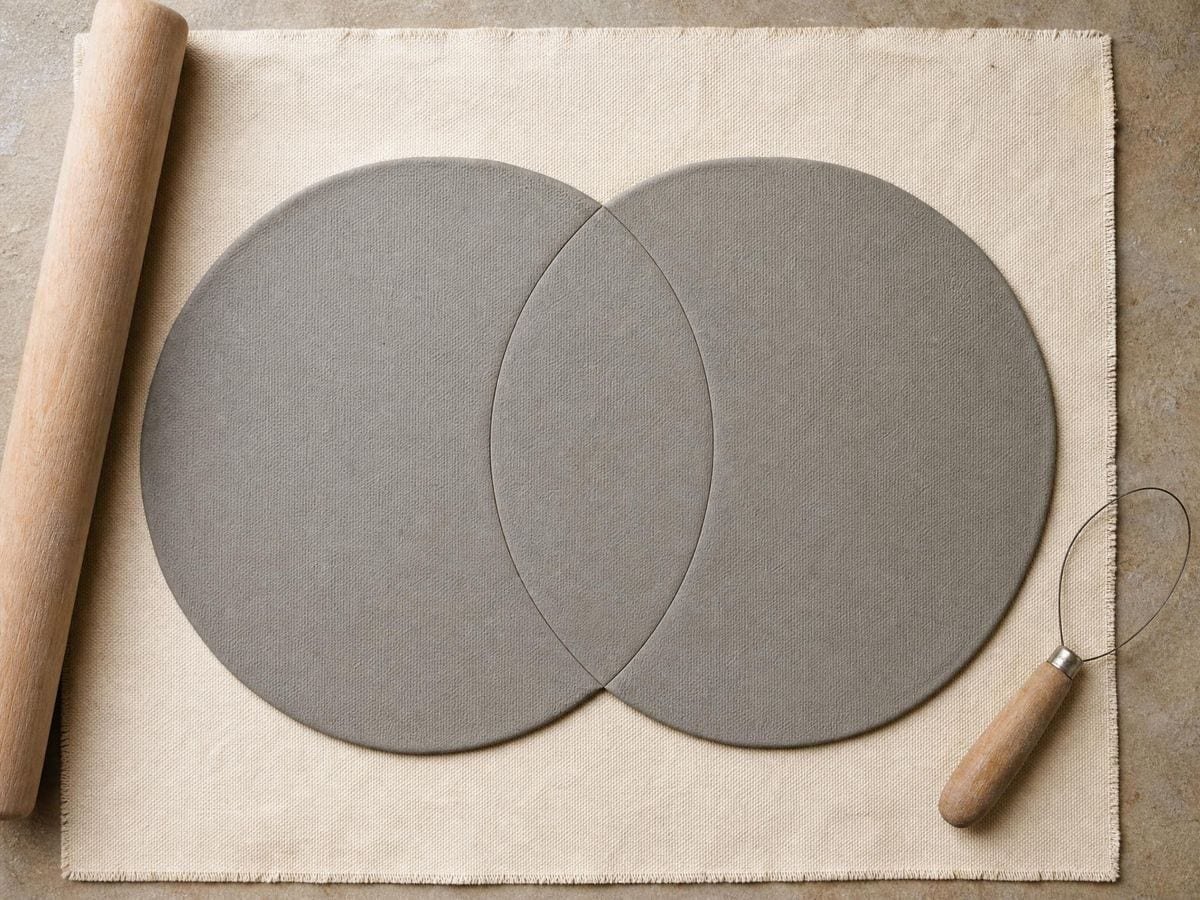
That matters because people rarely want the lens for its own sake. They want the proportion: to size a window, a panel, a page, a pendant, a stained-glass light. If the centres were placed by eye, everything derived from the lens carries an error that never announces itself, and the piece is proportioned to a number nobody chose.
Using it as a proportioning device
The practical workflow is simpler than the geometry suggests. Place the figure over your working area, scale it until the lens spans the dimension you care about, and read the other dimension off the construction. A lens whose width matches your panel gives you the height that stands in √3 relation to it; rotate the figure ninety degrees and you get the reciprocal. Because the overlay has its own transform, you can position it, take the proportion and move on without disturbing the artwork underneath.
It also composes. The vesica is the seed of the hexagonal lattice — repeat the construction around a circle and you are building the Seed of Life — so a layout proportioned on the vesica sits naturally with anything else from that family. Stack the Seed or the Flower over the same canvas and the relationships are visible rather than asserted.
The mandorla in ornament and architecture
The pointed-oval frame around a figure in medieval and Byzantine art — the mandorla — is this shape, and the vesica proportion turns up repeatedly in Gothic window tracery and in the layout of decorated pages. That is unsurprising rather than mystical: a mason or an illuminator with dividers and no calculator needs constructions that produce reliable proportion, and this is the cheapest one available. The Vesica Piscis reference page covers the documented appearances and is careful about which attributions the evidence actually supports.
It is worth being equally careful in your own work. That a proportion can be derived from the vesica does not establish that a given historical object was designed that way — √3 is close enough to several other ratios that after-the-fact fitting is easy and unreliable. Use the construction because it gives you a proportion you have chosen, not to claim membership in a lineage the object may not belong to.
Line weight and the two arcs
This figure is forgiving to weight because it is so open — there is no crowded region and only two curves to keep apart. The one place weight matters is at the tips of the lens, where the arcs meet at a sharp angle: a heavy stroke rounds those points off visually, and the tips are the part of the shape that carries its character. If the lens is reading as a fat oval rather than a pointed almond, the line is too heavy for the size.
For print, 600 DPI on A4 is more than the figure needs. For glass or cutting work, export SVG: the arcs are true circular segments, and a cutter or a lead line follows them exactly, whereas a traced curve introduces flats you will see in the finished piece. For an overlay used as a proportioning guide, drop opacity heavily and pick a colour off the artwork — you are using the construction to make a decision, not adding it to the composition, and it should be easy to switch off once the decision is made.
Checking a proportion you already have
The overlay is also a measuring instrument. If you have a panel, a window, a book page or a mark whose proportion you suspect is √3, photograph it and fit the lens: scale the figure until the short axis matches the object's width and see whether the long axis matches its height. It is faster than measuring and dividing, and it answers the question visually, which is usually how the question arose.
Do the same before committing to a build. Fitting the lens over a drawing tells you whether the proportion you have drawn by instinct is the one you meant, and if it is not, the construction gives you the corrected dimension immediately rather than requiring a second calculation. For work where the ratio is the point — a set of panels meant to relate, a series of frames — that check is worth doing once per piece. It is the cheapest quality check in the workshop: a proportion you can see is right beats one you believe is right, and the difference only ever shows up after the material has been cut.
Where the Vesica Piscis gets used
Every light in a traceried window relates to the vesica. Having the true lens as vector, rather than a curve I approximated, meant the lead lines followed real arcs.
I proportion panel sets on it. Fit the lens to the width, read the height, and the whole series relates without me doing arithmetic on every piece.
It is the clearest way to show students that a compass produces exact irrational proportion. Two circles and they have √3 in front of them.
Vesica Piscis: frequently asked questions
The geometry
What is the ratio of the Vesica Piscis?
The lens is √3 times taller than it is wide, which is 1.732 to 1. The triquetra generator is three of these lenses arranged symmetrically, and the nineteen-circle generator the lattice they tile into. The ratio comes out of the construction itself, because the two circle centres are exactly one radius apart.
Why does the exact spacing matter so much?
It is the only variable. If the centres are not exactly one radius apart the lens still looks like a vesica but its proportion is no longer √3, so anything you size from it is proportioned to an arbitrary number.
Is the Vesica Piscis connected to Euclid?
Yes — it is the construction behind the first proposition of the Elements, which builds an equilateral triangle. Joining the two centres to a lens tip gives three lengths of exactly one radius.
Can I put it over my own artwork?
Yes. Load any image and the figure draws on top with an independent transform, so you can fit it to a feature and take a proportion without moving the artwork.
Was Gothic tracery really designed on the vesica?
The proportion appears repeatedly in window tracery and page layout, which is unsurprising for designers working with dividers and no calculator. Whether a specific object was designed that way is a separate claim — the overlay reference page is careful about which attributions hold.
How does it relate to the Seed and Flower of Life?
It is their starting point. Repeat the same two-circle construction around a circle and the seven-circle Seed of Life appears; keep going and you reach the Flower. All three are in this app and they stack.
Using it
How do I use it to proportion a panel?
Scale the figure until the lens's short axis matches the dimension you have, then read the long axis: that is the √3 partner. Rotating the figure gives you the reciprocal relationship instead.
What do the equilateral triangle guides show?
Where √3 comes from. The two circle centres and either tip of the lens form an equilateral triangle, which is why the vesica's height-to-width ratio is √3 : 1 — the guides make that a drawing rather than a fact you have to take on trust.
Should I keep the axes on?
While proportioning, yes — the long and short axes are what you measure against, and the √3 relationship is invisible without them. For the finished mandorla, off: the lens is the shape, and the axes are scaffolding.
Export and print
Can I export it as an SVG?
Yes. SVG export gives true circular arcs, which matters for glass, cutting and plotting where a traced approximation introduces visible flats. Raster runs to 600 DPI — see the full feature list.
What do I export for a stained-glass or tracery template?
SVG at the finished size. The lens is two arcs meeting at points, and both the arc smoothness and the sharpness of the tips matter in glass — a raster template loses the first and blunts the second.
Choosing a grid
What is the difference between a vesica piscis and a mandorla?
They are the same shape under different names. Mandorla is the term used for the pointed-oval frame around a figure in Byzantine and medieval art; vesica piscis is the geometric name.
Should I use this or the Seed of Life to set out a panel?
This, if the proportion is the point — the vesica gives you √3 directly and nothing else to distract from it. The Seed of Life if you want the whole hexagonal lattice, of which the vesica is the first step.
Practical matters
Do I need an account, and does my image get uploaded?
Neither. There is no signup and no upload step: the geometry is drawn in your browser and any reference is read locally. There is no server to send it to.
Was Gothic tracery really designed on it?
In part, and far less universally than the usual telling claims. The vesica and √3 constructions genuinely appear in medieval masons' practice and in the surviving lodge books, but so do many other ad quadratum and ad triangulum methods. It was one tool among several, not the secret of the cathedrals.
Can I use it in commissioned work?
Yes. Two overlapping circles are unowned geometry, nothing exported carries a watermark and the terms leave your work yours.
Open the tool Vesica Piscis generator
Two circles, one exact proportion
The vesica piscis carries √3 in its own proportions. Fit it, read the ratio off the construction, export vector or 600 DPI. No signup, nothing uploaded.
Back to the generator →