Free Triquetra Grid Generator
Draw the triquetra instantly with our 100% free grid generator. Set three 240-degree arcs on one circle forming the closed trinity knot, boundary ring optional, over any image, then export SVG for celtic design, print and craft in seconds. No signup, no downloads needed. Trusted by 60,000+ artists worldwide.
Three vesicas, interlaced
Three overlapping arcs forming a trefoil knot, drawn as one continuous path with over-and-under crossings. Three-fold symmetry, and no beginning or end to the line.
3 controls, not a fixed picture
Set size and construction step, toggle boundary circle. Every one is live on the canvas.
Stacks with sacred geometry & pattern
Overlays combine, each carrying its own transform, so this one can sit under or over flower of life, sri yantra and metatron’s cube, and 15 more in the same set.
The interlace stays legible
The over-and-under crossings are what a low-resolution export loses first. SVG keeps them as paths; raster to 600 DPI.
| Ctrl + Z | Undo |
| Ctrl + Y | Redo |
| Esc | Deselect overlay |
| Alt + drag | Free positioning (no snap) |
| Ctrl + scroll | Zoom canvas |
| Ctrl + P | |
| ? | Show this help |
The trinity knot is not three loops drawn by hand. It is three arcs of one radius, centred a half radius from the middle at exactly 120° — and every proportion in it depends on those two numbers.
The triquetra generator draws one of the 82 composition overlays in Grid Maker Pro, and the rest stack on the same image.
- 3 arcs
- Centres at 0.5r
- SVG + 600 DPI export
- Nothing uploaded
What is a triquetra?
The triquetra generator is a free browser tool that draws the trinity knot exactly. Three arcs of the same radius have their centres placed half a radius from the middle at 120° to each other, and each sweeps 240° — two thirds of a full turn. Those numbers are what make the three lobes equal and the crossings land where they should. An optional boundary ring sits at 1.12 of the radius, and the whole figure can be dragged, scaled and rotated over your own work.

How to draw a triquetra
Three arcs on three centres, closed into one continuous interlace, with or without the circle that binds it. Drawn to measure, so the crossings are even.
Open the figure
The triquetra opens already placed: its three arc centres sit half a radius out at exactly 120° before you adjust anything, which is the condition for all three lobes being the same shape.
JPG · PNG · GIF · WEBP
Add the ring if you want it
The boundary ring sits at 1.12 of the radius — just clear of the lobes rather than touching them. It is the traditional enclosed form; leave it off for the open knot.
Size · Boundary circle · Construction step
Place it, then export
Drag, scale and rotate it over your artwork or work on a blank canvas at your paper size. Export SVG for a cutter or plotter, or a raster at up to 600 DPI.
PNG · JPG · PDF · SVG · up to 600 DPI
Three steps, about a minute. No signup, no upload.
What the Triquetra Generator does
Three lobes, genuinely equal
The triquetra is three arcs of one radius struck from three centres at exactly 120°, which is what makes its lobes identical. Drawn freehand, one lobe is always fatter or set slightly lower, and the eye reads the whole knot as tipping. Three centres at exactly 120° and one shared radius makes them identical by construction.
240° is the number that closes it
Each arc sweeps two thirds of a full turn. Less and the lobes leave gaps; more and they double back over themselves. At exactly 120°, that single angle is what makes three separate arcs read as one continuous path.
The ring, just clear
At 1.12 of the radius the enclosing circle sits a little outside the lobes rather than touching them. That gap is what stops the ring reading as part of the knot, which is how the enclosed form is traditionally drawn.
The outline, not the weave
This draws the path of the knot, without over-and-under crossings. That is the right form for a construction you will ink, carve or cut to, and the page says so rather than implying an interlace it does not draw.
Over your own work
Its own transform, so the knot can be rotated onto a photographed carving or scaled into a layout without disturbing what is beneath it.
Vector out
SVG export keeps the arcs as true curves rather than resampling them, which matters for a figure that is entirely curvature. Raster export goes to 600 DPI at your paper size.
Triquetra examples: four ways the figure reads
Triquetra vs a downloaded knot graphic vs compass and straightedge
| Option | Centres at 0.5r, 120° apart | Arcs sweeping exactly 240° | Vector export | Cost |
|---|---|---|---|---|
| Grid Maker Prothis tool | Yesby construction | Yes | SVG + raster to 600 DPI | Free |
| A downloaded knot graphic | Usually, unknown provenance | Usually, with the weave baked in | Sometimes | Free or paid |
| Compass and straightedge | Yesif the centres are stepped | By construction | No | Time |
| Drawing it freehand | Almost never — one lobe always leads | No | No | Time, and a redraw |
Who a triquetra is for: ornament that has to be symmetrical
How a triquetra works — Two numbers, three arcs, and the difference between a path and a weave
The triquetra is the most reproduced knot in Insular art and, among the 82 composition overlays, one of the easiest to draw slightly wrong, because it looks like freehand and is not. Here are the two numbers it depends on, what this overlay draws, and the thing it deliberately does not.
Take a circle of radius r. Mark three points half a radius from its centre, 120° apart. From each of those points draw an arc of radius r sweeping 240°. The three arcs cross each other and close into the three-lobed knot.
Two numbers do all the work: the centres at 0.5r, and the sweep at 240°. Move the centres further out and the lobes separate into three arcs that no longer meet; bring them closer and the figure collapses toward a circle. Shorten the sweep and gaps appear at the tips; lengthen it and the arcs double back over themselves.
It looks like something drawn in one movement. It is three arcs that were placed.
It is three vesicas, seen another way
Each pair of the three arcs overlaps in a pointed lens, which is a vesica piscis — the figure the vesica piscis tool draws on its own. The triquetra is the figure those three lenses make when the three circles they come from are arranged symmetrically, which is why it turns up in the same architectural contexts as the vesica: window tracery, arch heads, panel fills.
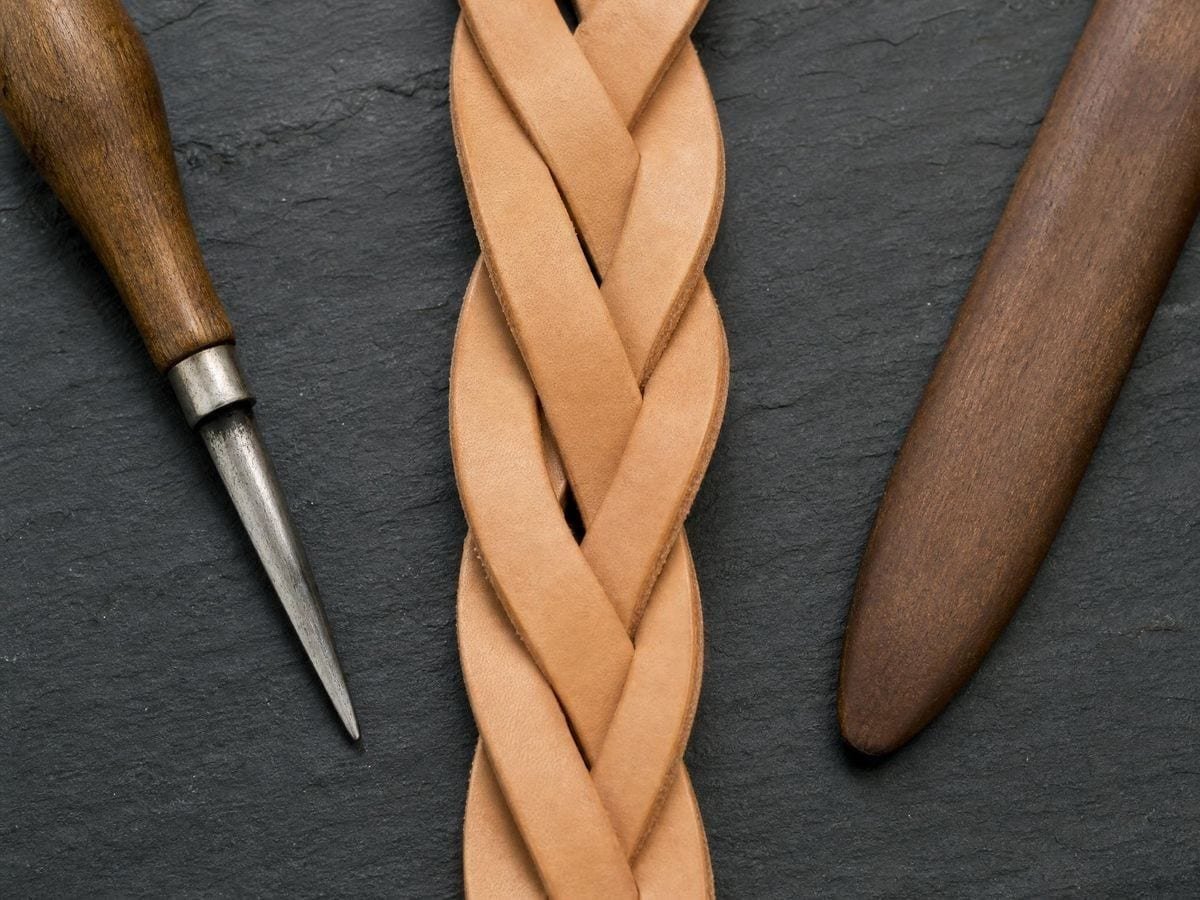
That relationship is a practical route into it. If you already know how to set out a vesica with compasses, you can set out a triquetra by doing it three times around a centre. And the proportions inherit: the lobes carry the same √3 relationships the vesica does, because they are the same construction repeated.
What this overlay does not draw
The overlay draws no over-and-under. A drawn or carved triquetra is usually an interlace: the three arcs weave, passing alternately above and below each other, and that alternation is what makes it read as a knot rather than as three overlapping loops.
This draws the path — the geometry the interlace follows — and leaves the weaving to you. That is the right form for a construction layer: you lay it down, then ink or carve the crossings with the correct alternation, and the underlying arcs stay exact while you do. An overlay that pre-decided the weave would be harder to work over, not easier.
It is also the honest form. Any two of the three arcs cross twice, and there are six crossings in total; a genuine alternating weave over them is a decision about which strand is on top at each, and there is more than one valid answer. Drawing the path leaves that decision where it belongs.
Where the figure actually comes from
Triquetra-like three-lobed motifs appear in Iron Age European metalwork and on Germanic and Norse objects well before the Insular manuscripts. The version most people picture — clean, closed, often enclosed in a ring — belongs to the Insular tradition of the seventh to ninth centuries, alongside the interlace of the Book of Kells and the Lindisfarne Gospels, and to the stone crosses of the same period.
Its use as a specifically Christian trinity symbol is documented but later and partial; the motif also appears in contexts with no such reading, and the hexagram generator carries a comparable history of later readings attached to an older figure. The modern name "trinity knot" projects one interpretation backward onto a much broader body of use. As with the hexagram, a figure this easy to construct recurs without needing to be borrowed.
Making things from it
For carving and cut work, export SVG. Everything in the figure is arcs, and a raster version of a curve becomes a staircase at any real cutting size — most obviously at the three tips, where the curvature is highest and the eye is most attentive.
For inked interlace, export the path at low opacity and draw the weave over it. The construction-step control is worth using here: watching the three arcs go down one at a time makes it obvious which strand is which, which is exactly what you need to keep straight when you start deciding crossings.
And a note on the ring. Enclosed and open triquetras read differently on the same object: the ring closes the figure and makes it a badge, where the open form reads as ornament that could continue. Both are traditional. The overlay draws the ring at 1.12r, just clear of the lobes, because a ring that touches them turns four separate elements into one ambiguous outline at small sizes.
The variants, and what changes between them
The triquetra overlay page works through the surviving examples, beside the rest of the other sacred-geometry figures. Three things vary between historical triquetras and all three are worth knowing before you copy one. The first is whether the ring is present, which changes the figure from ornament to badge. The second is the strand width relative to the radius — Insular manuscript versions are typically thin, while carved stone versions are much heavier because a thin strand does not survive weathering.
The third is the lobe proportion, which is the one this overlay fixes. Some drawn versions push the arc centres further out than half a radius, producing longer, narrower lobes and a more pointed figure; others pull them in for a rounder, fatter knot. Both are found historically, and the version here sits at the centre of that range.
If you are matching a specific piece, fit the overlay to it and see where the lobes disagree. Consistent disagreement means the original used a different centre offset, and once you know which way it went you can compensate by scaling the overlay non-uniformly — or simply accept it as the piece's own character and draw the rest to match.
A note on line weight, because it decides more about this figure than the geometry does. The three lobes meet at six crossings, and at every one of them two strokes converge at a shallow angle. Set the weight too heavy and those meetings fill in solid, turning six crossings into three blobs and losing the knot entirely — which is the single commonest failure in a printed or embroidered triquetra.
The safe test is to view the figure at the size it will actually appear, not at the size you are drawing it. A weight that reads as crisp at screen scale is frequently three times too heavy for a pendant and half what a carved version needs. The overlay's own line-width control makes that a five-second check, and it is worth doing before the geometry is committed rather than after.
Where a triquetra gets used
I carve the interlace by hand but I set the arcs from a print. Three lobes that are genuinely identical is the thing eyes catch and hands cannot do.
For silver I need the path as vector and the weave decided separately, because the crossings are where the piercing saw goes.
It is the fastest way to show that Celtic knotwork is compass work rather than freehand. Two numbers and the whole thing appears.
Triquetra: frequently asked questions
The geometry
How is a triquetra constructed?
Three arcs of the same radius, with their centres half a radius from the middle and 120° apart, each sweeping 240°. Those two numbers — 0.5r and 240° — are the whole figure; change either and the lobes stop meeting properly.
Why 240° for each arc?
Because two thirds of a turn is what makes three separate arcs close into one continuous-looking path. A shorter sweep leaves gaps at the tips; a longer one doubles the arcs back over themselves.
Does it draw the over-and-under weave?
No, and deliberately. It draws the path the interlace follows, leaving the crossings to you. There are six crossings and more than one valid alternating weave, so pre-deciding it would make the overlay harder to work over rather than easier.
What is the relationship to the vesica piscis?
Each pair of arcs overlaps in a vesica, so a triquetra is three vesicas arranged symmetrically. If you can set out a vesica with compasses you can set out a triquetra by doing it three times around a centre, and the √3 proportions carry over.
Should I use the enclosing ring?
It changes the reading. On the same object, the ring closes the figure and makes it a badge, where the open form reads as ornament that could continue. Both are traditional. The overlay places it at 1.12 of the radius, just clear of the lobes, because a ring that touches them turns four elements into one ambiguous outline at small sizes.
Is it a Christian symbol?
Partly and later. Three-lobed motifs appear in Iron Age European metalwork and on Norse objects before the Insular manuscripts, and the figure occurs in contexts with no trinitarian reading at all. The specifically Christian use is documented but is one strand rather than the origin.
Using it
What does the construction-step control do?
It lays the three arcs down one at a time. Useful when you are about to decide the weave, because watching each strand arrive makes it obvious which is which at every crossing.
How do I place it on a carving or a photograph?
Scale until the enclosing ring sits on the design's outer circle, then rotate through the three positions. If the drawn arcs wander off the overlay, the original was cut by eye — which is common and is exactly what the construction is for revealing.
Export and print
Can I export it for carving or cutting?
Yes. Export SVG so the arcs stay true curves; a raster version staircases most visibly at the three tips, where the curvature is highest and the eye is most attentive. Raster export goes to 600 DPI at your chosen paper size.
What do I export for carving or routing?
SVG. The figure is three arcs of one radius, and an arc is what a raster degrades first — a routed knot cut from a traced bitmap shows the faceting in the wood, where a vector path does not.
Can I get the weave as separate paths?
No — the overlay draws the three arcs as they cross, without an over-and-under. Build the weave in your own vector program by breaking the arcs at the crossings; the geometry underneath is exact, so the breaks will register.
Choosing a grid
Should I use the Borromean rings instead?
If you want three separate closed circles, yes. The Borromean rings generator draws three whole circles with a linking property; the triquetra is a three-lobed knot made of arcs. They share a three-fold symmetry and are not variants of each other.
Practical matters
Why does my freehand version look like it is tipping?
Because one lobe is fatter or set slightly lower than the others. The eye is extremely good at detecting broken three-fold symmetry, and freehand nearly always breaks it — which is why the construction is worth having even if you ink the final by hand.
Does my image get uploaded?
No. Everything happens in your browser — the image is drawn to a canvas on your own device and never sent anywhere.
Is it a Christian symbol or a pre-Christian one?
Both, in sequence. The form appears on Germanic and Norse objects before Christianisation, and was later used in Insular manuscripts including the Book of Kells, where it acquired the Trinity reading. Neither origin cancels the other.
Can I use it for a tattoo or jewellery design?
Yes. The knot is traditional and unowned, exports carry no watermark and the terms leave the design with you. Take SVG for a stencil — the arcs will be scaled and faceting shows.
Open the tool Triquetra generator
Three arcs, placed rather than drawn
The triquetra takes two numbers. Set them, lay the path, weave it yourself, and export vector or 600 DPI. No signup, nothing uploaded.
Back to the generator →