Free Borromean Rings Grid Generator
Construct exact Borromean rings instantly with our 100% free grid generator. Set three equal circles whose centres sit on a true equilateral triangle, the classic three-set Venn figure, then export SVG for print or laser cutting in seconds. No signup, no downloads needed. Trusted by 60,000+ artists worldwide.
Three rings, no two linked
Three circles joined so that removing any one frees the other two. No two are linked to each other, which is the property that makes the arrangement interesting rather than merely decorative.
2 controls, not a fixed picture
Set size and construction step. Every one is live on the canvas.
Stacks with sacred geometry & pattern
Overlays combine, each carrying its own transform, so this one can sit under or over flower of life, sri yantra and metatron’s cube, and 15 more in the same set.
Crossings that read correctly
The over-and-under pattern is the whole figure, so it exports as distinct paths in SVG. Up to 600 DPI in raster formats.
| Ctrl + Z | Undo |
| Ctrl + Y | Redo |
| Esc | Deselect overlay |
| Alt + drag | Free positioning (no snap) |
| Ctrl + scroll | Zoom canvas |
| Ctrl + P | |
| ? | Show this help |
The figure behind both the Borromean rings and every three-set Venn diagram is one arrangement: three equal circles, centres half a radius out, 120° apart — placed by construction rather than dragged into position.
The borromean rings generator draws one of the 82 composition overlays in Grid Maker Pro, and the rest stack on the same image.
- 3 circles
- 7 regions
- SVG + 600 DPI export
- Nothing uploaded
What are the Borromean rings?
The Borromean rings generator is a free browser tool that draws three equal circles with their centres half a radius from the middle, 120° apart. That is the standard arrangement for both the Borromean figure and the three-set Venn diagram, and it produces seven distinct regions — three single, three pairwise, one central. The overlay draws the circles themselves without over-and-under crossings, which is worth knowing: a genuine Borromean link needs that information, and cannot be made from round circles at all.

How to draw three overlapping rings
Three rings arranged so that no two are linked without the third, and the seven regions their overlaps create. Built from the construction, not drawn by eye.
Open the figure
The three centres are placed half a radius out at exactly 120° before you adjust anything, which is the condition for all seven regions being equal in the way the diagram implies.
JPG · PNG · GIF · WEBP
Set the size
One control scales the whole figure. The ratio of radius to centre offset is fixed, because that ratio is what decides whether the central region exists at all.
Size · Construction step
Place it, then export
Drag, scale and rotate it over your artwork or work on a blank canvas at your paper size. Export SVG so the arcs stay curves, or a raster at up to 600 DPI.
PNG · JPG · PDF · SVG · up to 600 DPI
Three steps, about a minute. No signup, no upload.
What the Borromean Rings Generator does
Three centres, exactly 120° apart
The Borromean rings are three circles whose centres sit half a radius out at exactly 120° — the same placement the triquetra generator uses, and the reason the vesica piscis generator draws the lens each pair makes — which is what makes all seven regions equal. Dragged into place by hand, one circle sits a little low or a little wide and the pairwise regions stop matching. The eye reads that as a diagram that is subtly lying about its own symmetry.
Seven regions, all present
Three singles, three pairs and one centre. The radius-to-offset ratio is what decides whether the central region exists — too small and the three circles never all meet, which is the commonest failure in a hand-placed Venn.
Circles, not a woven link
There is no over-and-under here. That is the honest form, and the page explains why it has to be: the Borromean link cannot be built from round circles at all, so any drawing of it with true circles is a diagram rather than a picture of an object.
Over your own work
Its own transform, so the figure can be scaled into a slide or rotated onto a photograph without moving what is underneath it.
Readable over anything
Per-overlay colour and opacity, and an eyedropper that samples the image, so three overlapping outlines sit in a photograph rather than on top of it.
Vector out
SVG export keeps three true circles, which is what a cutter, plotter or document needs. Raster export is sized from the paper format and DPI you choose, up to 600.
Borromean rings examples: four ways the figure reads
Borromean rings vs dragging three circles in an editor vs a downloaded Venn template
| Option | Centres exactly 120° apart | All seven regions present | Vector export | Cost |
|---|---|---|---|---|
| Grid Maker Prothis tool | Yesby construction | Yesby the fixed ratio | SVG + raster to 600 DPI | Free |
| Dragging three circles in an editor | Only by eye | Often the centre is missing | Yes | Subscription |
| A downloaded Venn template | Usually | Usually | Sometimes | Free or paid |
| Compass and straightedge | Yesif the offsets are stepped | By construction | No | Time |
Who the Borromean rings is for: diagrams and for pieces that link
How the Borromean rings works — Three circles, seven regions, and the thing this figure cannot actually be
The Borromean rings are, among the 82 composition overlays, the one famous for a property that is genuinely remarkable and a picture that is genuinely impossible. Both are worth getting straight, because the difference decides what this overlay is good for.
Place three equal circles with their centres half a radius from a common middle, 120° apart. Each overlaps both of the others, and the whole figure divides the plane into seven bounded regions: three belonging to one circle alone, three shared by exactly two, and one at the centre shared by all three.
That arrangement is the standard three-set Venn diagram, and it is standard precisely because it is the simplest placement in which all seven regions exist and are clearly visible. Get the radius-to-offset ratio wrong and the central region vanishes — which is by far the commonest failure when someone drags three circles into position by hand.
Seven regions is the test. If the middle one is missing, the circles are too small or too far apart, and the diagram is not saying what it thinks it is.
The property the rings are famous for
As a link — three closed loops in three-dimensional space — the Borromean rings have a striking property: all three are linked together, but no two of them are linked. Remove any one ring and the other two fall apart completely. It is the standard example of what topologists call a Brunnian link.
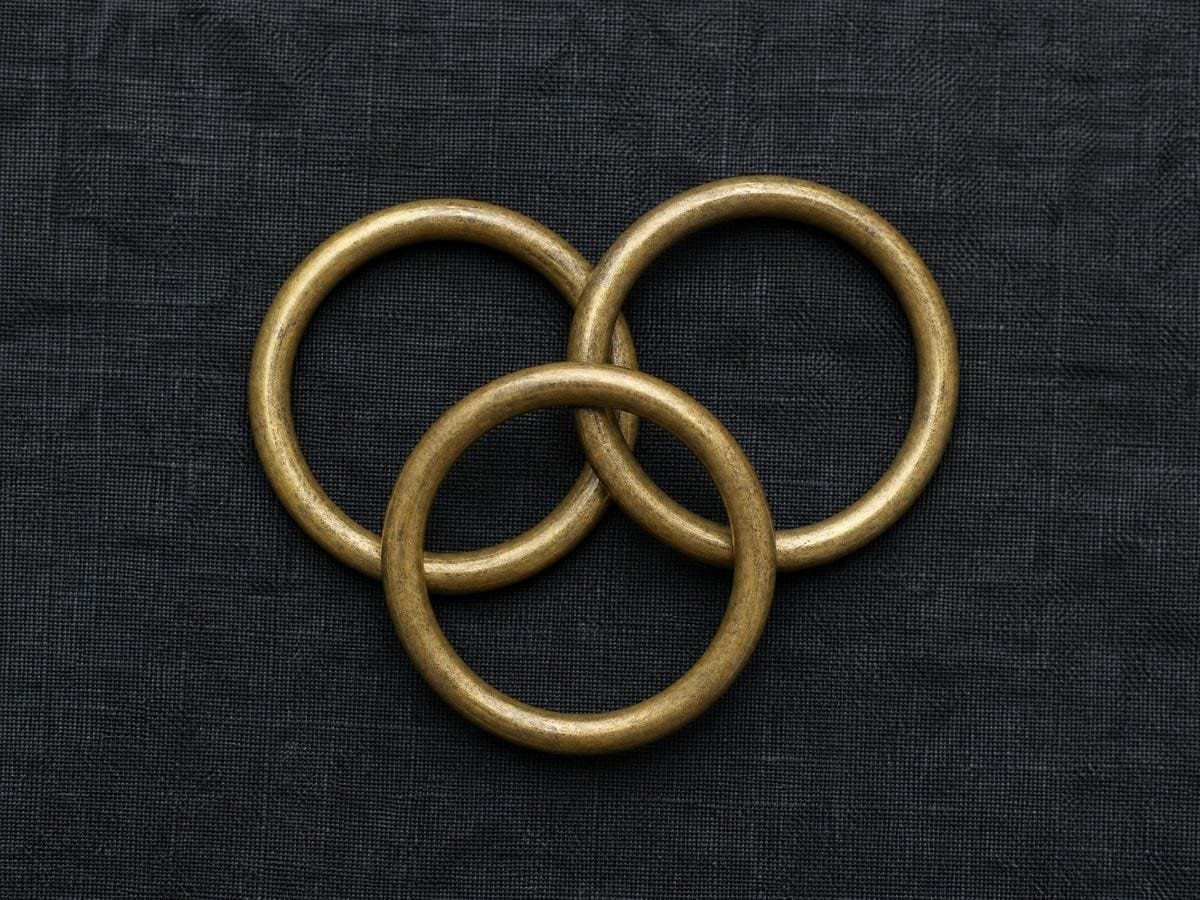
That property is real and it is genuinely surprising, because intuition says three-way linkage should imply at least one pairwise linkage. It does not. The rings are named for the Borromeo family of Renaissance Italy, whose arms carried the motif, and the same three-interlocked-loops figure appears much earlier — in Norse and Germanic ornament as the valknut, and in Buddhist and Japanese decorative work.
And the thing the picture cannot be
The Borromean rings overlay page covers the history, beside the rest of the sacred-geometry overlays. Here is the part that gets left out. The Borromean rings cannot be constructed from three flat, round, rigid circles in three-dimensional space. That is a proved result, not a practical difficulty — no arrangement of three geometric circles realises the link.
Every physical Borromean ring set is therefore made of loops that are bent, elliptical or otherwise not circular, and every drawing of them with true circles is a link diagram: a projection with over-and-under information added at the crossings, standing in for an object whose real components are not round.
This overlay draws the circles without that crossing information. That is deliberate and it is the honest choice for a construction layer — it gives you the exact geometry, and leaves the weave to whoever is inking, carving or rendering it. A tool that baked in one alternation would be asserting a three-dimensional object the circles cannot form.
Which makes it a very good Venn diagram
Strip the topology and what remains is the best three-set diagram there is. The seven regions are all present, all reasonably sized, and arranged with three-fold symmetry so no set looks more important than the others — which matters more than it sounds when the diagram is carrying an argument.
For that use the exact placement earns its keep immediately. Three circles dragged into position have three pairwise regions of visibly different sizes, and readers infer meaning from that difference whether or not any was intended. Constructed placement removes the accidental emphasis.
And for labelling, note that the central region is the smallest of the seven by some margin. If your three-way intersection needs a label longer than a word or two, plan to lead it out with a line rather than trying to set it inside — that is a layout decision the geometry forces, and it is better made before the labels than after.
Making things from it
For cut and inlay work, export SVG. Three true circles cut cleanly, and the seven regions can be separated into paths in whatever program you finish in. A raster version loses the tangency-like acuteness where two arcs meet at a shallow angle, which is exactly where the pairwise regions come to a point.
For a woven physical version — wire, cord, cast — remember what the geometry is telling you: you will have to depart from true circles to make the link close. Use the drawn figure to set the proportions and the crossing positions, then let the material take the small out-of-plane bend it needs. Trying to keep the loops perfectly round is the one approach that provably cannot work.
Setting the crossings yourself
If you are inking or carving the weave, the six crossings have to alternate correctly or the figure loses the property it is famous for. The rule is simple to state and easy to get wrong halfway round: follow one ring the whole way and it must pass alternately over, under, over, under at each crossing it meets.
Do that for the first ring, then the second, and the third is forced — there is no freedom left by the time you reach it. If you find yourself with a crossing that cannot be satisfied, one of the earlier ones is wrong, and the fix is to go back rather than to fudge the last one, which is the classic way a drawn Borromean set ends up being three ordinary linked loops.
Working over the exported outline at low opacity makes this straightforward, because you can mark each crossing as you decide it. It is also why the overlay does not decide for you: the alternation is the content, and doing it yourself is how you end up understanding what the figure claims.
One practical caution about the central region. It is the smallest of the seven by a wide margin, and it is also the one every reader looks for first, because it is where the three-way relationship lives. If it comes out too small to hold anything, the fix is not to shrink the type — it is to reduce the centre offset slightly, which grows the middle region and shrinks the three single-set regions.
That trade is worth understanding before you start labelling. Moving the circles closer together makes the intersections larger and the exclusive regions smaller, so a diagram about overlap wants tighter circles and a diagram about distinctions wants looser ones. The proportions in this overlay sit between the two, which makes them a good default and rarely the ideal for a specific argument.
Where the Borromean rings gets used
Three-set diagrams, constantly. Circles dragged by hand give three different-sized overlaps and readers read meaning into the difference — placing them exactly is the fix.
I set the proportions from the drawing and then let the wire bend where it wants. Knowing in advance that true circles cannot close saved me a weekend.
Brunnian links land as a surprise every time. Three linked, no two linked — and then the fact that you cannot do it with circles is the second surprise.
Borromean rings: frequently asked questions
The geometry
What makes the Borromean rings special?
All three are linked together, but no two of them are linked — remove any one and the other two fall apart. It is the standard example of a Brunnian link, and it is surprising because intuition says three-way linkage should imply at least one pairwise link. It does not.
Can the rings be made from three round circles?
No, and this is a proved result rather than a practical difficulty. No arrangement of three flat, rigid, geometric circles in three-dimensional space realises the link. Every physical set is made from loops that are bent or elliptical, and every drawing with true circles is a link diagram standing in for an object whose components are not round.
So why does this overlay draw circles?
Because the circles are the geometry, and drawing them without over-and-under crossings is the honest form for a construction layer. Baking in one alternation would assert a three-dimensional object that the circles cannot form. Lay the exact figure down, then ink or carve the weave over it.
Is this the same as a three-set Venn diagram?
The same arrangement, yes. It is standard for Venn diagrams precisely because it is the simplest placement in which all seven regions exist and are clearly visible, with three-fold symmetry so no set looks more important than the others.
Why do my hand-placed Venn circles look wrong?
Because the three pairwise regions end up different sizes, and readers infer meaning from that difference whether or not any was intended. Exact placement removes the accidental emphasis, which matters when the diagram is carrying an argument.
Where does the name come from?
The Borromeo family of Renaissance Italy, whose arms carried the motif. The same three-interlocked-loops figure appears much earlier and independently — as the valknut in Norse and Germanic ornament, and in Buddhist and Japanese decorative work.
How should I label the central region?
Lead it out with a line rather than setting the text inside. The three-way intersection is the smallest of the seven regions by some margin, and that is a layout constraint the geometry forces — better handled before the labels are written than after.
Using it
How many regions does the figure have?
Seven: three belonging to one circle alone, three shared by exactly two, and one at the centre shared by all three. If the central region is missing, the circles are too small or their centres too far apart.
What does the construction step control show?
The three circles arriving one at a time. For a Venn diagram that is how you would explain the sets; for the Borromean figure it shows that no two of the rings are linked, which is the property people find hardest to believe from the finished drawing.
How do I get the regions to line up for labelling?
Scale the overlay so the seven regions are large enough to hold your labels, then place the text in your own tool over the exported figure. The geometry is fixed — centres half a radius out at 120° — so the region sizes are determined and the only variable is how big you draw it.
Export and print
Can I export it as an SVG?
Yes. Three true circles export cleanly and the seven regions can be separated into paths in whatever program you finish in. A raster version loses the acute points where two arcs meet at a shallow angle, which is exactly where the pairwise regions come to a tip.
Can I export this as a Venn diagram for a slide?
Yes. Export the circles alone as a transparent PNG or as SVG, drop it into a slide and add the labels there. SVG is better if the slide will be projected, since the circles stay smooth at any size.
Can I cut it for jewellery or marquetry?
SVG is the format, and the interlacing is the thing to think about before you cut. The figure exports as three circles; the over-under weave that makes it Borromean rather than three overlapping rings is something you introduce in the material, not something the vector file encodes.
Choosing a grid
Should I use this or the triquetra for a three-fold knot?
The triquetra generator if you want the pointed three-lobed knot, this if you want three circles. They share a three-fold symmetry and nothing else — the triquetra is one continuous line, these are three separate closed curves.
Practical matters
Does my image get uploaded?
No. Everything happens in your browser — the image is drawn to a canvas on your own device and never sent anywhere.
Can I use it in a maths lesson?
Yes, and the honest version is the interesting one. True Borromean rings are impossible to build from three flat round circles — a genuinely surprising theorem, and a better lesson than the diagram alone. The overlay draws the standard circle arrangement everyone uses to depict them.
Open the tool Borromean rings generator
Three circles, placed rather than dragged
The Borromean rings come out with exact centres and all seven regions, and the weave is left to you. Export vector or 600 DPI. No signup, nothing uploaded.
Back to the generator →