Borromeo coat of arms
The figure's namesake and best-documented anchor — three interlinked rings borne by the Borromeo family of the Italian Renaissance.
Three rings hold together — but cut any one and the other two simply fall apart. That is the quiet trick of the Borromean rings: they are connected as a whole while no two of them are linked at all. It is the simplest Brunnian link, a genuine and beautiful piece of topology, and it hides a surprise — three perfectly round circles can never form it. Here is the real structure, the theorem behind the surprise, the honest history (Renaissance Borromeo heraldry, not timeless antiquity), and how to weave the three rings so the figure is true and not just a chain.
One of the 82 composition overlays every visual artist should know and use.
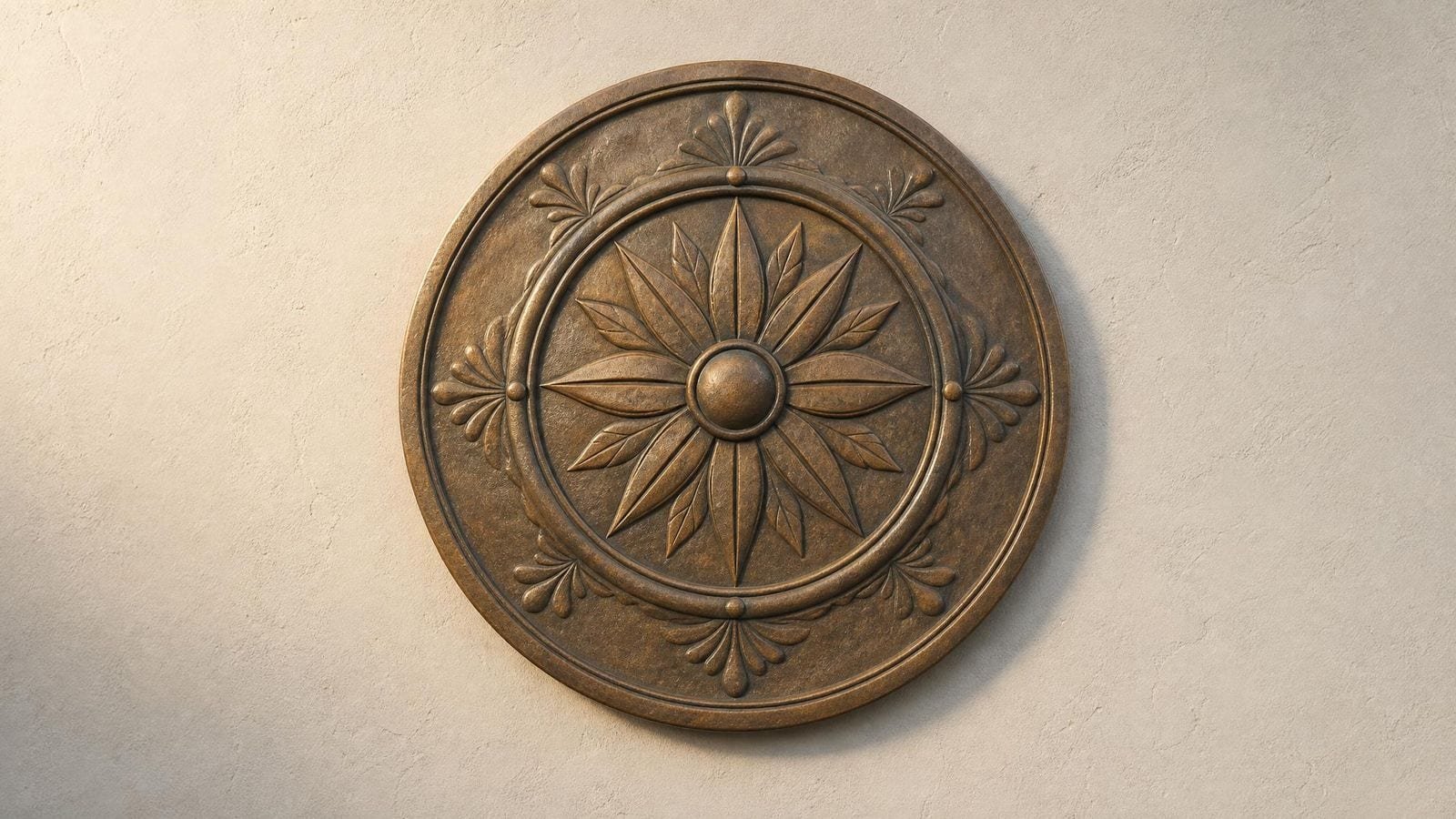
As an emblem the three rings want equal size at 120°. Centre them on the artwork and check the six crossings weave over-under-over consistently.
The Borromean overlay draws the three equal rings in their symmetric arrangement and marks the six crossings where the weave alternates. Because the three centres sit on one equilateral triangle, the layout is fixed by the size and position alone — the only real decision is the over-under pattern at the crossings.
In Grid Maker Pro the rings can be shown as outlines for construction or as woven bands for a finished mark, with the crossings highlighted to keep the weave honest. Line weight, colour, and rotation are adjustable. Build the figure on a blank canvas, or lay it over a design to confirm you have a true Borromean link rather than a pairwise-linked chain.
The Borromean rings are the canonical Brunnian link — connected as a trio, unlinked in every pair:
3 rings · no two linked · D3 symmetry · impossible with true circles
Three properties define it:
The overlay lays out the symmetric framework for you. Open it in the live tool and set the crossings.
A Renaissance heraldic device. The name comes from the Borromeo family of 15th-century Italy, who bore three interlinked rings in their arms. That coat of arms is the figure's best-documented historical anchor, traced in Cromwell, Beltrami and Rampichini's history of the rings.3
Genuine, deep topology. As a Brunnian link the figure is a real object of mathematics, studied rigorously rather than mystically — its impossibility with true circles is a theorem, not a metaphor.24
A living modern symbol. The rings recur across very different fields — the Ballantine beer logo, Jacques Lacan's psychoanalytic knot, and, remarkably, a 2004 synthesis of molecular Borromean rings reported in Science. The figure is genuinely useful, not merely decorative.6
"An ancient universal symbol of unity." Three-ring motifs are old and the unity reading is real, but the precise Borromean topology and the name are best documented from the Renaissance on. Treating it as one timeless, worldwide symbol smooths over a messier record.3
"The Norse rings are the same figure." The Norse Valknut is three interlocked triangles, related in spirit but not the same object, and not always in true Brunnian form. The resemblance is loose, as the structural literature is careful to note.2
"Any three overlapping rings will do." Most casual drawings are actually pairwise-linked chains, not Borromean links. The distinction is exact, and getting it wrong is the commonest error — a point Miranda Lundy's brief treatment underlines for the general reader.7
| If you want to... | Use the Borromean rings | Don't use it for... | Difficulty |
|---|---|---|---|
| Symbolise three things inseparable as a whole | The Brunnian link says "all together or none" exactly | Two-part or hierarchical relationships | Intermediate |
| Design a three-fold logo with hidden depth | The D3 symmetry reads clean; the topology rewards a closer look | A mark that must work as a flat silhouette | Intermediate |
| Teach Brunnian links and topology | The clearest worked example there is | Lessons on ratio or proportion (use the φ grid) | Advanced |
| Set a true three-ring tattoo or emblem | Overlay keeps the weave Borromean, not a chain | Simple overlapping-circle decoration (just draw circles) | Intermediate |
| Model interdependence in a diagram | Removing one ring visibly frees the others | Independent or one-way dependencies | Beginner |
Six settings for the three rings — with an honest note on date and structure.
The figure's namesake and best-documented anchor — three interlinked rings borne by the Borromeo family of the Italian Renaissance.
The theorem that true round circles can't link this way — which is why honest models lean slightly elliptical.
Jacques Lacan used the rings for the Real, Symbolic, and Imaginary — three orders that hold only together. A documented modern adoption.
A real molecule built as three interlocked rings — topology made matter, reported by Stoddart's group.
Three rings in a row are pairwise-linked, not Borromean — the most frequent mistake, shown here so you can spot it.
From the Ballantine rings to countless brands, the three-ring mark reads as unity — best when the weave is genuinely Borromean.
If two of the rings are directly linked, the figure is a chain — the defining "no two linked" property is gone.
If the crossings don't alternate cleanly, the link is either a chain or simply falls apart, even though it looks plausible.
A true physical model can't use three flat circles — forcing perfect circles produces a figure that won't actually hold.
Presenting the rings as a single ancient worldwide symbol overstates a record whose firmest anchor is Renaissance heraldry.
The three-ring tattoo usually means "three inseparable" — partners, children, ideals — so the Borromean property is the whole point. Drop the overlay on the placement, set the six crossings to alternate, and the rings read as genuinely interdependent rather than a chain. It is worth telling the client the figure can't be three perfect circles in the round; a slight ellipse is the honest, correct form.
As a logo the rings carry an idea most marks can't: a unity that depends on all parts at once. Use the overlay as a construction layer to keep the weave Borromean, then style the bands. The hidden topology is a gift for brand storytelling — "remove any one and it all comes apart" is a line that happens to be literally true.
In metal the rings have to physically hold without being soldered into a chain, so the construction is the design. The overlay gives the exact ring positions and crossing order, and the unavoidable slight ellipse becomes a making decision rather than a surprise. Get it right and the piece demonstrates the topology in the hand.
The Borromean rings are the friendliest doorway into knot theory: students can see the Brunnian property by covering a ring with a finger, and the "impossible with circles" theorem turns a doodle into real mathematics. Pair it with the chain lookalike and you have a complete lesson in what "linked" actually means.
"Symmetry, as wide or as narrow as you may define its meaning, is one idea by which man through the ages has tried to comprehend and create order, beauty, and perfection."
Hermann Weyl, Symmetry (1952)8

Illustrative composites of how the tool gets used in practice — not quotes from named individuals.
A family wanted three rings that mean "none of us without the others." I show them the Brunnian property on screen — cover one, the rest let go — and we ink the real thing, not a chain.
For a partnership logo the topology was the brief: remove any partner and it falls apart. The overlay kept my weave Borromean so the story was literally true.
In silver the rings can't be soldered or it's a chain. I set the positions and the slight ellipse from the overlay, and the piece actually holds the way the topology says it should.
Drop a reference image. The Borromean rings overlay applies in one click. Free, in your browser.
Launch Grid Maker Pro →You can use the Borromean Rings overlay here for nothing, today and always. What a browser still can't do is get the picture itself onto paper — that needs a camera. The Grid Maker Pro AR app floats your reference over the real page through your phone so you trace the outlines straight onto the surface, then build on them with the same overlays you use here.
Get the AR tracing app → Free web tool, free forever · AR tracing is the separate paid app