Free Torus Field Grid Generator
Draw the torus field diagram instantly with our 100% free grid generator. Set nested rings and radial spokes with counts and spacing you control over any canvas or image, then export SVG or 600 DPI for print and meditation art in seconds. No signup, no downloads needed. Trusted by 60,000+ artists worldwide.
Nested rings around a common axis
Concentric ellipses stacked to describe a torus in two dimensions, with the flow lines that indicate its circulation. A sectional diagram rather than a rendering.
4 controls, not a fixed picture
Set size, rings, spokes and construction step. Every one is live on the canvas.
Stacks with sacred geometry & pattern
Overlays combine, each carrying its own transform, so this one can sit under or over flower of life, sri yantra and metatron’s cube, and 15 more in the same set.
Smooth curves at any size
Many nested curves are exactly where raster stepping becomes visible; SVG keeps each an exact path. Up to 600 DPI in PNG, JPG or PDF.
| Ctrl + Z | Undo |
| Ctrl + Y | Redo |
| Esc | Deselect overlay |
| Alt + drag | Free positioning (no snap) |
| Ctrl + scroll | Zoom canvas |
| Ctrl + P | |
| ? | Show this help |
Concentric ellipses from the hole out to the rim, crossed by spokes — a diagram of a doughnut seen from about twenty degrees above its plane, with both counts in your hands.
The torus field generator draws one of the 82 composition overlays in Grid Maker Pro, and the rest stack on the same image.
- Rings + spokes
- Foreshortened 0.36
- SVG + 600 DPI export
- Nothing uploaded
What is the torus field?
The torus field generator is a free browser tool that draws the torus as a flat diagram: a set of concentric ellipses running from the inner hole out to the outer rim, crossed by radial spokes. Two controls set how many of each. Every ellipse is squashed vertically to 0.36 of its width, which reads as a viewpoint roughly 21° above the plane of the ring. The innermost ellipse is at 0.13 of the figure's radius and the outermost at 0.97, so the whole diagram fills the space it is given.

How to draw a torus field diagram
Rings and spokes in whatever counts you set, arranged as the sectioned field diagram. Two numbers decide the whole figure, and both stay adjustable.
Set the rings
Rings describe the torus's cross-section: at a low count the figure reads as a clean schematic, at a high one as a field. This is the control that decides whether the diagram is a shape or a texture.
JPG · PNG · GIF · WEBP
Set the spokes
Spokes run from the inner bound to the outer at equal angles, which is what makes the ring read as a surface rather than as a set of unrelated ovals. They are independent of the ring count.
Size · Rings · Spokes
Place it, then export
Drag, scale and rotate the diagram over your artwork or work on a blank canvas at your paper size. Export SVG for a plotter or cutter, or a raster at up to 600 DPI.
PNG · JPG · PDF · SVG · up to 600 DPI
Three steps, about a minute. No signup, no upload.
What the Torus Field Generator does
Rings from hole to rim
The torus field draws its innermost ellipse at 0.13 of the radius and its outermost at 0.97, with the intermediate rings spaced by a cosine so they crowd toward the rim exactly as a real torus's cross-sections do.
Spokes make it a surface
Without them the rings are a set of nested ovals. With them the eye reads a ring seen at an angle. The count is independent, so you can have many rings and few spokes or the other way round.
One consistent viewpoint
Every ellipse is squashed to the same 0.36 of its width, which corresponds to looking down on the ring from about 21 degrees above its plane. Mixed foreshortening is the thing that makes a hand-drawn torus look broken.
Readable over anything
A dense torus is a lot of ink. Per-overlay colour and opacity, and an eyedropper that samples the image, keep the diagram legible over a photograph rather than sitting on top of it.
Over your own work
It has its own transform, so the diagram can be rotated onto an object in a photograph or scaled into a layout without disturbing what is beneath it.
Vector out
SVG export keeps every ellipse as a true curve rather than resampling it, which matters for a figure made entirely of concentric arcs. Raster export goes to 600 DPI at your paper size.
Torus field examples: four ways the diagram reads
Torus field vs a downloaded torus graphic vs a 3D modelling program
| Option | Consistent foreshortening | Ring and spoke counts separate | Vector export | Cost |
|---|---|---|---|---|
| Grid Maker Prothis tool | Yesone factor for every ellipse | Yesindependent controls | SVG + raster to 600 DPI | Free |
| A downloaded torus graphic | Usually | Fixed by the file | Sometimes | Free or paid |
| A 3D modelling program | Yesand true perspective | Yes | Yes | Time, or a subscription |
| Drawing it by hand | Rarely — the outer ellipse flattens | Yes | No | Time |
Who the torus field is for: anything with a hole and a circulation
How the torus field works — A ring seen at an angle, how the spacing is computed, and what the diagram does not claim
The torus is the most-invoked and least-defined of the 82 composition overlays. This overlay draws a specific, ordinary thing: a schematic of a ring surface seen from above its plane. Here is exactly how it is built, and what that does and does not license you to say about it.
A torus is a doughnut: the surface you get by sweeping a circle around an axis that does not pass through it. It has two radii — the major one from the axis to the circle's centre, and the minor one of the circle itself — and everything about its shape follows from their ratio.
This overlay draws it as concentric ellipses. The outer ellipse is at the major plus the minor radius, the inner one at the major minus the minor — the rim and the hole — and the rings between them are spaced by a cosine, which is what makes them crowd toward the outer edge instead of sitting at even intervals. That crowding is not decoration; it is what the cross-sections of a real torus do when projected.
It is a ring drawn as contour lines. Everything else attached to the word is somebody else's addition.
Foreshortening is what makes it read
Every ellipse is squashed vertically to 0.36 of its width, and every one uses the same factor. That single number is the viewpoint: 0.36 is the sine of about 21 degrees, so the diagram is drawn as if you were looking down on the ring from a little over twenty degrees above its plane.
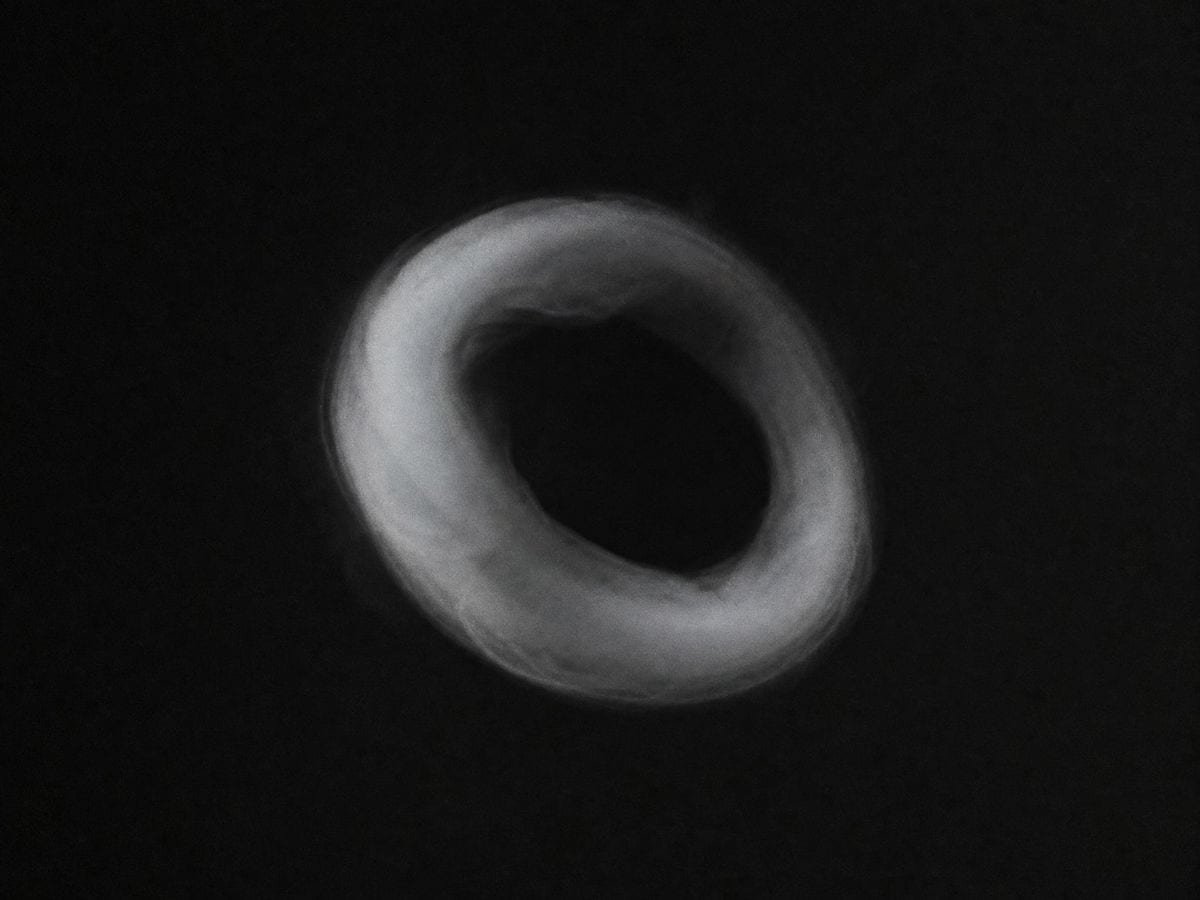
Keeping it constant is the whole trick. When a torus is drawn by hand the foreshortening usually drifts — the outer ellipse gets drawn flatter than the inner ones because it is bigger and the hand tires of the curve — and the result reads as a broken object rather than a ring. Every ellipse here shares the factor, so the surface stays coherent however many rings you ask for.
Rings and spokes do different jobs
Rings describe the cross-section. A handful gives you a clean schematic that reads instantly as a torus; many gives you a field, where the eye stops counting and starts seeing a continuous surface. That is the choice the control is really offering — diagram or texture.
Spokes describe the sweep. They run from the inner bound to the outer at equal angles, and without them the rings are just nested ovals with no reason to be related. Two or three spokes are enough to establish the surface; a dozen makes it a wireframe. The counts are independent, and the most readable diagrams usually have more rings than spokes.
What the word carries, and what the geometry does
The torus is a real and important surface. It is the shape of a magnetic field around a current loop, of a smoke ring, of the plasma confinement in a tokamak, and it is a standard object in topology — the surface of genus one, the first thing after a sphere. All of that is well documented and none of it is in dispute.
The torus field overlay page separates the two, beside the rest of the other sacred-geometry figures. What is added in the sacred-geometry literature — that the torus is the fundamental pattern of energy in living systems, that human hearts or auras generate toroidal fields with the properties claimed — is not supported by the physics it borrows its vocabulary from. The magnetic field of a current loop is toroidal because of Ampère's law; that fact does not extend to the claims built on top of it.
This page draws the diagram and stops there. The figure is genuinely useful as an illustration — for a field around a loop, for a flow that returns on itself, for anything with a hole in the middle and a circulation around it — and it does not need the additional claims to earn its place.
Using it as an illustration
For a flat ring diagram rather than a surface, the polar grid generator is the measured version, and the radial grid tool the ornamental one. For technical figures, keep the rings low and the spokes lower. Three or four rings and three spokes reads as a torus at a glance and leaves room for labels; anything denser competes with the annotation you are adding. Then export SVG so the figure can be dropped into a document and scaled without the curves degrading.
For decorative or pattern work the opposite applies — push both counts up until the surface becomes a moiré, which is where the figure stops being a diagram and starts being an image. Because both counts are independent, the interference pattern between them is controllable, which is a genuinely useful thing to have on a slider.
The ratio this overlay fixes, and what it would change
A torus is defined by two radii, and their ratio is the whole of its character. This overlay fixes them: the major radius is 0.55 of the figure's size and the minor is 0.42, which puts the hole at 0.13 and the rim at 0.97. That gives a fairly fat ring with a small hole — the proportions of a bagel rather than a hoop.
It is worth knowing that this is a fixed choice rather than a property of tori in general. Push the minor radius toward the major and the hole closes entirely, giving a horn torus whose inner surface meets itself at a point. Push it further and you get a self-intersecting spindle torus. Pull it the other way and you approach a thin ring, which is what most field diagrams in physics actually depict.
For most illustration the fixed ratio is what you want, because it reads unambiguously as a torus at any size and needs no explanation. Where it matters is if you are illustrating a specific physical case — a thin current loop, whose field is a far slenderer ring than this. There the honest options are to note the schematic nature of the figure in your caption, or to draw that case in a modelling tool. This page says so plainly rather than letting a fixed proportion be read as a measurement of anything.
One last practical note. Because every ring shares the same foreshortening, the diagram scales cleanly — doubling the size doubles every radius and leaves the apparent viewpoint untouched. That is worth knowing if you are producing a figure at two sizes for print and screen, since it means one export can be scaled rather than two being drawn.
Where the torus field gets used

Field diagrams. Three rings and three spokes, exported as vector, dropped into the document and labelled. It is a five-minute figure instead of an hour in a drawing program.
I push both counts high and use the moiré as a texture. Having the two independent is what makes the interference controllable.
It is the clearest way I have found to show what a surface of genus one is. Students see the hole and the sweep in one figure.
Torus field: frequently asked questions
The geometry
What exactly does this draw?
Concentric ellipses from the torus's inner hole out to its outer rim, crossed by radial spokes. The rings are spaced by a cosine so they crowd toward the rim, which is what a real torus's cross-sections do when projected rather than an aesthetic choice.
What is the foreshortening?
Every ellipse is squashed vertically to 0.36 of its width, and every one uses the same factor. That corresponds to viewing the ring from about 21 degrees above its plane. Keeping it constant is what stops the surface reading as broken.
Why do hand-drawn tori look wrong?
Because the foreshortening drifts. The outer ellipse gets drawn flatter than the inner ones, since it is larger and the hand tires of the curve, and the object stops being coherent. Every ellipse here shares one factor.
Is the torus scientifically significant?
Genuinely, yes. It is the shape of the magnetic field around a current loop, of a smoke ring, of tokamak plasma confinement, and it is the standard first example of a surface of genus one in topology. All of that is well documented.
What about the claims that it is the pattern of energy in living systems?
Those are not supported by the physics the vocabulary is borrowed from. A current loop's field is toroidal because of Ampère's law; that does not extend to the claims built on top of it. This page draws the diagram and stops there — the figure is useful without them.
Can I make it dense enough to use as a texture?
Yes. Push both counts up and the rings and spokes interfere into a moiré. Because the counts are independent, the interference is controllable, which is more useful than it sounds if you are making surface pattern.
Can I place it over a photograph?
Yes. The overlay carries its own transform, so drag, scale and rotate it over an object without moving the image beneath, and drop the opacity so the diagram sits in the picture rather than on it.
Using it
How do I make it dense enough to use as a texture?
Raise both counts together. Rings and spokes are set independently, and pushing one alone gives a striped field rather than a woven one — the mesh reads as a surface only when the two spacings are close to each other at the rim.
Why do the rings crowd together at the rim?
Because every ring is a circle seen at an angle, and the foreshortening compresses them as they approach the outer edge. That crowding is what makes the diagram read as a three-dimensional surface rather than as a flat target — it is the drawing being right, not a spacing error.
Export and print
Can I export it as an SVG?
Yes, and for this figure it matters. It is made entirely of concentric arcs, and vector export keeps them as true curves rather than resampling. Raster export goes to 600 DPI at your chosen paper size.
What do I export for a presentation slide?
The grid alone as a transparent PNG, so the diagram sits on whatever background the deck uses. SVG instead if the slide gets projected large. Concentric ellipses show faceting quickly when a raster is scaled up.
Choosing a grid
What is the difference between the rings and the spokes?
Rings describe the cross-section; spokes describe the sweep. Without spokes the rings are just nested ovals. The counts are independent, and the most readable diagrams usually have more rings than spokes.
Should I use 3D software for a torus instead?
If you need it lit, shaded or rotated, yes. This draws the flat wireframe diagram — the conventional way a torus is shown in a book — at a fixed foreshortening, which is faster and is what most illustrations of the shape actually are.
Practical matters
Does my image get uploaded?
No. Everything happens in your browser — the image is drawn to a canvas on your own device and never sent anywhere.
Are the claims about torus energy fields scientific?
No. The torus is a real and important shape in mathematics and physics — magnetic fields around a current loop genuinely are toroidal — but the broader claims about it being the pattern of energy in living systems or consciousness have no evidence behind them. The geometry is sound; treat the metaphysics as metaphysics.
Can I use it in a physics or maths lesson?
Yes, and the foreshortening is worth pointing at — every ellipse here is a circle seen at an angle, which is the whole reason a hand-drawn torus looks wrong. Nothing is metered and no account is needed.
Open the tool Torus field generator
Rings and spokes, one viewpoint
The torus field takes two counts. Set them, place the figure on your own page, and export vector or 600 DPI. No signup, nothing uploaded.
Back to the generator →