
Free Tartan Grid Generator
Design tartan grid setts instantly with our 100% free generator. Set unevenly spaced bands at two line weights with an optional fill, adjustable density and contrast for plaid and weaving work, then export SVG or 600 DPI in seconds. No signup, no downloads needed. Trusted by 60,000+ artists worldwide.
A sett, repeated both ways
Bands of stated widths in a repeating sequence, run identically in warp and weft so the pattern crosses itself. That symmetry is what makes a tartan a tartan rather than a plaid.
3 controls, not a fixed picture
Set band density, contrast and fill alternating bands. Every one is live on the canvas.
Stacks with lattices & pattern
Overlays combine, each carrying its own transform, so this one can sit under or over hexagonal, dot grid and triangular, and 4 more in the same set.
A repeat that actually repeats
The sett is computed, so tiled exports align edge to edge. SVG for textile and cutting work, raster to 600 DPI for print.
| Ctrl + Z | Undo |
| Ctrl + Y | Redo |
| Esc | Deselect overlay |
| Alt + drag | Free positioning (no snap) |
| Ctrl + scroll | Zoom canvas |
| Ctrl + P | |
| ? | Show this help |
A grid with a rhythm instead of a spacing: wide and narrow bands in both directions, every third line heavier, and the two emphasis sets offset from each other on purpose.
The tartan grid generator draws one of the 82 composition overlays in Grid Maker Pro, and the rest stack on the same image.
- 5–16 bands
- 1.6× / 0.8× weights
- SVG + 600 DPI export
- Nothing uploaded
What is a tartan grid?
The tartan grid generator is a free browser tool that draws a tartan-style band grid: lines at deliberately uneven spacing in both directions, with every third one stroked at 1.6× and the rest at 0.8×, plus optional filled bands. Density and contrast are adjustable. It draws over your own layout or photograph, exports SVG and raster to 600 DPI, and never uploads anything.

How to use the tartan grid
Bands of uneven width crossing at right angles, which is what separates a tartan from a check. Set the rhythm, then print the sett at size.
Set the band density
A tartan grid takes five to sixteen bands in each direction. Below about eight the pattern reads as a few strong lines; above twelve it reads as a texture. The interesting range for layout work is the middle.
JPG · PNG · GIF · WEBP
Set the contrast
Contrast controls both the line weights and the fill strength together, from 20% to 100%. At low contrast the grid is a faint suggestion of rhythm; at full contrast it is the dominant structure on the page.
Band density · Contrast · Fill alternating bands
Decide about the fills, then export
Filled bands at low alpha give the woven look and make the wide bands read as areas rather than as gaps between lines. Export SVG or a raster up to 600 DPI sized to your paper.
PNG · JPG · PDF · SVG · up to 600 DPI
Three steps, about a minute. No signup, no upload.
What the Tartan Grid Generator does
A rhythm, not a spacing
A tartan grid has several intervals where an even grid has one, arranged arranged so no two adjacent gaps are the same. That turns the grid from a measuring device into a pattern, which is a different tool for a different job.
Two weights, every third line
Every third line is stroked at 1.6× and the rest at 0.8× — a two-to-one difference. That is what makes the pattern legible as a repeating sett rather than as a random scatter of lines.
Offset emphasis
The heavy verticals fall on indices 0, 3, 6 and the heavy horizontals on 1, 4, 7 — offset by one. That asymmetry is deliberate: aligned emphasis would produce a regular lattice of crossings and lose the woven quality.
Bands you can fill
Filled at low alpha, the wide bands read as areas rather than as the space between lines. That is the difference between a grid drawn over a subject and a pattern the subject sits inside.
Over your own image
Lay it on a photograph of a woven cloth and adjust the density until the bands line up. Recovering a sett's rhythm from a sample is faster than counting threads, though it will not give you a historical pattern.
Vector out
SVG keeps both line weights and the fills, so the pattern goes into a vector application with its hierarchy intact. Raster export runs to 600 DPI, sized from the paper format.
Tartan grid examples: four ways the tartan grid reads
Tartan grid vs a registered tartan sett vs setting guides by hand
| Option | Uneven spacing | Two line weights | Vector export | Cost |
|---|---|---|---|---|
| Grid Maker Prothis tool | Yesdeterministic | 1.6× and 0.8× | SVG + raster to 600 DPI | Free |
| A registered tartan sett | Yesand symmetric | By colour, not weight | Depends | Free to look up |
| Setting guides by hand | Yes | Yes | Yes | Time |
| An even grid with some lines deleted | Approximately | Manual | Yes | Free |
Who a tartan grid is for: structures with a rhythm
How it works — The tartan grid: uneven on purpose, in cloth and in architecture
Nearly every one of the 82 composition overlays is an argument for regularity. The tartan grid is the exception: its whole content is that the intervals are different from each other, and both of the traditions that use it depend on that difference.
Start with what makes it a grid at all. Two families of parallel lines, crossing at right angles. So far, a square grid. The difference is that the spacing between adjacent lines varies, in a pattern that repeats, and the lines carry two different weights.
The sett
In weaving, that arrangement has a name: the sett. It is the sequence of colours and thread counts that defines a tartan, and because the same sequence is used in both warp and weft, the cloth produces the characteristic squares where each colour crosses itself and blended rectangles where two colours cross.
A real sett is symmetric. It runs out from a pivot point, reflects, and repeats — which is why an authentic tartan has mirror symmetry through certain lines and why the pattern looks the same approached from either direction.
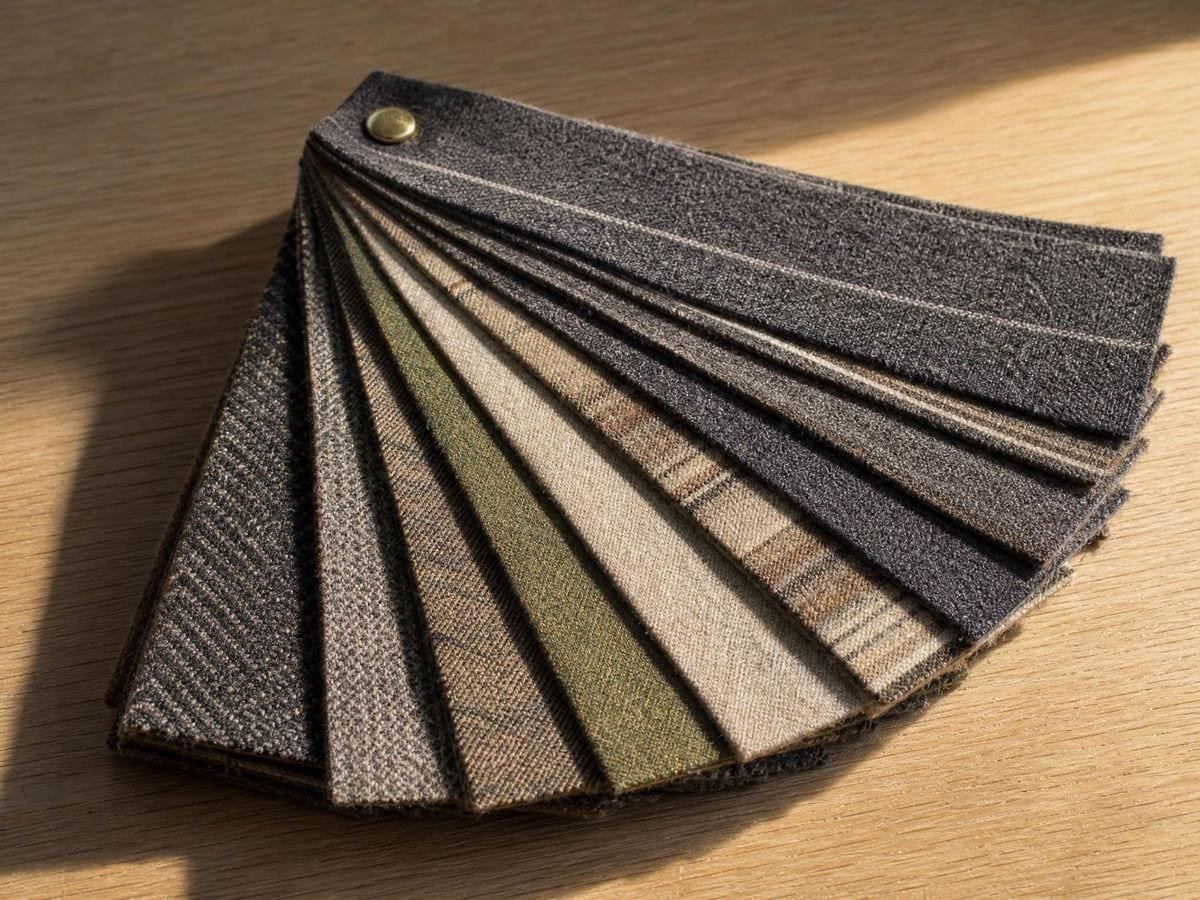
How this overlay differs from a real sett
This overlay does not do that, and the distinction is worth being clear about. The band positions here come from an even division with a deterministic wobble applied — a sine displacement of up to 1.8% of the dimension, which shifts each band off its even position by a different, repeatable amount.
To anyone who knows the weave, the result reads as an irregular sett and is not one. It gives you the visual character of tartan — uneven bands with a repeating weight pattern — without reproducing any historical sett, and it has no mirror symmetry. For layout and composition work that is exactly what is wanted. For reproducing a specific clan tartan it is not the tool.
The weight pattern
The weight pattern is where the structure lives. Every third line is stroked at 1.6 times the base width and the others at 0.8 — a two-to-one ratio. That regular emphasis over irregular spacing is what makes the pattern read as a system rather than as noise.
There is a detail in that emphasis worth noticing. The heavy verticals fall on indices 0, 3 and 6; the heavy horizontals fall on 1, 4 and 7. They are offset by one, which means the crossings of two heavy lines do not form a regular lattice.
That is deliberate. If both families put their heavy lines at the same indices, the heavy crossings would line up into an obvious sub-grid and the pattern would resolve into a plain grid with decoration. Offsetting them keeps the eye from finding that sub-grid, which is a large part of why woven patterns feel woven.
Contrast controls both the weights and the fill strength together, and it does so multiplicatively — at 20% the heavy lines are barely heavier than the light ones and the fills are almost invisible, so the whole pattern flattens toward an even grid. At 100% the hierarchy is at full strength.
That coupling is useful because the two would otherwise need balancing by hand. A pattern with strong fills and weak lines looks unresolved; so does the reverse. Tying them to one control keeps them in proportion.
Tartan grids in architecture
The tartan grid overlay page covers both traditions, beside the rest of the architecture grid overlays. The other tradition that uses this grid is architecture, and it arrived independently. A tartan grid in planning is one where wide bands alternate with narrow ones, the wide bands carrying the served space and the narrow ones carrying structure, services and circulation.
Louis Kahn's distinction between served and servant space is the clearest statement of the idea, and the Richards Medical Research Laboratories in Philadelphia — completed in 1960 — is its most literal demonstration: laboratory floors served by separate towers carrying stairs, ducts and extract.
The planning advantage is real. Putting services in a dedicated narrow band means they can be reached without disturbing the served space, and it means a building's servicing can be replaced on a different cycle from its structure. Both matter enormously over a building's life.
The same pattern turns up in laboratory and hospital planning as standard practice, in office buildings where a service band runs behind a column line, and in housing where wet rooms are stacked into a narrow zone. In each case the narrow band is doing the difficult work and the wide band gets the light.
Uneven grids in layout
For graphic layout, an uneven grid is a way of building rhythm into a page structurally rather than by placement. Alternating wide and narrow columns produces a page where the reader's eye has somewhere to rest, which an evenly divided page does not.
That is most useful in editorial work where one column carries running text and its neighbour carries captions, marginal notes or images. Making those columns different widths states the difference in role before anything is read.
For an even grid the rectangular grid tool is the tool, and for the structural version the structural grid generator. For textile and craft work, the overlay is a design aid rather than a reproduction tool. It gives you a band structure you can colour, and the density control sets how many bands you are working with. Reproducing an existing tartan needs the actual thread counts, which are published for registered setts.
Reading woven cloth, and moiré
Laying it over a photograph of woven cloth is a reasonable way to read the rhythm of a sample — how many bands, roughly what proportions — even though it will not give you the exact counts. For a designer working from a photograph rather than a sample, that is often enough.
The band positions are fully deterministic: the same density always produces the same positions, and the sine phase differs between the two directions by a fixed amount. So a pattern you set up today reproduces exactly tomorrow, which matters if the overlay is part of a workflow rather than a one-off.
A moiré caution applies here as it does to any fine grid over a photograph. Uneven bands over a woven or printed texture at a similar scale will beat against it. Changing the density by one usually clears it.
The grid draws over your own image rather than exporting a fixed template because the alignment is the decision. Where the wide bands fall relative to your subject is what makes the pattern work or not, and that cannot be judged on a blank sheet.
The export sizes itself from the paper format and the DPI you choose rather than from your screen. SVG keeps both line weights and the fills, so the hierarchy survives into a vector application.
Everything runs in your browser. Images you load are never uploaded, because there is no server for them to reach. The drawing, the transform and the export all happen on your own machine.
Where a tartan grid gets used
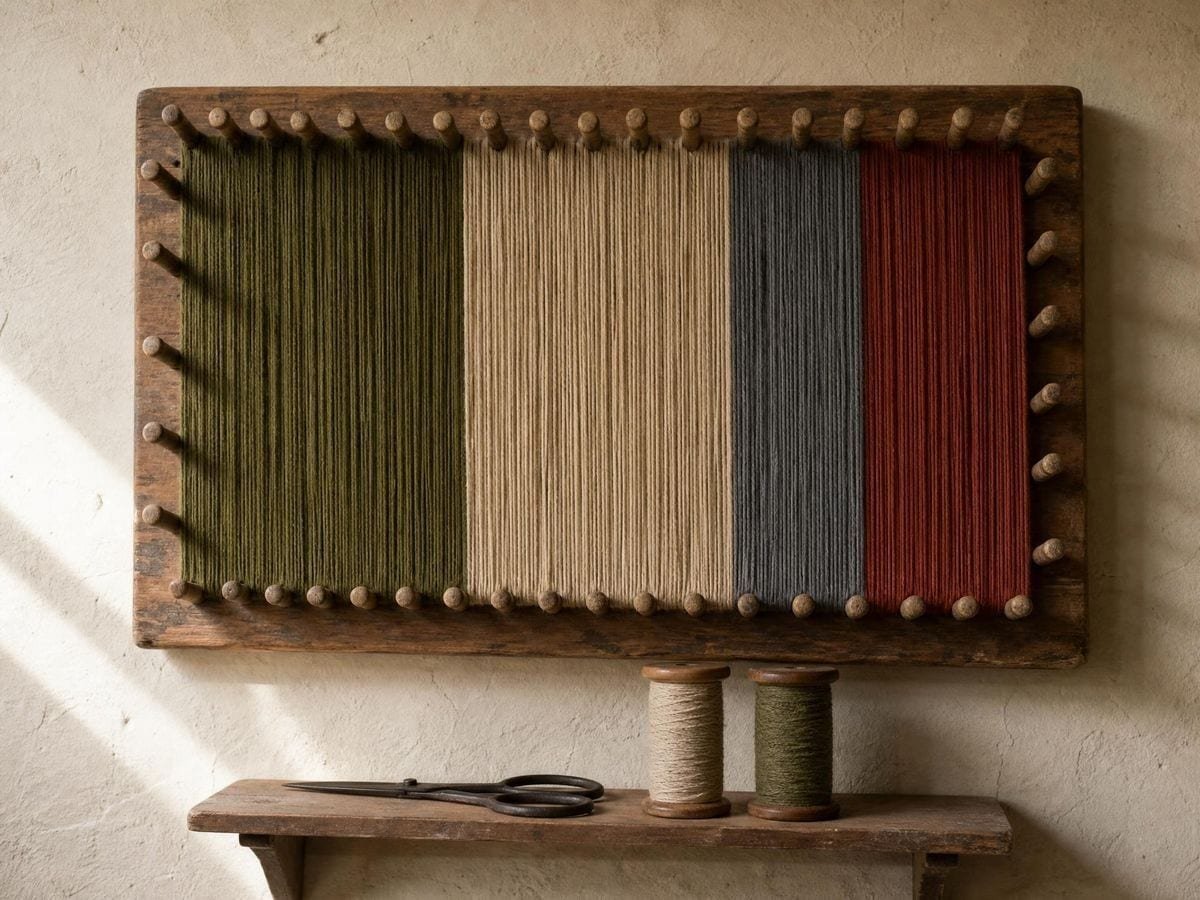
Wide bands for the laboratory, narrow bands for the services. You can replace the servicing without touching the served space, which is the whole point.
Uneven columns state the difference in role before anything is read. Running text and marginal notes should not be the same width.
For design work it is ideal. For reproducing a registered sett you need the published thread counts, and no overlay will give you those.
Tartan grid: frequently asked questions
The geometry
Is this an authentic tartan sett?
No, and the distinction matters. A real sett is symmetric — it runs out from a pivot, reflects and repeats. The band positions here come from an even division with a deterministic sine wobble of up to 1.8%, which reads as an irregular sett but has no mirror symmetry and reproduces no historical pattern.
So what is it good for?
Design work: layout, composition, pattern development, and any case where you want the character of an uneven band structure. For reproducing a specific clan tartan you need the published thread counts of the registered sett, which no overlay can supply.
What makes the pattern read as a system rather than as noise?
The weight pattern. Every third line is stroked at 1.6× the base width and the others at 0.8× — a two-to-one difference — so a regular emphasis runs across irregular spacing.
Why are the heavy verticals and horizontals offset?
Deliberately. The heavy verticals fall on indices 0, 3, 6 and the heavy horizontals on 1, 4, 7. If both used the same indices, the heavy crossings would line up into an obvious sub-grid and the pattern would resolve into a plain grid with decoration. Offsetting them is a large part of why woven patterns feel woven.
What is a tartan grid in architecture?
A plan where wide bands alternate with narrow ones — the wide carrying served space and the narrow carrying structure, services and circulation. Louis Kahn's served-and-servant distinction is the clearest statement, and the Richards Medical Research Laboratories of 1960 its most literal demonstration.
Why is that useful in a building?
Services in a dedicated narrow band are reached without disturbing the served space, and replaced on a different cycle from the structure. Both matter enormously over a building's life, which is why the pattern is standard in laboratory and hospital planning.
Are the band positions repeatable?
Yes. The positions are fully deterministic — the same density always gives the same positions, with a fixed phase difference between the two directions — so a setup made today reproduces exactly tomorrow.
I am getting interference over a photograph. What do I do?
Moiré. Fine uneven bands over a woven or printed texture at a similar scale beat against it. Changing the density by one usually clears it.
Using it
What does contrast control?
Both the line weights and the fill strength, together and multiplicatively. At 20% the heavy lines are barely heavier and the fills nearly invisible, so the pattern flattens toward an even grid. Coupling them keeps the two in proportion, which they otherwise need balancing by hand.
Export and print
Can I export a sett to weave or print from?
The band structure exports — SVG for a vector workflow, a raster to 600 DPI for print. Treat it as a design starting point rather than as a weaving draft. It has no thread counts and no colour sequence, which is what an actual sett is made of.
Does the alternating fill survive export?
Yes, in every raster format and in SVG, where the filled bands come across as filled shapes rather than as a screened approximation. If you want the bands without the fill, switch it off before exporting rather than trying to remove it afterwards.
Choosing a grid
Why not just delete lines from an even grid?
Because that chooses the gaps by eye, and eyes are bad at uneven-but-systematic. The uneven spacing here is generated, so it repeats predictably and reads as a system; hand-deleted lines read as an even grid with mistakes in it, which is a different and worse impression.
Should I use this or a structural grid for a plan?
This, if the plan alternates wide and narrow bays; the structural grid generator if the bays are meant to be equal. Kahn's served-and-servant planning is the classic case for a tartan, and it is a genuinely different diagram, not a decorated version of the same one.
Practical matters
Does anything I load get uploaded?
No. There is no server to upload to. The image is read by your browser, the grid is drawn on your machine, and the export is generated locally.
Is it based on any registered tartan?
No, and it does not stand in for one. It draws a tartan-STYLE band structure — uneven spacing with a repeating emphasis — not the sett of any clan or authority. Registered setts have specific thread counts and colours and are recorded in the Scottish Register of Tartans.
Can I use the pattern commercially?
The geometry here is generic band spacing and carries no restriction from us; exports have no watermark and the terms leave your work yours. Registered tartans are a separate matter and are protected under their own rules — do not assume this output is one.
Open the tool Tartan grid generator
Wide, narrow, wide again
A tartan grid has a rhythm rather than a spacing. Export vector or 600 DPI. No signup, nothing uploaded.
Back to the generator →