Free Yin Yang Grid Generator
Draw the yin yang taijitu from its construction instantly with our 100% free grid generator. Build the S-curve from two exact half-radius arcs, not traced from memory, over any image, then export SVG or 600 DPI for print and design in seconds. No signup, no downloads needed. Trusted by 60,000+ artists worldwide.
One circle, two half-circles
The dividing line is not an S drawn by hand but two semicircles of half the outer radius, joined head to tail. That is what makes the two halves exactly equal in area.
4 controls, not a fixed picture
Set size and construction step, toggle yin/yang dots and boundary circle. Every one is live on the canvas.
Stacks with sacred geometry & pattern
Overlays combine, each carrying its own transform, so this one can sit under or over flower of life, sri yantra and metatron’s cube, and 15 more in the same set.
Curves that stay true
The boundary is circular arcs, so SVG export keeps it smooth at any size. PNG, JPG and PDF up to 600 DPI for print.
| Ctrl + Z | Undo |
| Ctrl + Y | Redo |
| Esc | Deselect overlay |
| Alt + drag | Free positioning (no snap) |
| Ctrl + scroll | Zoom canvas |
| Ctrl + P | |
| ? | Show this help |
The S-curve is not freehand. It is two semicircles of exactly half the outer radius, and the eyes sit at their centres — which is the whole construction, and the thing a drawn version always gets slightly wrong.
The yin yang generator draws one of the 82 composition overlays in Grid Maker Pro, and the rest stack on the same image.
- S-curve at R/2
- Eyes at 0.1R
- SVG + 600 DPI export
- Nothing uploaded
What is a yin yang?
The yin yang generator is a free browser tool that draws the taijitu exactly. The figure is one circle of radius R, divided not by a freehand S but by two semicircles of radius exactly R/2, centred half a radius above and below the middle. Each eye sits at one of those arc centres, at one tenth of the outer radius. The boundary circle and the eyes can each be shown or hidden, and a construction-step control builds the figure up rather than revealing it complete.

How to draw an exact taijitu
One circle, one S-curve through its centre, two smaller circles on the axis. The taijitu drawn to its actual proportions rather than to an approximation of them.
Open the taijitu
The taijitu opens already exact: its dividing curve is two arcs of half the outer radius before you adjust anything, so the two halves are genuinely equal rather than approximately so.
JPG · PNG · GIF · WEBP
Choose what shows
Boundary circle on for the complete symbol, off when it will sit inside something else. Eyes on for the figure, off when you only want the division.
Size · Yin/yang dots · Boundary circle
Place it, then export
Drag, scale and rotate it over your artwork, or work on a blank canvas at your paper size. Export SVG for a cutter or plotter, or a raster at up to 600 DPI.
PNG · JPG · PDF · SVG · up to 600 DPI
Three steps, about a minute. No signup, no upload.
What the Yin Yang Generator does
Two arcs, exactly R/2
The taijitu's dividing curve is two semicircles of exactly half the outer radius, joined at the centre — a construction, not a gesture. The curve most people draw instead is a freehand S that swells or pinches somewhere.
Eyes at the arc centres
Each eye is not placed by eye. It sits exactly at the centre of one of the two half-radius arcs — half a radius from the middle — at one tenth of the outer radius. That is why a correct taijitu looks balanced and a drawn one rarely does.
Two halves, provably equal
Because the construction is symmetric about the centre point, each region is exactly half the circle's area — and each one's perimeter equals the whole circle's circumference. Both facts follow from the arcs being R/2 and neither survives approximation.
Every part optional
Circle, curve and eyes are separate. A carved or cut version usually needs the outline and the curve; a diagram needs all three; a mark inside another shape often needs the circle gone.
Over your own work
Its own transform, so the figure can be rotated onto an object in a photograph or scaled into a layout without disturbing what is underneath.
Vector out
SVG export keeps the arcs as true curves rather than resampling them, which matters for a figure that is nothing but curvature. Raster export goes to 600 DPI at your paper size.
Yin yang examples: four ways the figure reads
Yin yang vs a downloaded yin yang graphic vs compass and straightedge
| Option | S-curve from exact R/2 arcs | Eyes at the arc centres | Vector export | Cost |
|---|---|---|---|---|
| Grid Maker Prothis tool | Yesby construction | Yesat half a radius out | SVG + raster to 600 DPI | Free |
| A downloaded yin yang graphic | Usually, unknown provenance | Usually | Sometimes | Free or paid |
| Compass and straightedge | Yesif the halving is exact | By construction | No | Time |
| Drawing the S freehand | Almost never | Placed by eye, usually too central | No | Time, and a redraw |
Who a yin yang is for: work where the two halves have to be equal
How a yin yang works — Two half-radius arcs, and the two properties that follow from them
The taijitu is the most-drawn symbol among the 82 composition overlays here and the least-constructed. Almost everyone draws the dividing line freehand, which is exactly the step that decides whether the figure is balanced. Here is the construction, and the two measurable consequences it has.
Draw a circle of radius R. Mark the two points half a radius above and half a radius below the centre. From each, draw a semicircle of radius R/2 — one bulging left, one bulging right — so that together they run from the top of the circle to the bottom. That S is the whole division, and it is made of two exact arcs rather than one drawn curve.
Then put an eye at each of those two arc centres. The overlay draws them at one tenth of the outer radius, which is the proportion that reads correctly at most sizes — small enough not to be a third element, large enough to survive at thumbnail scale. Their position, unlike their size, is not a matter of taste: it is where the arcs are centred.
The S is not a brushstroke. It is two circles you are only seeing half of each.
The two halves are exactly equal, and so are their edges
The construction is symmetric under a half-turn about the centre, so the two regions have exactly equal area — each precisely half the circle. That is the property the symbol is about, and it is only true if the arcs are R/2. Make the S bulge a little more and the halves stop being halves; the figure still reads, but it no longer means what it claims.
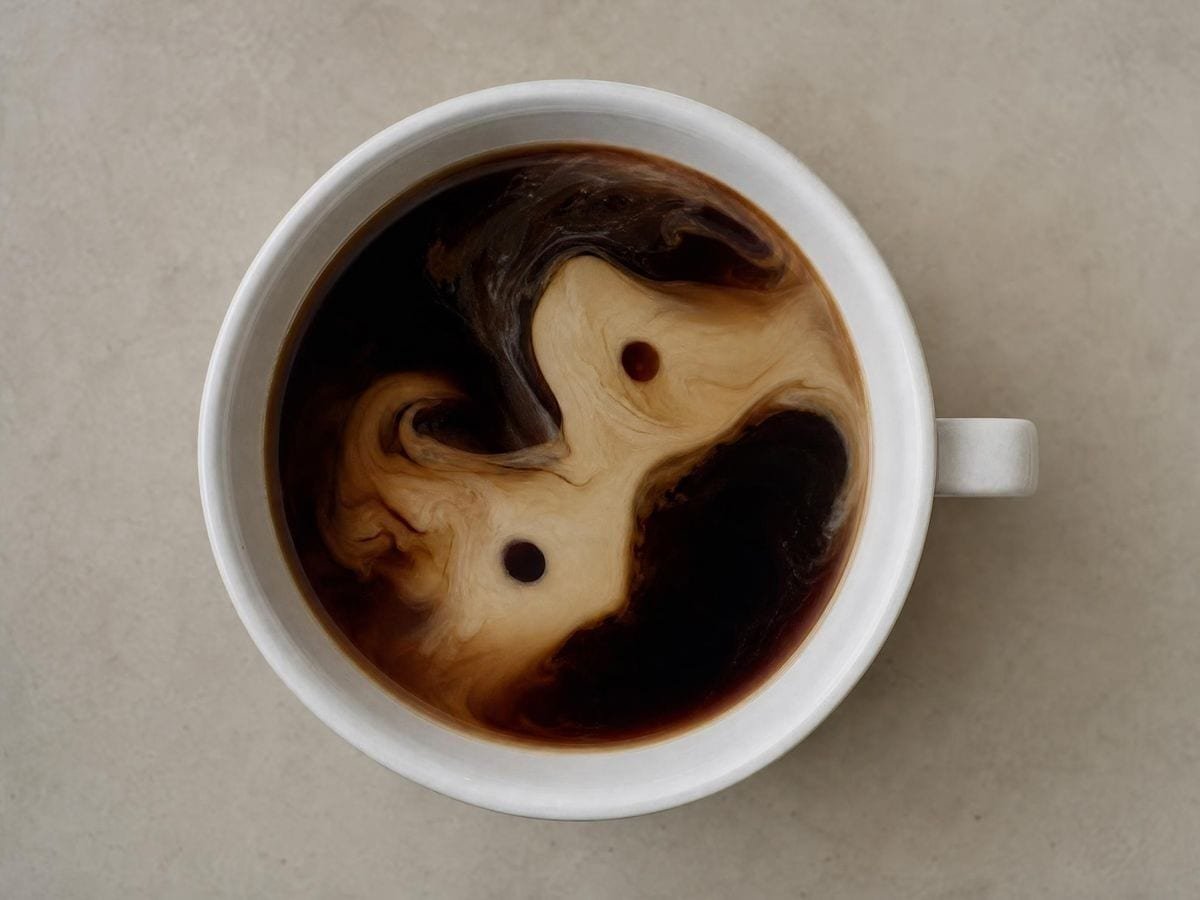
The second consequence is prettier. The S-curve is two semicircles of radius R/2, so its total length is 2 × πR/2 = πR — exactly the length of half the outer circle. Which means each region is bounded by πR of outer circle and πR of S-curve, and its whole perimeter is 2πR: the same as the circumference of the circle that contains it. Each half has the boundary length of the whole.
Why the drawn version always looks slightly off
Because the eye is very good at detecting broken symmetry and very bad at producing it. A freehand S is nearly always steeper at one end, which makes one region visibly fatter at the waist even when the two ends look right. The error is small in absolute terms and obvious once seen, and it is the reason hand-drawn taijitu look homemade in a way that a hand-drawn circle does not.
The eyes compound it. Placed by eye they usually drift toward the centre — the illustrator's instinct is to balance them against the whole figure rather than to place them at the arc centres — and the result reads as slightly crowded. Half a radius out is further than it feels.
What the figure is, historically
The name is taijitu, the diagram of the supreme ultimate, and the graphic is a great deal younger than the idea it stands for. Robin Wang draws the distinction carefully in Yinyang: The Way of Heaven and Earth in Chinese Thought and Culture (Cambridge University Press, 2012): the concept runs through Warring States and Han cosmology, the diagram's ancestors are the layered Song-dynasty Taijitu associated with the 11th-century thinker Zhou Dunyi, and the interlocking form this overlay draws became standard only later, in the Ming. Divided-circle motifs of the same kind appear centuries earlier in Roman ornament, with no line of transmission to the Chinese use.
Which is worth knowing for the same reason it is worth knowing about the hexagram: when a figure turns up in traditions that were never in contact, the explanation is constructional before it is historical. Peter S. Stevens makes the general argument in Handbook of Regular Patterns: An Introduction to Symmetry in Two Dimensions (MIT Press, 1981) — the set of figures a compass and a straightedge produce easily is small, so the same ones surface again and again. This one needs nothing but a compass and one radius halved, which is why the hexagram generator tells the same story about a different shape.
Making things from it
For cut, inlay and carved work, export SVG. The whole figure is arcs, and a raster version of a curve becomes a staircase at any real cutting size — the outline and the S-curve are the two paths a cutter needs, and both come out as true curves.
For inlay in particular, note that the two regions are congruent: each is the other rotated a half turn. One template cuts both pieces, which is a practical consequence of the construction being exact and one you lose the moment the S is drawn freehand.
And use the construction step while you learn it. Circle, two marks at half a radius, two arcs, two eyes — five moves, and after building it twice you will not need the overlay again except to check a drawn one.
The variants people draw, and how to check one
Three failures account for nearly every hand-drawn taijitu. The first is a comma-shaped division, where the curve is drawn as two tapering teardrops rather than as two arcs; it reads as a logo rather than a diagram, and the halves stop being equal. The second is an S drawn as a single sweep, which is almost never symmetric about the centre. The third is arcs of the wrong radius — usually too small, which pinches the waist and leaves the two regions visibly different at their widest points.
To check a drawn one, lay the exact overlay over it at the same outer radius and look at three places rather than at the whole figure: where the curve crosses the vertical axis, and the two points where it meets the outer circle. If all three coincide, the arcs are right. A discrepancy at the crossing but not at the ends means the radius is wrong; a discrepancy at one end only means the S is asymmetric.
The eyes are worth checking separately, because they fail independently. Drop the overlay opacity until only its two eye positions read, and compare. A drawn taijitu almost always has them too close to the centre, and moving them out to the arc centres is usually the single change that makes a wonky one look composed.
Finally, a note on line weight. The figure is usually shown as two filled regions rather than as outlines, and this overlay draws outlines — the circle, the S-curve and the two eyes. That is the right form for a construction you are drawing over or cutting to, and the wrong form for a finished mark. If you want the filled version, export the outlines as SVG and fill the two closed paths in whatever program you are finishing in; the geometry is already correct, and filling is a five-second operation that no overlay needs to do for you.
Where a yin yang gets used
Inlay. The two halves being congruent means one template cuts both pieces, which only works if the arcs are exact.
It is a constant request and the freehand curve always betrays itself. Having the S as two real arcs is the difference between a clean design and one that looks slightly melted.
Showing that the dividing line is the same length as half the circle is the moment the construction stops being decorative for a class.
Yin yang: frequently asked questions
The geometry
How is the S-curve constructed?
From two semicircles of exactly half the outer radius, centred half a radius above and half a radius below the middle. One bulges left and one bulges right, and together they run from the top of the circle to the bottom. It is not a freehand curve.
Where exactly do the eyes go?
At the centres of those two arcs — half a radius above and below the middle. Placed by eye they nearly always drift inward, because half a radius out is further than it feels. The overlay draws them at one tenth of the outer radius.
Are the two halves really equal?
Exactly equal, because the construction is symmetric under a half turn about the centre. That is only true if the arcs are R/2; a slightly fuller S makes one region measurably larger, and the symbol stops meaning what it claims.
Is there anything else measurable in it?
Yes, and it is a nice one. The S-curve is two semicircles of radius R/2, so its length is πR — exactly the length of half the outer circle. Each region is therefore bounded by πR of circle and πR of curve, giving it the same perimeter as the whole circle that contains it.
Why does a hand-drawn one always look slightly wrong?
Because a freehand S is nearly always steeper at one end, which makes one half visibly fatter at the waist even when both ends look right. The eye detects broken symmetry far better than it produces symmetry.
Can I cut both halves from one template?
Yes, and it is the practical payoff of an exact construction. The two regions are congruent — each is the other rotated a half turn — so one template cuts both pieces. That stops being true the moment the curve is freehand.
How old is this form of the symbol?
Younger than the idea it stands for. Robin Wang, in Yinyang: The Way of Heaven and Earth in Chinese Thought and Culture (Cambridge University Press, 2012), places the diagram's ancestors in the Song — the layered Taijitu associated with the 11th-century thinker Zhou Dunyi — with the interlocking form drawn here becoming standard only later, in the Ming. The concept is ancient; this picture is medieval to early-modern. The yin yang overlay page sets out the Daoist reading and the Korean taegeuk variant.
Can I turn the circle off?
Yes. Boundary circle, S-curve and eyes are three separate toggles, so you can take just the division when the figure has to sit inside another shape.
What else in the catalogue is built from a compass and one radius?
The vesica piscis, which is two circles of equal radius drawn through each other's centres. Where the taijitu halves a radius to divide one circle, the vesica piscis tool keeps the radius whole and overlaps two — the same compass, one step fewer. Both sit with the rest of the sacred-geometry family.
Using it
What does the construction step control show?
The figure being built rather than arriving finished — outer circle, then the two half-radius arcs, then the eyes. It is the setting to use if the point is that the S-curve is constructed rather than drawn, which is the one thing a finished taijitu never shows.
How do I place it accurately over an existing design?
Scale the overlay until the boundary circle sits on the design's outer edge, then look at the S. If the drawn curve wanders off the two arcs, you have found exactly where it was done freehand — which is the commonest fault in a hand-drawn taijitu and is invisible without the construction over it.
Export and print
Can I export it as an SVG?
Yes, and for this figure it is the export that matters. Everything in it is arcs, and a raster curve becomes a staircase at cutting size. SVG keeps them as true curves; raster export goes to 600 DPI at your chosen paper size.
Can I cut it on a vinyl or laser cutter?
Yes, and SVG is the format. The arcs export as true curves rather than as sampled segments, which matters more here than on any straight-line figure — a taijitu is nothing but curvature, and a faceted S reads as wrong immediately.
Can I get both halves as separate shapes?
Not as two files — the export gives you the figure as drawn. Cut it in your own vector program along the S and the boundary circle, which is a single path split; the geometry is exact, so the two halves will register.
Choosing a grid
Why not just download a yin yang graphic?
Because most of them are wrong in the same way: the S is drawn by eye rather than from two exact half-radius arcs, and the eyes are placed by feel rather than at the arc centres. Those errors are small and they are what makes a downloaded taijitu look subtly off at large sizes.
Practical matters
Does my image get uploaded?
No. Everything happens in your browser — the image is drawn to a canvas on your own device and never sent anywhere.
Can I use it for a commissioned piece or a tattoo?
Yes. The taijitu is an ancient symbol and unowned, exports carry no watermark and the terms leave your work with you. For a tattoo, take the SVG — it will be scaled to a stencil and any faceting shows on skin.
Open the tool Yin yang generator
Two arcs, two equal halves
The taijitu comes out of the construction rather than out of memory. Export vector or 600 DPI. No signup, nothing uploaded.
Back to the generator →