Free Islamic 8 Point Star Grid Generator
Construct the Islamic 8 point star instantly with our 100% free grid generator. Rotate two squares 45 degrees with the octagon through all eight midpoints, the khatam of traditional pattern work, over any image, then export SVG or 600 DPI in seconds. No signup, no downloads needed. Trusted by 60,000+ artists worldwide.
Two squares, one turned 45 degrees
The khatim: a square overlaid on itself at 45 degrees, giving eight points on a common circle. The basis of the eight-fold girih patterns that tile so much Islamic architectural ornament.
4 controls, not a fixed picture
Set size and construction step, toggle inner octagon and boundary circle. Every one is live on the canvas.
Stacks with sacred geometry & pattern
Overlays combine, each carrying its own transform, so this one can sit under or over flower of life, sri yantra and metatron’s cube, and 15 more in the same set.
Tiles without a seam
The construction is exact, so repeated copies meet edge to edge. SVG for cutting or CNC work, raster to 600 DPI for print.
| Ctrl + Z | Undo |
| Ctrl + Y | Redo |
| Esc | Deselect overlay |
| Alt + drag | Free positioning (no snap) |
| Ctrl + scroll | Zoom canvas |
| Ctrl + P | |
| ? | Show this help |
The star that carries half of Islamic ornament is two squares on one circle, turned 45° from each other — a construction with no measurement in it, drawn here at exact angles rather than approximated.
The eight-pointed star generator draws one of the 82 composition overlays in Grid Maker Pro, and the rest stack on the same image.
- 2 squares
- Octagon at 0.707
- SVG + 600 DPI export
- Nothing uploaded
What is an Islamic eight-pointed star?
The Islamic eight-pointed star generator is a free browser tool that draws the khatim over any image or blank canvas. Two squares are inscribed in the same circle, one turned 45° from the other, and their overlap produces the eight-pointed star. The overlay also draws an octagon at r/√2 — 0.70711 of the radius — which is the polygon that touches all eight edge midpoints of the two squares. The boundary circle and the octagon can each be shown or hidden.

How to draw an Islamic eight-pointed star
Two squares at forty-five degrees, the star they make and the octagon inside it — the unit that a full girih pattern repeats from.
Open the star
The Islamic 8 point star opens with both squares inscribed in the same circle and exactly 45° apart, before you adjust anything, so all eight points are identical rather than nearly so.
JPG · PNG · GIF · WEBP
Decide what the figure is for
The star alone is a mark. Add the octagon when you are using the figure as a construction, and the boundary circle when it has to sit inside something round or repeat on a circular grid.
Size · Inner octagon · Boundary circle
Place it, then export
Drag, scale and rotate it over your artwork or work on a blank canvas at your paper size. Export SVG for a cutter, plotter or tile layout, or a raster at up to 600 DPI.
PNG · JPG · PDF · SVG · up to 600 DPI
Three steps, about a minute. No signup, no upload.
What the Islamic Eight-Pointed Star Generator does
Eight points, all identical
The Islamic 8 point star is two squares and nothing else. If either is a degree out or a hair larger, four of the eight points are visibly different from the other four — and in a repeating pattern that error compounds across the surface.
The octagon through the midpoints
The inner octagon sits at r/√2 and passes through all eight edge midpoints of the two squares. It is a construction line rather than an outline of the star's core, and knowing which it is matters when you are placing elements on it.
Every part separate
Squares, star, octagon and circle are independent. A cut or pierced version usually wants two of them; a pattern unit wants the circle for registration; a finished mark usually wants only the star.
Built to tile
Eight-fold symmetry sits on a square grid, so the star repeats without gaps by stepping it a whole diameter in each direction. The boundary circle is the registration mark for doing that by hand.
Over your own work
Its own transform, so the star can be rotated onto a photographed tile or scaled into a layout without moving what is underneath it.
Vector out, at real size
SVG export gives true straight lines for cutting, inlay and tile setting. Raster export is sized from the paper format and DPI you choose, up to 600.
Islamic eight-pointed star examples: four ways the figure reads
Islamic eight-pointed star vs a downloaded star graphic vs compass and straightedge
| Option | Squares exactly 45° apart | Octagon on the edge midpoints | Vector export | Cost |
|---|---|---|---|---|
| Grid Maker Prothis tool | Yesby construction | Yesdrawn at r/√2 | SVG + raster to 600 DPI | Free |
| A downloaded star graphic | Usually, unknown provenance | Rarely a separate path | Sometimes | Free or paid |
| Compass and straightedge | Yesbisecting a right angle | By construction | No | Time |
| A drawing program's polygon tool | Yes | Only if you build it | Yes | Subscription |
Who an Islamic eight-pointed star is for: surfaces that repeat
How an Islamic eight-pointed star works — Two squares, eight points, and the octagon that is not the one you think
The eight-pointed star is the most-drawn unit in Islamic geometric ornament and, of the 82 composition overlays, the easiest to construct correctly, because it needs no measurement at all. Here is the construction, the two different octagons hiding in it, and what the figure does when you repeat it.
Draw a circle. Inscribe a square. Inscribe a second square turned 45° from the first. The two overlap into an eight-pointed star, and that is the entire construction — no ruler, no protractor, nothing but the ability to bisect a right angle, which a compass does for free.
That accessibility is the whole reason the figure is everywhere. Eight-fold symmetry is the second easiest after six-fold, and unlike six-fold it sits comfortably on the square grid that architecture is already built on. A pattern unit that agrees with the walls is a pattern unit that gets used.
Two squares and a compass. The most-repeated figure in a thousand years of ornament needs no arithmetic.
There are two octagons in it, and they are not the same
This is worth being precise about, because the difference is visible and most descriptions blur it. The two squares' edges cross each other at eight points, and those crossings form a regular octagon at 0.76537 of the radius — that is the boundary of the star's solid core, where the eight points begin.
The octagon this overlay draws is a different one: it sits at r/√2, 0.70711 of the radius, and its vertices touch the midpoints of the squares' edges rather than the crossings. It is inscribed just inside the star's core — about eight percent smaller — and it is the classical construction octagon, because the edge midpoints are points you can find with a compass while the crossings are points you have to draw the figure to discover.
Which you want depends on the job. For placing elements inside the star, the crossing octagon at 0.765 is the real boundary. For building the pattern outward — the octagon is the shape that tiles with the star — the midpoint octagon is the construction line. The overlay draws the second; the first is where the star's own edges meet, and you can see it without it being drawn.
The silver ratio, which is the octagon's version of φ
Five-fold figures — what the pentagram generator draws — produce the golden ratio, where eight-fold ones produce the silver ratio, 1 + √2, approximately 2.41421. It is the ratio of a regular octagon's diagonal-across-two-vertices to its side, and it plays the same structural role: a self-similar constant that appears whenever the figure is nested inside itself.
Practically, that means an eight-pointed star drawn inside the octagon of a larger one sits at a fixed and calculable fraction — which is what makes Islamic ornament's characteristic nesting possible without the pattern drifting. It is the same trick as the pentagram's 1/φ² recursion, in a different arithmetic.
Repeating it
Eight-fold stars tile in two standard ways. The simplest is to step the whole unit by one diameter horizontally and vertically, leaving a small four-sided gap between every four stars — the classic star-and-cross pattern, where those gaps are filled with a cross-shaped tile. The second is to overlap the units so the points of one star interlock with the points of its neighbours, producing a denser field with no gaps at all.
Both need registration, which is what the boundary circle is for. Turn it on, place the unit, and step the circle rather than the star — the circle's centre and edge are unambiguous, while a star's points are eight similar-looking things it is easy to misalign by one.
What the figure is called, and what that means
In Arabic the eight-pointed star of two overlapping squares is khatim, a seal. The specific ornamental version used as a division marker in the Quran — marking each eighth of a hizb — is the rub el hizb, and it has its own Unicode character. Both refer to figures of this construction, and neither name is a claim about mystical content.
The eight-pointed star overlay page traces those appearances, beside the rest of the sacred-geometry catalogue. The figure also appears far outside that tradition — in Byzantine floor mosaic, in Hindu and Buddhist mandala, in medieval European tilework and in heraldry — for the same reason the hexagram does: two squares in a circle is what a compass and a straightedge produce when you ask for eight of anything. Recurrence here is evidence of a shared tool, not of a shared meaning.
Making things from it
For twelve points rather than eight the twelve-pointed star generator is the same construction one step further. For tile and inlay, export SVG and keep the parts separate: the two squares as construction, the star outline as the cut path, the octagon as the inlay boundary if the centre is a different material. A raster version of a star with eight acute points loses the tips at any real cutting size, which is exactly where the figure's character lives.
For drawing by hand, use the construction-step control. Circle, first square, second square, star, octagon — five moves, and once you have built it twice you will not need the overlay except to check a repeat. Checking a repeat is where it keeps earning its place, because accumulated error in a tiled pattern is invisible per unit and obvious across a wall.
One caution on scale. The eight points are acute, and the octagon at 0.707 leaves a fairly thin band between the star's core and its tips. If you are nesting a second star inside that octagon, check it at the line weight your process actually holds — on paper it will read, and in cut metal or fired glaze the inner figure's points are usually the first thing to disappear.
Reading a historical example
If you are copying from a photograph of real tilework, resist the temptation to trace. Fit the overlay to the star instead: scale it until the eight points land on the photographed points, and the construction lines will show you where the original's squares were — including where the maker's own setting-out drifted, which on hand-cut work it usually did.
That drift is worth keeping when you are reproducing a specific piece and worth discarding when you are designing a new one in the same idiom. The distinction is easy to make once the exact figure is sitting over the photograph, and almost impossible to make by eye.
Where an Islamic eight-pointed star gets used
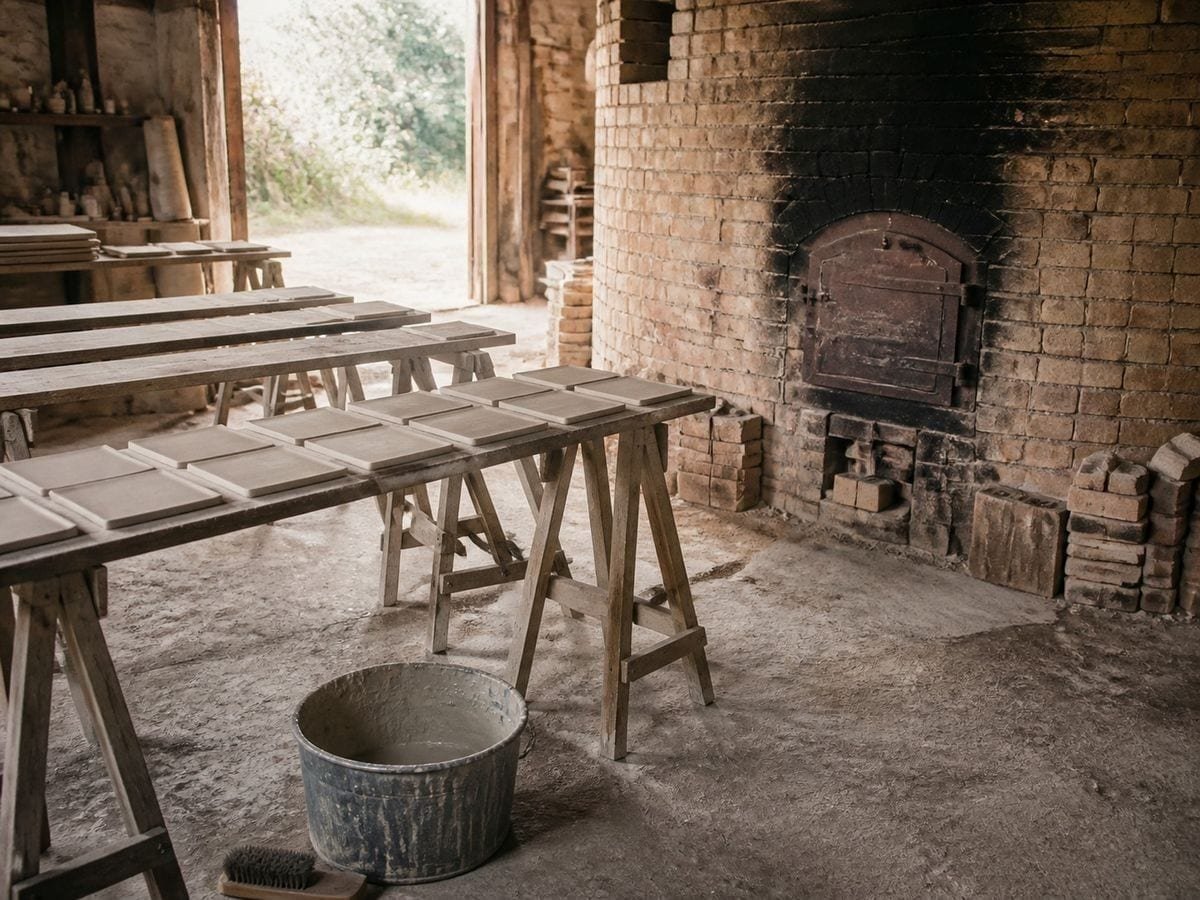
Tile layout. The unit has to be exact or the repeat drifts, and drift across a wall of forty tiles is obvious in a way it never is on a single one.
For inlay I need the star and the octagon as separate closed paths, because the centre is a different wood. Vector export with the parts I chose is the whole reason this works.
Teaching Islamic geometry, this is the first figure. Two squares and a compass, no numbers — students have a correct one in five minutes and understand why the tradition went this way.
Islamic eight-pointed star: frequently asked questions
The geometry
How is the star constructed?
Two squares inscribed in the same circle, one turned 45° from the other. That is all of it — no measurement, since bisecting a right angle is something a compass does for free, which is why the figure appears wherever compasses have been used.
Where exactly is the inner octagon?
At r/√2 — 0.70711 of the radius — with its vertices on the midpoints of the squares' edges. Worth knowing that this is not the same as the octagon formed where the two squares actually cross, which sits at 0.76537. The drawn one is the classical construction octagon; the crossing one is the boundary of the star's solid core.
What is the silver ratio and where is it here?
1 + √2, about 2.41421 — the ratio of a regular octagon's two-vertex diagonal to its side. It plays the role in eight-fold figures that the golden ratio plays in five-fold ones, and it is what makes an eight-pointed star nested inside a larger one's octagon land at a fixed, calculable fraction rather than drifting.
What is it called?
In Arabic, an eight-pointed star of two overlapping squares is khatim, a seal. The specific ornamental version marking each eighth of a hizb in the Quran is the rub el hizb, which has its own Unicode character. Both name figures of this construction.
Is it exclusively Islamic?
No. The same figure appears in Byzantine mosaic, in Hindu and Buddhist mandala, in medieval European tilework and in heraldry. Two squares in a circle is simply what a compass produces when you want eight of something, so recurrence is evidence of a shared tool rather than a shared meaning.
Using it
How do I repeat it into a pattern?
Two standard ways. Step the unit by one diameter horizontally and vertically, leaving four-sided gaps for cross-shaped tiles — the classic star-and-cross. Or overlap the units so neighbouring points interlock, giving a dense field with no gaps. Use the boundary circle for registration; a circle's centre is unambiguous where eight similar points are not.
What does the construction-step control do?
It builds the figure up: circle, first square, second square, star, octagon. Worth using while you learn to draw it by hand, since five moves is the whole method.
How do I line it up with a tile photograph?
Scale so the boundary circle matches the tile's own circumscribing circle, then rotate — eight-fold symmetry gives eight positions that fit, so turn until a point lands on the tile's point. If the star never quite agrees, the tile is probably built on a different fold count rather than badly made.
Export and print
Can I export the parts separately?
Yes. Whichever of the squares, star, octagon and circle you have switched on export as separate SVG paths — which is what inlay and tile work need when the centre is a different material from the points.
Why do my printed points look blunt?
Because they are acute and a raster edge rounds them. Export SVG for anything cut, fired or engraved. It is the single most common failure with this figure, and it only shows up after the process rather than on screen.
What do I export to cut a stencil?
SVG, with the boundary circle switched off unless you want it cut too. The eight points are the whole shape, and a vector file keeps their tips sharp where a raster rounds them — which is the thing that shows on a cut edge.
Choosing a grid
Should I use the twelve-pointed star instead?
That follows from what the surrounding pattern is built on. Eight-fold comes from two squares and tiles naturally with squares and octagons; twelve-fold comes from two hexagons and sits with hexagons and triangles. Mixing the two families in one field is possible and is a much harder design problem.
Why not use a polygon tool's star setting?
Because a polygon tool asks you for a spike depth and you guess it. The khatim's points are determined — they are where the edges of two 45°-offset squares cross — so the proportions come out of the construction rather than out of a slider.
Practical matters
Does my image get uploaded?
No. Everything happens in your browser — the image is drawn to a canvas on your own device and never sent anywhere.
Is the eight-pointed star exclusively Islamic?
No. The two-squares construction is old and widespread, and versions appear in Byzantine, Indian and European ornament as well. It is strongly associated with Islamic geometric design because that tradition developed it furthest, not because it originated only there.
Can I use it in a commercial pattern?
Yes. The construction is centuries old and unowned, exports carry no watermark, and the terms leave your design with you. What you build on top of it is your own work.
Open the tool Eight-pointed star generator
Two squares, a thousand years of ornament
The Islamic 8 point star draws exactly, and you keep the parts you need. Export vector or 600 DPI. No signup, nothing uploaded.
Back to the generator →