Free Canvas Size Calculator
Match a reference photo to a stock canvas instantly with our 100% free canvas size calculator. Enter its proportions and see the closest standard sizes in inches or centimetres in seconds, with exactly how much crops and from which edges. No signup, no downloads needed. Trusted by 60,000+ artists worldwide.
YOUR SELECTED CANVAS
36 × 24 in
- Image kept
- 100%Every detail stays
- Reference ratio
- 1.5:1Canvas ratio 1.5:1
- Canvas area
- 864in² of painting space
Compare standard sizes
Stock sizes, matched to your picture
Enter the proportions you are working from and it lists the canvases you can actually buy in that neighbourhood, closest first, rather than returning an ideal size that no shop stocks.
2 controls, not a fixed result
Set width and height. Every change redraws the sheet, in this page's own document.
Part of the calculators set
The set also holds aspect ratio calculator and mural grid calculator, all of them free and all of them working in the browser.
The crop, drawn over your own reference
Each suggestion is drawn rather than described, with the strips that leave the frame hatched at the size they actually go, so a 4:3 reference on a square canvas shows what you lose before you buy it rather than after.
- 100% free
- No signup
- No watermark
- Nothing is uploaded
Stretched canvases come in a handful of ratios, almost none of which match a camera. The useful answer is not a size but a size and its crop: which standard canvas fits best, and exactly what you lose to it.
The canvas size calculator draws one of the 82 composition overlays in Grid Maker Pro, and the rest stack on the same image.
- 19 stock sizes
- Crop stated
- Inches or cm
- Nothing uploaded
What is a canvas size calculator?
A canvas size calculator matches the proportions of your reference against the sizes canvases are actually sold in. This one ranks nineteen standard stretched-canvas sizes by how little each crops, reports the loss as a percentage, names the edges it comes off, and flags exact fits. It works from any pair of numbers, because only the ratio between them matters.

How to choose a canvas size for a reference image
A reference's proportion turned into canvas dimensions you can actually buy, with the nearest standard sizes and what each one crops.
Enter the reference dimensions
Pixels, millimetres, inches — the unit does not matter, because only the ratio between the two numbers is used. A 4,000 by 3,000 photograph and a 40 by 30 centimetre print give identical results.
JPG · PNG · GIF · WEBP
Choose the orientation and the unit
Automatic follows the reference. Forcing portrait or landscape is useful when you intend to crop across the orientation — turning a landscape photograph into an upright composition, which is a real and deliberate choice.
Rectangle outline · Reciprocals
Read the crop, not just the size
The list is ranked by least cropping, with the loss as a percentage and the edges it comes from. An exact fit is labelled as one. Everything else is a trade, and the number tells you how big a trade.
PNG · JPG · PDF · SVG · up to 600 DPI
Three steps, about a minute. No signup, no upload.
What the Canvas Size Calculator does
Canvas ratios and camera ratios disagree
A canvas size calculator exists because cameras shoot 3:2 and phones shoot 4:3. Stock canvases are mostly 4:5, 3:4 and square, with 8×10 and 16×20 among the commonest. Almost nothing matches, so some crop is the normal case rather than the exception.
Ranked by loss, not by size
The list is ordered by how little each canvas cuts from the reference, so the first entry is the one that changes the picture least. Sorting by dimension instead would bury the good answer among near misses.
Which edges go
A canvas wider than the reference takes the loss off the top and bottom; a narrower one takes it off the sides. Knowing which before you buy tells you whether the crop lands on sky you do not need or on a subject you do.
Exact fits called out
A 3:2 reference on a 24×36 canvas is an exact match, and that is worth saying plainly rather than reporting as a 0.0% crop among a list of near misses.
Any unit, because only the ratio matters
Pixels, millimetres, inches or arbitrary numbers all give the same answer. That means you can type the dimensions straight off a file without converting anything first.
Both units on the output
Canvases are sold in inches in some markets and centimetres in others, often the same size under two names. Both are shown so the figure matches whatever the supplier prints on the label.
Canvas size calculator examples: four references against the same stock sizes
Canvas size calculator vs 3:2 camera vs 4:3 phone
| Option | Closest stock ratio | Example size | Crop | Comes off |
|---|---|---|---|---|
| 3:2 camera | 2:3 | 24 × 36 in | Noneexact | — |
| 3:2 camera | 4:5 | 16 × 20 in | About 17% | The sides |
| 4:3 phone | 3:4 | 18 × 24 in | Noneexact | — |
| 16:9 video | 4:5 | 16 × 20 in | About 44% | The sides |
Who a canvas size calculator is for: people about to buy a surface
How a canvas size calculator works — Standard canvas sizes, camera ratios, and deciding what to lose
Choosing a canvas looks like picking a size and is really picking a proportion, which puts it upstream of all 82 composition overlays. The sizes are fixed by what manufacturers stretch; the proportion is what determines whether your composition survives the transfer.
Why stock sizes are the sizes they are
Stretched canvases are sold in a set of sizes inherited from framing and from imperial paper conventions: 8×10, 9×12, 11×14, 16×20, 18×24, 24×36 and so on. They exist because ready-made frames exist in the same dimensions, and because stretcher bars are manufactured in inch increments.
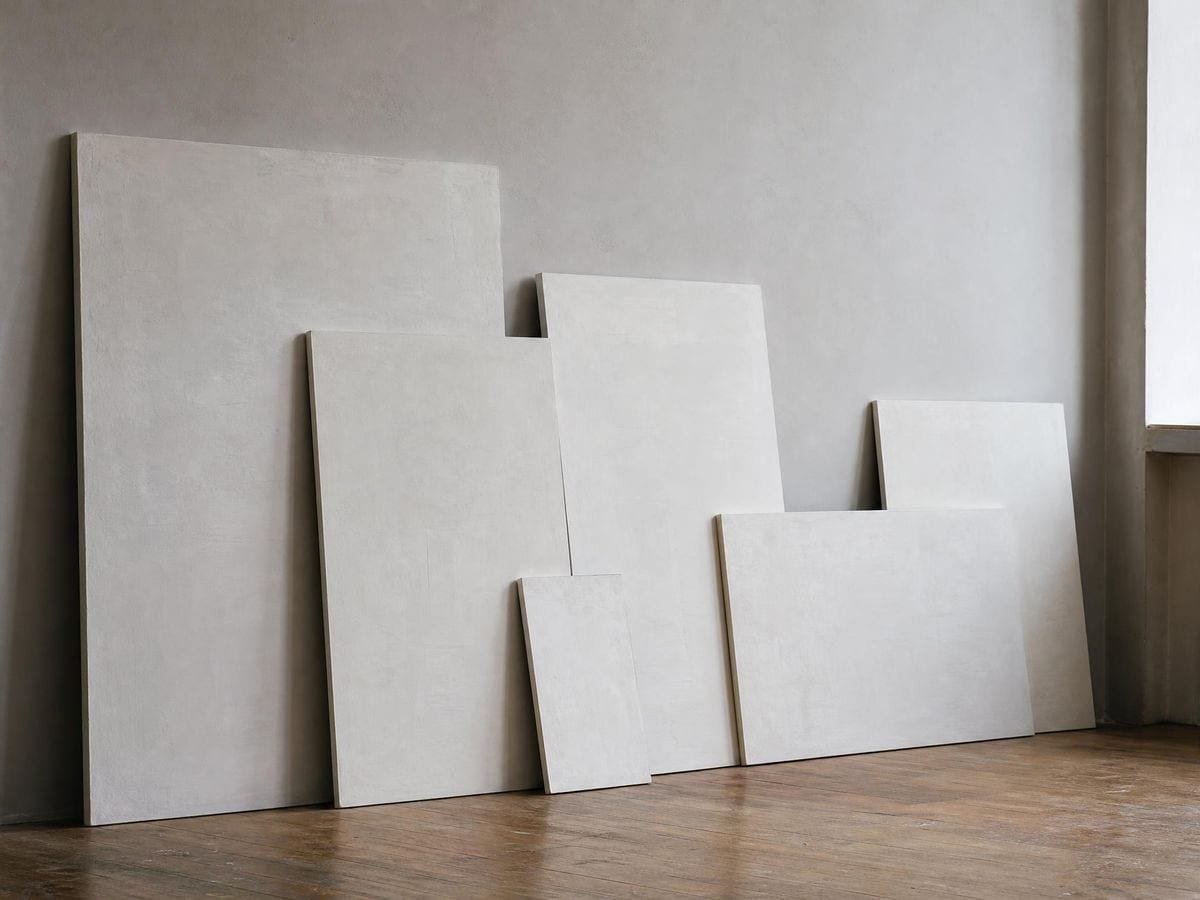
The consequence is a cluster of ratios: 4:5 (8×10, 16×20), 3:4 (9×12, 18×24), 5:7, 2:3 (24×36) and square. There is no 16:9 canvas, and 3:2 appears only at the larger sizes.
Metric markets sell many of the same physical sizes relabelled in centimetres — a 40×50 cm canvas is essentially 16×20 inches. The ratios are the same because the stretcher bars are the same.
The mismatch with cameras is structural
A full-frame or APS-C camera produces 3:2, inherited from 35mm film. Micro Four Thirds and most phone cameras produce 4:3. Neither is a common canvas ratio in the small and medium sizes, which is where most painting happens.
A 3:2 photograph on a 16×20 canvas — a 4:5 ratio — loses about 17% of its width. On an 8×10, the same. That is not a rounding error: it is a sixth of the frame, and where it comes from decides whether the painting works.
This is why the crop percentage is the useful output. A number tells you whether you are trimming a margin or removing a third of the composition, and it does so before the canvas is bought rather than after.
Deciding what to lose
The first question is whether the crop is at the edges or through the subject. A landscape photograph with expendable sky and foreground survives a 17% loss off the top and bottom, and frequently improves. A portrait framed tightly has nothing spare, and the same crop takes the top of the head.
The second is whether the composition depends on its proportions. A picture built on the diagonal of a 3:2 rectangle stops working when the rectangle changes shape, because the diagonal moves. A centrally composed subject is far more tolerant.
The third is whether to change orientation deliberately. A landscape photograph cropped to an upright canvas loses a great deal, and sometimes the result is stronger — the crop forces a decision about what the subject actually is. Forcing portrait in the calculator shows what that costs.
Painting to the reference, not the canvas
There is an alternative to cropping: paint the reference at its own proportion inside a larger canvas, leaving a margin. On a stretched canvas that margin usually becomes part of the work — a painted border, a field of colour, or bare primed surface.
It is a legitimate choice and it removes the crop problem entirely, at the cost of buying a canvas larger than the image. The calculator's exact-fit entries are the alternative to it, which is why they are labelled rather than ranked silently.
Square canvases, and why they are common
The aspect ratio calculator reduces a pair of numbers to its simplest ratio, and the 3:2 rectangle generator draws the armature of the commonest camera proportion. Square canvases have become far more common than they were, largely because square is the one ratio that crops symmetrically from any source. A 3:2 landscape and a 2:3 portrait lose the same proportion to a square, from opposite axes.
That symmetry is also why a square is a demanding composition. Nothing in the frame is favoured by the shape, so there is no natural direction and the picture has to supply its own. Photographers who shoot square deliberately do it for exactly that reason.
The depth nobody accounts for
Stretched canvases come in different depths — commonly around 1.8 cm for a standard profile and 3.8 cm or more for a gallery or deep-edge profile. The face dimensions are the same, but a deep-edge canvas wraps the image around the sides if you paint them.
If you intend to paint the edges, the effective face is smaller than the stated size, and anything important near the border wraps out of the front view. It is not part of the ratio arithmetic, and it is the commonest surprise after the crop.
Panel, board and paper have their own sizes
Stretched canvas is not the only surface with fixed dimensions. Cradled wood panels follow much the same imperial set, because they are sold into the same frames. Canvas boards and canvas pads tend to run smaller and cheaper, which makes them the sensible surface for testing a crop before committing to a stretched canvas.
Watercolour and printmaking papers follow different conventions entirely. Full imperial sheets are 22 by 30 inches, a ratio close to 3:4, and half and quarter sheets inherit it by folding. That means paper work and canvas work often want different crops of the same reference, which is worth knowing before a single decision is made for both.
Panels also behave differently at large sizes. Above about 30 inches a stretched canvas needs a cross brace to stay flat, while a cradled panel does not, and that structural difference sometimes decides the surface before the proportion does.
Working from the reference you will actually use
Enter the dimensions of the file or print you are going to work from, not the dimensions of the original scene or an earlier version. A photograph already cropped in an editor has a different ratio from the one the camera produced, and it is the cropped version that is going onto the canvas.
Practical order of decisions
Take the reference proportion from the file itself rather than from memory. Then decide whether the composition can survive a crop and roughly how much. Then look at the list, which is already ordered by that criterion, and take the largest size in the acceptable band — bigger canvases are easier to paint on than smaller ones, and the crop percentage does not change with size, only with ratio.
The sizes at the top of the list are all the same ratio, so choosing among them is purely a question of how large you want to work and what you are willing to carry home. The dynamic symmetry overlays treat several of these as constructions in their own right, and the root 2 rectangle overlay is the one the paper sizes are built on.
Where a canvas size calculator gets used
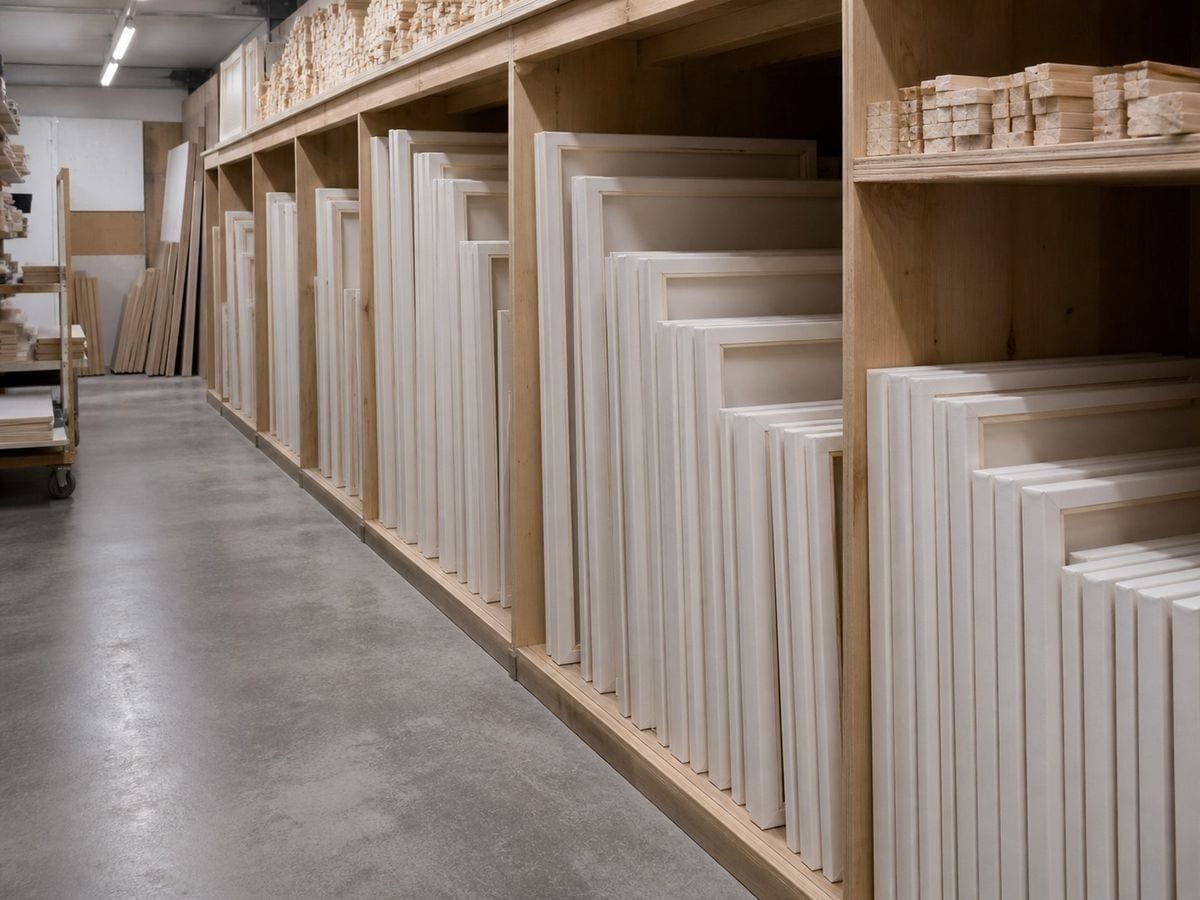
Before buying, which is the whole point. A crop discovered in the shop is an inconvenience; one discovered after the reference has been gridded onto the canvas is a repaint.
Commission work, where a client has supplied a photograph and expects a particular canvas size, and the crop has to be agreed rather than assumed.
Teaching, where showing that a 3:2 photograph loses a sixth of itself on an 8×10 makes the ratio problem concrete in a way a chart does not.
Canvas size calculator: frequently asked questions
The geometry
What is a canvas size calculator?
It matches the proportions of a reference image against the sizes stretched canvases are sold in, and reports how much each one crops. The useful output is the crop rather than the size, because some crop is almost always unavoidable.
What units should I enter?
Any. Only the ratio between the two numbers is used, so 4000 × 3000 pixels, 40 × 30 centimetres and 4 × 3 all give identical results.
Why does my photograph not fit any canvas exactly?
Because camera ratios and canvas ratios come from different traditions. Cameras give 3:2 or 4:3; canvases are mostly 4:5, 3:4 and square, sized to match ready-made frames and stretcher bars. Exact matches exist but are the exception.
Can I avoid cropping altogether?
Yes, in two ways. Choose a canvas whose ratio matches the reference exactly, which the calculator labels as an exact fit. Or paint the image at its own proportion inside a larger canvas and let the margin become part of the work.
Why are square canvases so common now?
Because square is the one ratio that crops symmetrically from any source — a landscape and a portrait lose the same proportion, from opposite axes. It is also a demanding shape to compose in, since nothing in the frame is favoured by the format.
Are metric and imperial canvases different sizes?
The same physical sizes under different labels. A 40×50 cm canvas is a 16×20 inch one. A 40 × 50 cm canvas is essentially 16 × 20 inches, because the stretcher bars are the same. Both units are shown so the figure matches the supplier's label.
Does canvas depth affect the calculation?
Not the ratio, but it affects the result. A deep-edge canvas wraps the image around the sides if you paint them, so the effective front face is smaller than the stated size and anything near the border disappears from the front view.
What if I want to change the orientation?
Force portrait or landscape rather than leaving it automatic. Cropping a landscape photograph to an upright canvas loses a great deal and sometimes produces a stronger picture, because it forces a decision about what the subject really is.
Using it
How much cropping is acceptable?
Ten per cent is the number to judge against, and the picture decides whether it matters. Ten per cent off a landscape with spare sky is nothing; the same crop off a tightly framed portrait takes the top of the head. Look at which edges the loss comes from, which the calculator names.
Should I pick the largest size that fits?
Yes, for most subjects. The crop percentage depends on the ratio, not the size, so every canvas sharing the best ratio crops identically. Larger canvases are easier to paint on, so the choice among them is about space and cost rather than fidelity.
Which edges does it tell me the loss comes off?
It names them, which is the part that matters. A 6% loss off the top and bottom of a landscape is very different from 6% off one side, and the calculator reports which — so you can decide whether the crop takes anything you needed.
How do I handle a portrait reference against landscape canvases?
Switch the orientation rather than rotating the reference. Canvas sizes are sold as pairs, so a 24 × 36 becomes a 36 × 24, and the calculator ranks against whichever way round you set — comparing a portrait image with landscape sizes only ever reports enormous crops.
Export and print
Can I print the crop guide to take to the shop?
Print the page with the ranked sizes on it, or export the overlay showing the crop on your reference. The second is more useful in front of a rack of canvases — it shows what you actually lose, which a percentage does not.
Does the overlay export at the canvas proportion?
The overlay draws the chosen size's rectangle on your image, and exporting it keeps that rectangle exactly. Set the paper format to something near the canvas proportion if you are printing it, so the sheet is not mostly margin.
Choosing a grid
Should I crop the photograph or choose a different canvas?
Choose the canvas, if the crop is over about a tenth of the picture. Losing a tenth off one edge is usually invisible; losing a quarter changes the composition into a different one, and at that point you are painting something you did not photograph.
Is a custom-made canvas worth it instead?
For a piece that matters, yes — a stretcher made to your ratio removes the problem entirely. It costs more and takes a week, so the calculator is for the far commoner case of wanting to paint this weekend on something the shop has in stock.
Practical matters
Is it free, and do I need an account?
It is free and there is no account.
Is anything uploaded?
No. It is arithmetic on two numbers you type. There is no image and no server.
Open the tool Canvas size calculator
The size that fits, and what it costs
A canvas size calculator takes the reference proportions and returns the list. Ranked by least cropping, with the loss named.
Back to the generator →