
Free Root 4 Rectangle Grid Generator
Draw the root 4 rectangle instantly with our 100% free grid generator. Overlay the 1:2 double square with its armature and central square boundary, eyes falling at exactly a fifth of each side, on any image, then export SVG or 600 DPI in seconds. No signup, no downloads needed. Trusted by 60,000+ artists worldwide.
The 1:2 rectangle and its armature
Root 4 is exactly 2, so this is the double square — the one root rectangle with a whole-number proportion, and the easiest of the family to verify by eye.
4 controls, not a fixed picture
Toggle rectangle outline, reciprocals, eyes (intersection points) and square boundary (midline). Every one is live on the canvas.
Stacks with composition & photography
Overlays combine, each carrying its own transform, so this one can sit under or over rule of thirds, golden spiral and armature (14-line), and 15 more in the same set.
A proportion you can check
One side is exactly twice the other, so a printed sheet at 300 or 600 DPI can be measured and confirmed. PNG, JPG, PDF or SVG.
| Ctrl + Z | Undo |
| Ctrl + Y | Redo |
| Esc | Deselect overlay |
| Alt + drag | Free positioning (no snap) |
| Ctrl + scroll | Zoom canvas |
| Ctrl + P | |
| ? | Show this help |
One to two is the only rational member of the root family — two squares side by side — and its armature lands on the fifths, which no other common rectangle does.
The root 4 rectangle generator draws one of the 82 composition overlays in Grid Maker Pro, and the rest stack on the same image.
- 1 : 2
- Eyes at 1/5
- SVG + 600 DPI export
- Nothing uploaded
What is the root 4 rectangle?
The root 4 rectangle generator is a free browser tool that draws the 1 : 2 double square and its armature over any image or blank canvas. Both diagonals, four reciprocals dropped at right angles, and the four eyes where those land — at exactly one fifth of the width and height, since a rectangle of ratio r puts its eyes at 1/(1+r²) and here r² is exactly 4. A midline shows the square boundary, the cut that divides the rectangle into two exact squares.

How to use the double square
Two squares side by side, which is what root 4 is, subdivided into fifths with the reciprocals marked. The widest of the root rectangles that still reads as a frame.
Open the rectangle
The largest 1 : 2 rectangle that fits your canvas is drawn and centred with both diagonals. Unlike the irrational members of the family, this proportion is easy to check by eye — the two halves are squares or they are not.
JPG · PNG · GIF · WEBP
Turn on what you need
Reciprocals for the four eyes at the fifths, the square boundary to see the division, or the diagonals alone when you only want direction.
Rectangle outline · Reciprocals
Place, then export
Subject on an eye, counterweight on the diagonal running away from it. Export SVG for vector or a raster up to 600 DPI sized to your paper.
PNG · JPG · PDF · SVG · up to 600 DPI
Three steps, about a minute. No signup, no upload.
What the Root 4 Rectangle Generator does
Two squares, exactly
The midline divides it into two perfect squares. It is the one rectangle in the root family whose correctness you can verify without arithmetic — if the halves are square, the proportion is right.
Eyes exactly on the fifths
The reciprocals land at one fifth of each side — the only common rectangle that produces fifths from its own diagonals. If a composition wants a five-part division, this is the proportion that gives it structurally.
Its diagonal is √5
The diagonal of a double square measures exactly √5 of the short side, which is how the golden ratio is classically constructed — φ is (1 + √5) ÷ 2. This rectangle is where φ comes from, drawn.
Letterboxed, and visibly so
On a canvas of another proportion the overlay draws the largest 1:2 rectangle that fits. The inset shows how much of the frame the armature does not govern.
Over your own work
Its own transform, so the armature can be rotated onto a subject that is not square to the frame with the right angles intact.
Vector or print size
SVG export keeps every line vector. Raster export is sized from the paper format and DPI you choose, up to 600.
Root 4 rectangle examples: four ways the armature reads
Root 4 rectangle vs drawing it by hand vs a downloaded template
| Option | Proportion exact | Reciprocals at true right angles | Vector export | Cost |
|---|---|---|---|---|
| Grid Maker Prothis tool | Yes1 : 2 | Yescomputed feet | SVG + raster to 600 DPI | Free |
| Drawing it by hand | Yestwo squares | By construction | No | Time |
| A downloaded template | Usually | Rarely | Sometimes | Free or paid |
| Guides in a layout program | Yestrivially | Only if you draw them | Yes | Subscription |
Who the root 4 rectangle is for: surfaces made to a module
How the root 4 rectangle works — The rational one, the fifths it gives, and the golden ratio hiding in its diagonal
Root 4 is the odd member of the family among the 82 composition overlays — the only one whose proportion is a whole number ratio — and it earns its place twice over: once for the fifths its armature produces, and once for being the construction the golden ratio is built from.
A root 4 rectangle is 1 : 2. Two squares side by side, and the only rectangle in the root series whose ratio is rational — √4 is simply 2, where √2, √3 and √5 are all irrational. That makes it the one you can verify without measuring: if the two halves are squares, it is correct.
Its self-similar property follows the family pattern: the root 2 armature generator halves into itself, root 3 thirds into itself, and root 4 quarters into itself — cut it into four across the long side and each piece is 1:2 again. The overlay draws the halving line, which is the more useful of the cuts because it is where the two squares meet.
Two squares is the most ordinary rectangle in the family and the one that generates the least ordinary number in it.
The eyes land on the fifths
The armature is both diagonals, four reciprocals at right angles and four eyes. On this rectangle they fall at exactly one fifth of the width and one fifth of the height, because the eyes of a rectangle of ratio r sit at 1/(1 + r²) and here r² is exactly 4.
That is worth knowing because fifths are otherwise awkward to arrive at. The rule of fifths exists as a composition overlay in its own right, but it is imposed on the frame rather than produced by it; on a double square the fifths are what the rectangle's own diagonals generate. If a composition genuinely wants a five-part rhythm, this is the proportion that gives it structurally rather than by decree.
The diagonal, and where φ comes from
Measure the diagonal of a double square against its short side and you get exactly √5 — 2.23607. That single fact is the classical construction of the golden ratio: φ = (1 + √5) ÷ 2, so a double square plus its own diagonal is all you need to produce φ with a compass and straightedge.
The construction is worth doing once. Draw the double square. Put the compass point at the midpoint of the long side and open it to a far corner — that radius is √5 halves of the short side. Swing it down to extend the long side, and the extended length divided by the short side is φ. Every golden rectangle construction in every textbook is this, however it is dressed.
So the double square is not merely adjacent to the golden ratio; it is the thing φ is defined out of, which is what the phi rectangle tool then builds on. If you want to build a golden rectangle by hand rather than by number, you start here.
Where the proportion actually gets used
It is everywhere in things made to a module. A tatami mat is 1:2, and the traditional Japanese room is measured in whole mats, which makes the double square the underlying unit of an entire architectural tradition. Brick bonds work on the same ratio — a stretcher face is roughly two headers — which is why brickwork lays out in halves so readily.
In imaging it is the panoramic crop that is not a crop: 1:2 is close to the classic 6×12 medium-format panoramic frame, and it is the proportion a great many banner and header formats settle at because it is long enough to read as wide without being a letterbox slot.
And in panel painting it is a standard because the double square divides so cleanly. Two squares, four quarters, five-part eyes — the same surface supports a symmetrical two-part composition and an asymmetrical five-part one without either fighting the frame.
Practical notes
Because 1:2 is long, the letterboxed inset on a standard sheet or a 3:2 photograph is significant. Composing on the armature then means composing on a band, which is deliberate if you meant it. Where root 4 fits without inset is panels, banners and anything you are cutting to proportion yourself.
The square boundary is the line to place against first. On a double square the eye reads the two halves as separate fields before it reads the rectangle as a whole, so an element that straddles the midline reads as crossing a boundary rather than as sitting in the middle. That can be exactly what you want; it is rarely what you get by accident.
And if you are using the rectangle to construct φ rather than to compose, turn the reciprocals off. The diagonal alone, with the square boundary, is the whole construction — the four eyes are a different question and they clutter it.
Why it is the one you can check
Every other rectangle in this family has an irrational ratio, so comparing lengths does not verify it — you trust the construction, or measure to more decimal places than a rule offers. The double square is the exception, and that is a practical advantage rather than a mathematical footnote.
Fold it in half across the long side and look at the halves. If they are square, the proportion is exact; if they are not, it is not, and you can see which way by which pair of edges is longer. No measurement, no calculation, no trust in a template you downloaded.
That makes it the sensible rectangle to build a physical straightedge or a set of panel formats around. Anything you can check by folding, you can also correct by folding, which is not true of root 2 or root 5 and is the reason the double square appears so persistently in traditions that worked without rulers.
It is also the easiest of the family to fake convincingly, which is worth guarding against. A rectangle a few percent off 1:2 still reads as a double square to the eye, and the error only surfaces when you divide it and the halves are visibly not square. Check by folding before you commit a cut, particularly on stock someone else prepared. The root 4 overlay page places it in the family, beside the rest of the dynamic symmetry category.
Where the root 4 rectangle gets used
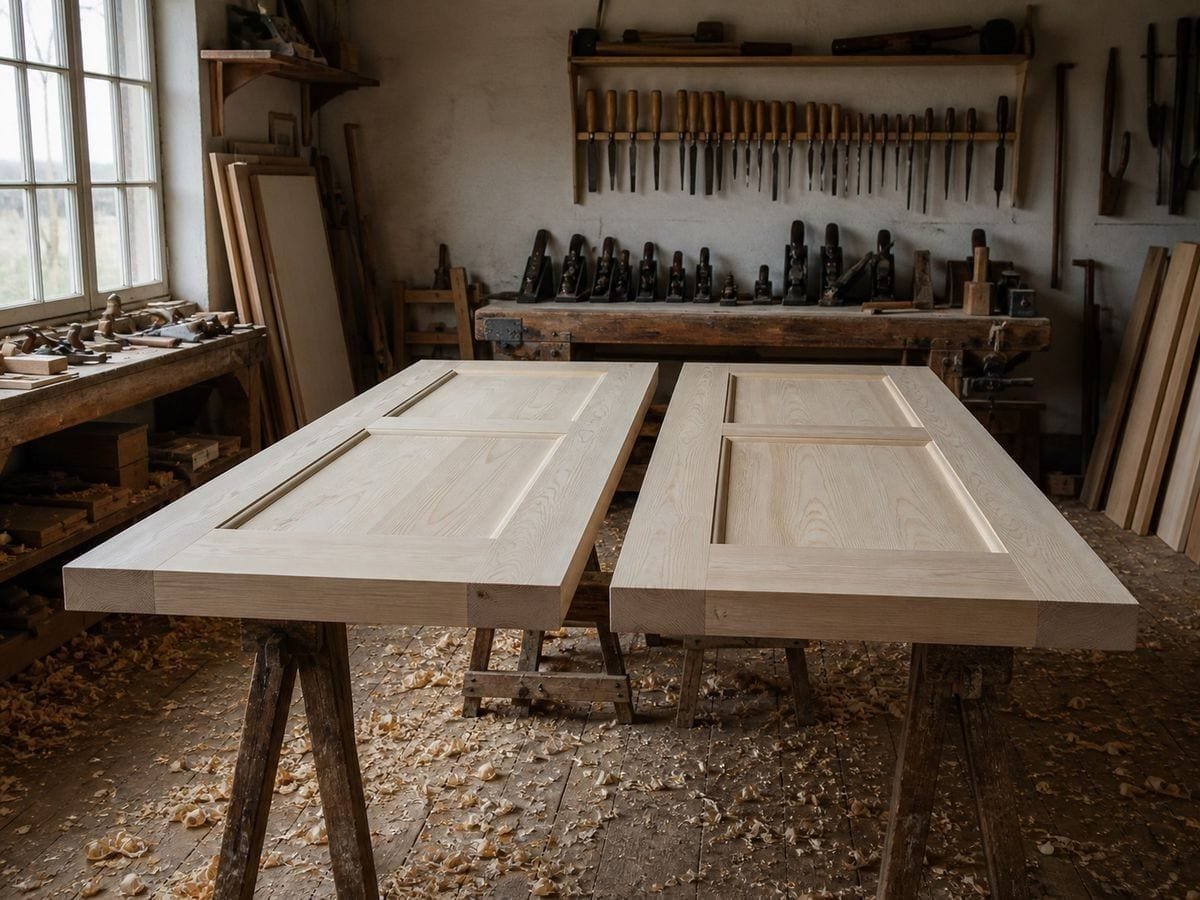
Banner and header formats settle near 1:2 constantly, and having the armature of the format rather than an imported grid is what stops the type drifting.
Panels. Two squares divide cleanly and the fifths give me an off-centre option on the same board without a second system.
I teach the golden ratio from the double square rather than from the number. Compass, diagonal, swing — and φ is on the paper.
Root 4 rectangle: frequently asked questions
The geometry
Why is it called root 4 if it is just 1:2?
Because the family is named by the square root of the ratio's square: √4 is 2. It is the only member whose proportion is rational — √2, √3 and √5 are all irrational — which makes it the one you can verify by eye rather than by measurement.
Where do the eyes fall?
At exactly one fifth of the width and one fifth of the height. The eyes of a rectangle of ratio r sit at 1/(1 + r²), and here r² is exactly 4, so the fraction is 1/5.
Why do fifths matter?
Because they are otherwise awkward to arrive at. The rule of fifths exists as an overlay, but it is imposed on a frame rather than produced by it. On a double square the fifths are what the rectangle's own diagonals generate, so a five-part rhythm is structural rather than decreed.
What is the connection to the golden ratio?
The diagonal of a double square is exactly √5 times the short side, and φ = (1 + √5) ÷ 2. So the double square plus its own diagonal is the classical compass-and-straightedge construction of the golden ratio — this rectangle is what φ is defined out of.
How does it subdivide?
Following the family pattern: root 4 quarters into itself, so cutting it into four across the long side gives four more 1:2 rectangles. The overlay draws the halving line, which is more useful because it is where the two squares meet.
Where does the proportion turn up?
In anything built to a module. A tatami mat is 1:2 and traditional Japanese rooms are measured in whole mats; brick bonds work on roughly the same ratio; and a great many banner and header formats settle there because it reads as wide without being a slot.
Should I let elements straddle the midline?
Only deliberately. On a double square the eye reads the two halves as separate fields before it reads the whole, so an element crossing the midline reads as crossing a boundary rather than as centred. That is a strong effect and rarely what you get by accident.
Why is my rectangle inset so much?
1:2 is long, so on a standard sheet or a 3:2 photograph the fitted rectangle is a band across the middle. That is fine if intended. Where it fits without inset is panels, banners and anything you cut to proportion yourself.
Using it
How do I actually construct φ from it?
Draw the double square. Put the compass at the midpoint of the long side and open it to a far corner. Swing that radius down to extend the long side; the extended length divided by the short side is φ. Every golden rectangle construction is this, however it is presented.
Should I keep the square boundary on?
Yes, longer than the other toggles. The double square is literally two squares, and the midline showing where they meet is the structural fact of the rectangle — whether an element straddles that line or respects it is the main compositional decision this armature offers.
How do I use it on a panorama?
This is the one armature that suits a wide frame, so scale it to fill rather than accepting a heavy letterbox. A 2:1 crop is exactly root 4, and if your panorama is close to that, cropping to it costs little and puts the armature on the real frame.
Export and print
Can I print it for a diptych layout?
Yes, and it is a natural use — the square boundary marks the join, and the eyes at fifths tell you where to place a subject inside each half. Export the grid alone at your paper proportion so the midline lands where the two panels actually meet.
Which format do I want for setting out a long panel?
SVG. The eyes sit at exactly one fifth of a side and the whole armature is derived from a 1:2 ratio, so a vector file reproduces it at wall scale without accumulating the rounding error a raster brings with it.
Choosing a grid
Is the rule of fifths the same thing as these eyes?
Related, not the same. The rule of fifths generator rules all four fifth-lines in both directions and gives you sixteen crossings; this puts four eyes at one fifth of each side as a consequence of the 1:2 proportion. Same fraction, different construction and a very different amount of line.
Practical matters
Does my image get uploaded?
No. Everything happens in your browser — the image is drawn to a canvas on your own device and never sent anywhere.
Where does the double square turn up in practice?
In banners, cinema-scope-adjacent crops, Japanese scroll formats and a great deal of architectural elevation. It is one of the few root rectangles a client asks for by accident, because 2:1 is a number people reach for without knowing it is √4.
Open the tool Root 4 rectangle generator
Two squares, five-part eyes
The simplest proportion in the family, and the one φ is built from. Export vector or 600 DPI. No signup, nothing uploaded.
Back to the generator →