Is tracing cheating?
The honest answer is that it depends what you use it for. Tracing is a tool, and a tool is neither honest nor dishonest by itself. Optical and mechanical aids have been part of serious art since at least 1435, and some of the most celebrated painters in history quietly used them. What decides the question is not the method but two other things — whose image you traced, and whether you did the real work afterward. This guide walks the ethics, the six centuries of history, the copyright rules in plain language, the genuine learning value, and the specific cases where tracing does hold you back — so you can answer the question for yourself instead of feeling guilty about it.
One of the guides behind the 82 composition overlays every visual artist should know and use.
- Short answer
- It depends what you use it for
- Oldest documented aid
- Alberti's gridded veil, 1435
- The ethical line
- Whose image, and whose decisions
- The legal line
- Your own or licensed reference
- Learning value
- Real, if the aid is removed over time
- When it hurts you
- When it becomes a ceiling
In short
- Is tracing cheating? It depends what you use it for. The method is morally neutral — what matters is whose image you traced and whether you did the artistic work yourself afterward.
- Optical and mechanical aids have been part of serious art since Alberti described the gridded veil in 1435. Dürer, very likely Vermeer, and Ingres all used them; celebrated reputations survived intact.
- The ethics turn on honesty and attribution, not on the aid. Tracing your own reference and rendering it by hand is legitimate; tracing another artist's work and claiming it as your own invention is not.
- The law turns on what you traced, not the act. Tracing your own photo, a public-domain image, or a licensed image is generally safe to sell; tracing someone else's copyrighted photo or art without permission can be infringement. This is general information, not legal advice.
- Tracing helps you learn if you use it as a removable crutch — trace placement, render by hand, then draw freehand. It only holds you back when it becomes the only thing you ever do.
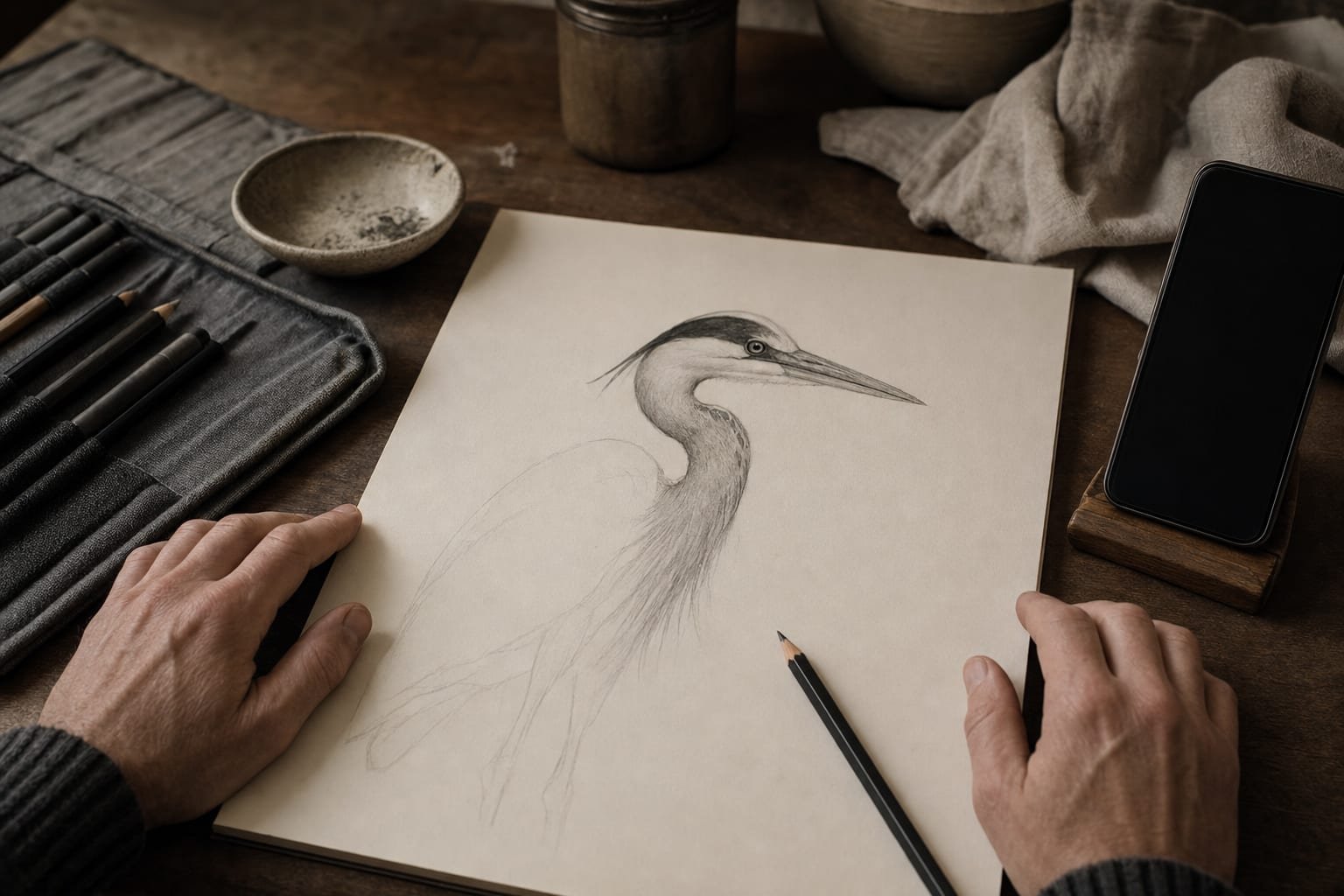
The honest answer: it depends what you use it for
Almost everyone who has ever traced an image has felt the small guilt that follows. You get a proportion right in a fraction of the time it would have taken freehand, and a voice says you did not really earn it. That voice is worth taking seriously, but it asks the wrong question. "Is tracing cheating?" treats the method as the thing being judged, when the method is the one part of the situation that carries no moral weight at all.
Tracing is a tool. A ruler is a tool. A photograph is a tool. None of them is honest or dishonest on its own — they take on meaning only from how a person uses them and what that person claims. Ask instead the two questions that actually decide the matter: whose image did you trace, and whose decisions ended up in the finished piece. Almost every real disagreement about tracing collapses into one of those two, and the rest of this guide is organised around them.
The word "cheating" also smuggles in an assumption: that art is a contest with rules, and using an aid breaks them. But there is no rulebook, no referee, and — for the vast majority of artists — no competition. A muralist getting a client's photo onto a wall is not sitting an exam. An illustrator hitting a deadline is not being marked on whether they used a lightbox. The only place tracing can genuinely be "against the rules" is a context that has explicitly set them — a life-drawing class that forbids reference, a competition that requires original observation, a commission that specifies freehand work. Outside those, the frame of cheating simply does not apply.6
What remains, once you drop the contest metaphor, are three sensible sub-questions. Is it ethical? Is it legal? Does it help or hurt your growth? Those have real, answerable content, and they do not all point the same way. That is why the one-word answers — "no, it's fine" or "yes, it's cheating" — are both wrong. The truthful answer is longer, and it is worth the read.
The free Grid Maker Pro tool is a good place to feel the distinction. Drop in your own photo, overlay a grid, and you have used an aid — but every decision about value, edge, and emphasis is still yours to make. The overlay places; you draw.
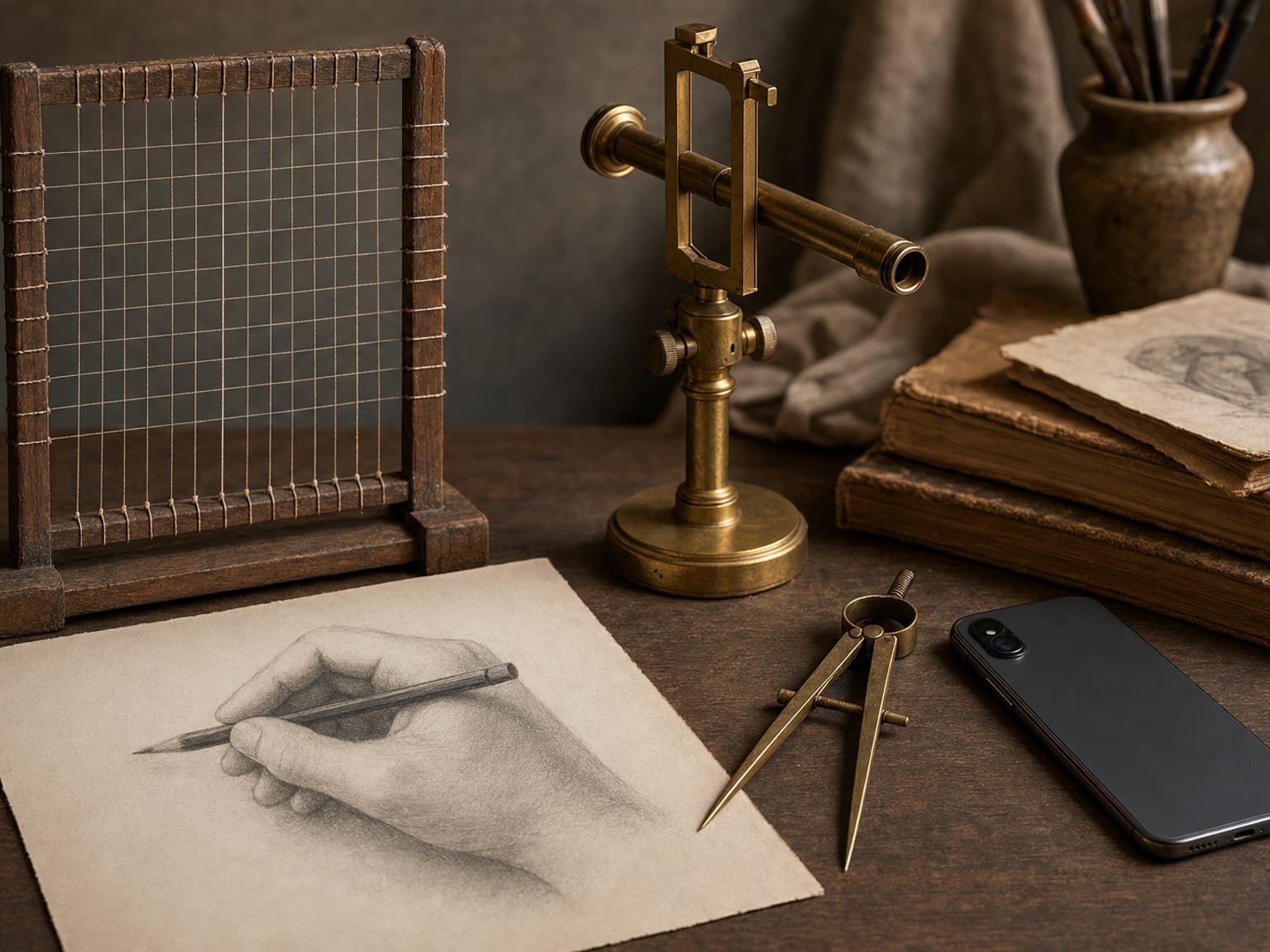
The ethical question: whose image, whose decisions
Strip away the anxiety and the ethics of tracing come down to honesty and authorship. There are two ways to trace that are hard to defend, and a large space between and around them that is perfectly ordinary practice.
The two genuinely questionable cases
The first is tracing another artist's finished work — a drawing, a painting, an illustration — and presenting the result as your own original invention. The problem here is not the pencil path; it is the claim. You have taken someone else's design decisions, the part that actually took their skill and judgement, and passed them off as yours. That is a problem of attribution and honesty, and it would be a problem whether you traced, copied by eye, or reproduced by any other means.
The second is tracing to deceive about your own ability in a context where that ability is what is being assessed. Turning in a traced piece for a freehand assignment, entering an aided drawing in an unaided competition, or accepting a commission for original observational work and quietly tracing it — these are dishonest not because tracing is bad but because a specific promise has been broken.
The large ordinary space
Now the everyday cases, which are the overwhelming majority. Tracing the placement of your own reference photograph, then doing the values, edges, and colour by hand, is what working illustrators, animators, muralists, and sign painters have always done. Using the grid method to enlarge a study you drew from life is not ethically different from using a ruler. Locking a licensed or public-domain image over a canvas to rough in proportions is a production step, not a confession. In none of these has anyone been misled, and no one else's authorship has been claimed.
Is using a projector cheating? Is the grid method cheating? By this reasoning, no more or less than any other aid. A projector and a grid do exactly the same job — they place a reference accurately — and neither makes a single artistic decision for you. If you would not call a ruler cheating, the projector and the grid are on the same footing.9 What they change is speed, not authorship.
That split — placement above the line, artistry below it — is the heart of the whole debate, and it is the reason the historical record matters so much. If tracing were really the death of skill, the artists who used it would not be the ones we still study. They are, which is where we turn next.
Do "real" artists trace? Six centuries of evidence
The belief that serious artists work only with an unaided eye is one of the most durable myths in art, and it is not true. Optical and mechanical aids are woven through the whole history of Western picture-making, often used by exactly the figures whose names anchor the canon.
The gridded veil, 1435
The earliest written description of tracing for transfer comes from Leon Battista Alberti's On Painting (Della Pittura), completed in 1435. Alberti described a velum — a veil of fine threads stretched on a frame and ruled into squares — held between the artist and the subject. By noting where each contour crossed a thread, a painter could record proportion exactly onto paper ruled with matching squares.1 He presented it not as a guilty secret but as sound professional practice, a tool to be taught. The grid method, in other words, was recommended by one of the founding theorists of Renaissance art nearly six hundred years ago.
Dürer's proud machines, 1525
A century later, Albrecht Dürer engraved his famous woodcuts of draughtsmen using gridded frames and sighting devices to draw a lute, a seated woman, and a reclining nude in correct perspective. Those 1525 images, from his Underweysung der Messung, were published as instruction — Dürer wanted artists to learn these mechanical aids.2 He did not hide the frame; he taught it.
The Hockney–Falco thesis and the old masters
The most provocative modern account of this history is the painter David Hockney's Secret Knowledge: Rediscovering the Lost Techniques of the Old Masters, published in 2001. Working with the optical physicist Charles Falco, Hockney argued that artists from roughly 1420 onward used lenses, mirrors, and projection — the camera obscura and later the camera lucida — to achieve the sudden leap in optical accuracy visible in early Netherlandish and later European painting.3 The Hockney–Falco thesis is genuinely contested; many art historians dispute how far optical aids can explain specific works, and it is fair to present it as an argument rather than a settled fact.4 But two things are not in dispute: the aids existed and were available, and artists who could work better with a tool generally did.
The most carefully examined single case is Vermeer. Philip Steadman's Vermeer's Camera reconstructs the geometry of Vermeer's interiors and argues in detail that he worked with a camera obscura, using the room itself as the device.5 The case is strong and widely respected, and Vermeer's standing has not suffered an inch for it. If the artist behind Girl with a Pearl Earring may have projected his scene and it changed nothing about his greatness, the idea that an optical aid disqualifies an artist is hard to sustain.
Ingres and the tracing debate
Then there is Jean-Auguste-Dominique Ingres, whose superbly precise portrait drawings have long been linked to the camera lucida — the small Wollaston prism that overlays a virtual image of the subject onto the paper.7 The suggestion has attracted real argument: some scholars find the linear exactness of his drawings consistent with the device, others defend it as pure freehand mastery, and the debate has never been fully closed. That unresolved argument is itself instructive. Even where we cannot be certain an artist traced, the possibility is treated as a serious art-historical question, not as a scandal that would demote them — which tells you how normal these tools were understood to be.
The overlay you can call up over your own photo in the browser is the direct descendant of Alberti's veil and Ingres's prism — the same idea, six centuries on. Nothing is uploaded; the overlay renders on your device.
The pattern across all of it is consistent: the aids were tools of the trade, used openly by the best, and their reputations were never in question. That settles the "do real artists trace" version of the question. The harder, more practical version — can you sell what you trace — is a matter of law, not history, and it is where the answer gets genuinely careful.
Can you legally sell traced art? The copyright question
This is the one place where the answer genuinely can be "you may be doing something wrong," and it has nothing to do with the act of tracing and everything to do with what you traced. The safest way to hold the whole question in your head is this: tracing does not create or destroy a copyright problem — the source image does.
The one rule that keeps you safe
Trace your own photograph, a public-domain image, or an image you are properly licensed to use. If the reference is genuinely yours to use, the fact that you traced it rather than drawing it freehand does not, by itself, make the resulting work illegal to create or sell. You made the picture from a source you were entitled to work from.
Where the risk actually lives
The risk appears when you trace someone else's photograph or artwork that is still under copyright, without permission. Copyright protects original creative works, and the owner generally holds the exclusive right to make derivative works from them. Tracing another person's copyrighted photo can produce a derivative work that reproduces its protected expression — and selling that work raises the exposure, because commercial use weighs against you in most fair-use-style analyses.8 This is why "I found it on the internet" is not a safe basis for a piece you intend to sell.
A few honest nuances, all still general information:
- Copyright protects expression, not facts or ideas. You cannot copyright the fact that a sunset is orange, but you can protect a specific photograph of a specific sunset — its framing, light, and choices. Tracing tends to copy exactly those protected choices, which is what makes it riskier than being loosely "inspired by" an image.
- Public domain is not a vibe. An image is in the public domain for concrete reasons — age, expired term, or an explicit dedication. Old does not automatically mean free, and a photograph of a public-domain painting may carry its own separate considerations. When in doubt, verify the specific status.
- Licences have terms. A stock or Creative Commons licence may allow commercial use, or may not, and may require attribution. Read the actual licence for the actual image.
- "Fair use" is a defence, not a permission slip. It is decided case by case and is not something to rely on for a piece you plan to sell without advice.
The practical takeaway is simple and freeing: build the habit of working only from references you own or are licensed to use, and the copyright anxiety around tracing mostly evaporates. It is also why every Grid Maker Pro tool is built around your reference — you drop in your own photo, and it never leaves your device. With the legal ground covered, the last big sub-question is the one beginners care about most: does tracing actually help you learn?
Does tracing help you learn to draw?
Here the honest answer is a qualified yes: tracing can genuinely accelerate learning, but only if you use it deliberately and then take the training wheels off. Used carelessly it teaches nothing; used well it teaches exactly the skills beginners most neglect.
What tracing frees you to notice
Placement — getting the proportions and positions right — is the part of drawing that eats a beginner's entire attention. When the grid or the overlay handles placement, your attention is suddenly free for the things that actually make a drawing convincing: the quality of an edge, the relationship between two values, the temperature of a colour. Betty Edwards's Drawing on the Right Side of the Brain makes the underlying point — the difficulty in drawing is rarely the hand, it is seeing relationships accurately instead of drawing the stored symbol your brain keeps for "eye" or "nose."10 A grid is, in effect, that comparison work pre-printed, so you can spend your seeing on what is left.
The removable-crutch method
The way to make tracing teach you is to design its own removal. Across a series of drawings, grid the first one fully, the next with half the cells, the third freehand with the grid switched on only to check your work against. This is comparative measurement learned through tracing: the grid shows your eye what accurate proportion feels like, then withdraws. Andrew Loomis built his whole pedagogy on the idea that construction and proportion are the literacy that frees imaginative drawing — once placement is handled, everything interesting becomes available.11 Trace to learn the feel of correct proportion, then keep drawing without it, and the aid has done its job.
Trace, then redraw freehand
A second reliable habit: trace an image once to understand its structure, then put the trace away and draw the same subject again from scratch. The traced pass is reconnaissance; the freehand pass is the real practice. Careful copying has always worked this way — the Bargue–Gérôme academic course was built on meticulous copies that trained an eye which then worked unaided.12
Build the removable-training-wheels habit with the free tool: grid a study, draw it, then redraw the same subject with the grid off and compare. The gap you see between the two is the exact skill you are building.
So tracing can teach — but the same features that make it a good teacher make it an easy trap. The next chapter is the honest counterweight: the cases where tracing genuinely holds you back.
When tracing genuinely is a shortcut that hurts you
A guide that only defends tracing would be dishonest. There are real ways it can stall your growth, and naming them plainly is the point of a balanced answer. None of these makes tracing "cheating" — but each is a genuine reason to be careful.
When it becomes the only thing you do
If you trace every single piece, your observational eye never develops. The aid stops being a tool and becomes a ceiling — you can produce passable work indefinitely without ever learning to see, and the moment you have no reference to trace, you are lost. This is the single most important caution in the whole subject. The strongest working artists keep a freehand or sight-size habit running alongside whatever tracing their jobs require. Sight-size training — placing the drawing beside the subject at the same apparent size and correcting by eye — builds an eye no tracing method can substitute for, and it remains the core of contemporary classical ateliers precisely because it cannot be shortcut.13
When you trace another artist's decisions
Tracing your own photo copies the world; tracing another artist's finished drawing copies their judgement — their choices about what to emphasise, simplify, and leave out. Do that repeatedly and you never build your own visual judgement, because you keep borrowing someone else's. It is also where the ethical and legal lines from the earlier chapters converge. Copy from life or from your own reference, not from other artists' finished work, if you want to grow.
When you skip straight to a "finished" line
A traced outline can look deceptively complete, which tempts beginners to stop before the actual drawing has happened. Every method gives you placement, not artistry; a traced contour with no value structure reads flat and lifeless. Treating the trace as the finish line rather than the starting scaffold is how people trace for years and never improve.
When the aid papers over a weak image
Accuracy is not the same as a good picture. A precisely traced but poorly composed or badly cropped reference is a precisely bad drawing — tracing locks in whatever you feed it, flaws and all. The aid can make weak source material look intentional, which is not a virtue.
With the risks named honestly, the picture is nearly complete. What is left is how professionals actually fold tracing into real work — where the theory meets the deadline.
How professionals actually use tracing
Away from the online debates, working artists have long since stopped agonising over this. They trace when tracing is the right tool for the job and draw freehand when it is not, and they do both without guilt because they understand what each is for.
Where the aid saves the day
Tracing earns its place exactly where the unaided eye is least relevant and speed or scale matters most. A muralist getting a complex composition onto a two-storey wall is not going to draw it freehand and hope — they grid it, project it, or use AR to place it, then paint every stroke by hand. An animator registering a new drawing over the previous frame on a light table is doing production, not cheating. A sign painter transferring lettering, an illustrator hitting a magazine deadline, a portrait painter matching a client's supplied photo precisely — all of them trace the placement and pour their skill into everything above and below that outline.
The rotation that keeps the eye sharp
The tell of a mature practice is not whether someone traces but whether they also draw without it. Professionals treat the two as a rotation, not a choice: observational practice keeps the eye sharp, and tracing keeps the deadlines met. Müller-Brockmann made the parallel argument about grids in graphic design — the grid is a tool for clarity and economy, not a substitute for the designer's judgement, and the best designers use it precisely because it frees them to think about what matters.14 Tracing sits in the same place in a drawing practice: a discipline that removes drudgery so judgement has room.
The modern proportion tool
The methods professionals reach for have kept pace with the tools available. The free Grid Maker Pro web tool is the open front door — 82 composition and drawing overlays, in your browser, free forever, no account, nothing uploaded. It does everything a browser can: overlay grids on your photo, check composition, set a crop, work the grid method on screen. What a browser physically cannot do is lock a reference over your real paper, canvas, or wall through the camera so you can draw the proportions by hand. That is a different job, and it is what the Grid Maker Pro AR app exists for — the camera lucida's old idea, delivered by the phone already in your pocket.
The AR app, plainly
- A separate app that adds AR tracing onto real surfaces — not a paywall on the free tool. The browser tool stays free forever.
- Built by Sujith Puthran, a working artist of more than 15 years, to solve the AR-tracing job at his own easel.
- On Android via Google Play (com.gridmakerpro.app); an iOS version is planned.
- Runs on-device. Your reference photos stay on your phone.
- Free tier: 3 AR traces of your own photo every month, plus all 82 grids. Paid: $29.99 / year, $6.99 / month, or $79 once for lifetime.
If you want the full mechanics of every transfer method rather than the ethics, the companion guide on how to trace a photo onto paper walks all seven, and the camera lucida explained covers the optical ancestor of AR in detail. With practice covered, we can gather the whole answer into one place.
A fair conclusion
So, is tracing cheating? The fair answer, having walked the whole question, is: almost never, and only for reasons that have nothing to do with the tracing itself.
Ethically, tracing is neutral. It becomes dishonest only when you claim another artist's decisions as your own or break a specific promise about how a piece was made. Legally, tracing is neutral too — the source image decides everything, so work from your own, public-domain, or licensed references and the exposure disappears. For learning, tracing is genuinely useful when it is a removable crutch and genuinely harmful when it is a permanent substitute for seeing. And in professional practice, it is simply one tool among many, used without guilt by people whose work you admire.
The whole anxiety, in the end, rests on a false picture of art as a contest with a rulebook. Drop that, and the question dissolves into three sensible ones with three honest answers. Use aids on images that are yours to use, do the real work — value, edge, colour, decision — by hand and eye, and keep drawing without the aid often enough that your eye stays alive. Do that, and you are not cheating. You are working the way artists have worked for six hundred years.
| The sub-question | What decides it | The honest verdict |
|---|---|---|
| Is it ethical? | Whose decisions, and whether a promise was broken | Neutral — fine unless you claim another's work or break a stated rule |
| Do real artists do it? | The historical record | Yes — openly, since 1435, by the masters we still study |
| Is it legal to sell? | The source image, not the method | Yes for your own / public-domain / licensed; risky for others' work (general info) |
| Does it help you learn? | Whether you remove the aid over time | Yes, as a removable crutch; no, as a permanent substitute |
| When does it hurt? | When it replaces seeing entirely | When it becomes the only thing you ever do |
The best way to settle the question for yourself is to use an aid honestly and see how much art is still left for you to make. Drop your own photo into the free tool, overlay a grid, and notice how every real decision is still waiting.
Open the free grid tool → · or the AR app for walls and canvas →
Artists who used tracing and optical aids
The case that tracing belongs to serious practice is strongest made by name. These are documented or strongly argued uses of transfer and optical aids by artists whose work anchors the canon.
Leon Battista Alberti (1404–1472)
Alberti did not merely permit tracing — he wrote the instructions. His On Painting of 1435 describes the gridded veil as a professional device for recording proportion accurately, presenting it as knowledge to be shared rather than a shortcut to be hidden.1
Albrecht Dürer (1471–1528)
Dürer engraved his gridded frames and sighting devices into instructional woodcuts in his Underweysung der Messung of 1525, presenting mechanical aids to perspective as proper professional knowledge to be taught to other artists.2
Johannes Vermeer (1632–1675)
The case for Vermeer's use of a camera obscura is among the most thoroughly examined in art history, reconstructed in geometric detail by Philip Steadman.5 It is the textbook example of an undisputed master whose reputation survives the strong likelihood that he used a projecting device.
Jean-Auguste-Dominique Ingres (1780–1867)
Ingres's precise portrait drawings are frequently linked to the camera lucida, the Wollaston prism that overlays a virtual image on the paper.7 The attribution remains debated — which is itself evidence of how routine such aids were considered.
The early Netherlandish painters (15th c.)
Hockney and Falco's optical thesis centres on the sudden leap in accuracy visible from around 1420, arguing that lenses and mirrors enabled the new optical realism of painters like Jan van Eyck.3 The thesis is contested, but the rise in optical precision it tries to explain is not.4
Common mistakes in the tracing debate
Treating the method as the moral question
The most common error is arguing about whether tracing is allowed at all, when the real questions are whose image was used and whether the artistic work was done. The method carries no moral weight on its own.
Assuming old references are free to use
People often treat any image they can find as fair game for tracing and selling. Age, source, and licence all matter, and "found online" is not a safe basis for commercial work.
Never drawing without the aid
Tracing every piece means the observational eye never develops and you stay dependent. The aid stops being a tool and becomes a ceiling.
Stopping at the traced outline
Every method gives you placement, not a finished drawing. A traced outline with no value structure reads flat, and the work that makes an image convincing has not been done.
I shall describe what I do. First about where I draw, I inscribe a quadrangle of right angles, as large as I wish, which is considered to be an open window through which I see what I want to paint.— Leon Battista Alberti, On Painting, 14351
Notes from the studio · Three ways the question comes up in practice
Illustrative composites of how the tracing question plays out at the easel — not quotes from named individuals.
Someone always says "so you just traced it." I say yes — I traced my own photo to place it, then I painted for three days. The tracing was the first ten minutes and the least interesting part.
I grid the first study of a series, then wean off it. By the fourth drawing I only switch the overlay on to check where I went wrong. The grid taught me what right proportion feels like, then got out of the way.
For a mural I place the reference with AR and paint every stroke by hand. Nobody calls a two-storey wall cheating. The method is just how the design gets onto a surface that big.
Frequently asked questions
Is tracing cheating?
It depends entirely on what you use it for and what you claim about it. Tracing is a tool, and a tool is neither honest nor dishonest on its own. If you trace the placement of your own reference and then do the real work — value, edge, colour, and every decision — by hand and eye, you are using your time the way professionals always have, and it is not cheating. It becomes a problem only when you trace someone else's artwork and pass it off as your own invention, or when you trace to avoid ever learning to see.
Do real artists trace?
Yes, constantly, and they have for six hundred years. Alberti described the gridded veil as a professional tool in 1435, Dürer engraved his tracing frames into instructional woodcuts, and the case that Vermeer used a camera obscura is one of the best-examined in art history. Working illustrators, animators, sign painters, and muralists use transfer and tracing methods as routine parts of the job. The belief that serious artists only ever draw freehand is a modern myth, not a historical fact.
Can you legally sell traced art?
This is general information, not legal advice, and the answer turns on what you traced, not on the act of tracing. If you trace your own photograph, a public-domain image, or an image you are licensed to use, the method itself does not make the resulting work illegal to sell. If you trace someone else's photograph or artwork that is still under copyright without permission, you may be creating an infringing derivative work, and selling it worsens the exposure. When unsure whether an image is free to use, treat it as protected, use your own or a licensed reference, and consult a qualified professional for anything with money at stake.
Is using a projector cheating?
No more than a ruler is. A projector places a reference accurately and quickly; it makes no artistic decision for you. Muralists and scenic painters have relied on projection for generations precisely because it is a legitimate production tool. The value, edge, and colour work is still yours to do by hand.
Is the grid method cheating?
No. The grid method is the oldest documented transfer aid, recommended by Alberti in 1435, and it is the one tracing method that actively trains measurement. It places the reference; you draw. If a ruler is not cheating, neither is a grid.
Does tracing help you learn to draw?
It can, traced deliberately. Tracing fixes placement so your attention is free for the parts beginners neglect — edge quality, value, colour temperature. Used as a removable crutch across a series, it teaches your eye what accurate proportion feels like. It does not build raw observational skill on its own, but it is a legitimate stage in a learning sequence, not the opposite of learning.
What is the difference between tracing your own photo and someone else's?
Ethically and legally, all the difference. Tracing your own photo copies the world you observed and is yours to sell. Tracing another artist's finished work copies their creative decisions, which is both an authorship problem and — if the image is under copyright and used without permission — a potential legal one. Work from your own, public-domain, or licensed references.
Did the old masters really trace?
Many used optical and mechanical aids. Alberti and Dürer documented gridding openly; Steadman's reconstruction argues in detail for Vermeer's camera obscura; the Hockney–Falco thesis argues more broadly for lenses and mirrors from around 1420. The last is genuinely contested among historians, but that aids existed, were available, and were used is not seriously in doubt.
Is tracing copyright infringement?
The act of tracing is not the issue; the source is. Tracing your own or a licensed or public-domain image is generally fine. Tracing someone else's copyrighted photo or artwork without permission can produce an infringing derivative work, especially if you sell it. This is general information — for a specific piece with money involved, consult a qualified professional.
If I trace, am I still a "real" artist?
Yes. Being an artist is about the decisions you make — value, edge, colour, emphasis, meaning — not about whether you placed the reference freehand. Tracing handles placement; the art is everything else, and that is still entirely yours.
Should beginners avoid tracing to learn faster?
Not avoid — balance. Tracing helps beginners see relationships they would otherwise miss, but relying on it exclusively stops the observational eye from developing. The best approach is to trace deliberately as a removable crutch and keep a freehand and sight-size habit running alongside it.
Is the Grid Maker Pro tool or AR app "cheating"?
By everything in this guide, no. The free web tool overlays grids on your own photo, on your device, with nothing uploaded; the AR app locks your own reference over a real surface so you can draw it by hand. Both handle placement only. Every artistic decision is still yours. The web tool is free forever; the AR app is a separate product that adds AR tracing, not a paywall on the free tool.
References
- Alberti, Leon Battista. On Painting (Della Pittura, 1435). Translated by Cecil Grayson, introduction by Martin Kemp. Penguin Classics (1991 ed.). ISBN 978-0-14-043331-3. Book Two describes the gridded veil (velum) and the "open window" framing quadrangle as legitimate professional practice.
- Dürer, Albrecht. Underweysung der Messung mit dem Zirckel und Richtscheyt (Instruction in Measurement with Compass and Ruler). Nuremberg (1525). The perspective-machine woodcuts, published as instruction; widely reproduced, e.g. in the Metropolitan Museum of Art collection.
- Hockney, David. Secret Knowledge: Rediscovering the Lost Techniques of the Old Masters. Thames & Hudson (2001; expanded ed. 2006). ISBN 978-0-500-23785-5. The optical thesis on lenses, mirrors, the camera obscura, and the camera lucida in old-master practice, developed with optical physicist Charles Falco.
- "Hockney–Falco thesis." Wikipedia. Summary of the argument and the substantial scholarly criticism of it, including responses from art historians and optical scientists. Consulted 2026-07-01, for orientation to the debate only.
- Steadman, Philip. Vermeer's Camera: Uncovering the Truth Behind the Masterpieces. Oxford University Press (2001). ISBN 978-0-19-280302-3. The detailed geometric reconstruction arguing for Vermeer's use of a camera obscura, the most thoroughly examined optical-aid case in art history.
- On art as practice rather than a rule-bound contest: the framing that "cheating" applies only where an explicit rule (a class, a competition, a commission's terms) has been set is a matter of ordinary reasoning rather than a single source; the historical record in refs. 1–3 supports the underlying premise that aids were normal professional tools.
- Wollaston, William Hyde. Patent for the camera lucida, British Patent No. 2993 (1806). The prism device that overlays a virtual image of the subject onto the drawing surface; its connection to Ingres's portrait drawings is discussed and debated in Hockney (2001), ref. 3.
- General principles of copyright and derivative works (protection of original expression, the owner's derivative-work right, and the weighing of commercial use) are summarised for orientation only; they are not legal advice and vary by jurisdiction. Verify the specific status of any image and consult a qualified professional for commercial work.
- On aids as morally neutral placement tools: the argument that a grid or projector is no more "cheating" than a ruler follows from the placement-versus-artistry distinction developed throughout this guide and grounded in the historical acceptance of such tools (refs. 1–2).
- Edwards, Betty. Drawing on the Right Side of the Brain. Definitive 4th edition. Tarcher/Penguin (2012). ISBN 978-1-58542-920-2. On comparative perception, the "symbol system" obstacle, and learning to see relationships rather than draw stored symbols.
- Loomis, Andrew. Drawing the Head and Hands. Viking Press (1956); Titan Books reprint (2011). ISBN 978-1-84856-680-6. On construction and proportion as the literacy that frees imaginative drawing once placement is handled.
- Ackerman, Gerald M. Charles Bargue: Drawing Course. ACR Édition (2003). ISBN 978-2-86770-145-1. The Bargue–Gérôme academic copying course, in which careful copying builds an eye that then works unaided.
- On sight-size in contemporary classical ateliers: the method of placing the drawing beside the subject at the same apparent size and correcting by eye is the core of atelier training; see the Bargue–Gérôme tradition in Ackerman (2003), ref. 12, and the construction discussion in Loomis (1956), ref. 11.
- Müller-Brockmann, Josef. Grid Systems in Graphic Design (Raster Systeme für die visuelle Gestaltung). Niggli (1981). ISBN 978-3-7212-0145-1. On the grid as a tool for clarity and economy that frees rather than constrains the designer's judgement.
- Kemp, Martin. The Science of Art: Optical Themes in Western Art from Brunelleschi to Seurat. Yale University Press (1990). ISBN 978-0-300-05241-6. The standard scholarly survey of optical and perspectival devices in Western art, providing the measured counterpoint to Hockney's thesis.
Update log
- — Published. A balanced answer to "is tracing cheating?" across the ethical, historical, legal, and learning dimensions, with the cases where tracing genuinely holds you back.
From the screen to the page
Everything here is free in your browser and stays that way. When a reference has to leave the screen and land on real paper, canvas, or a wall, a browser has no camera to register it to the surface. The Grid Maker Pro AR app adds exactly that — hold your phone over the paper and trace your own photo directly, with the same 82 composition overlays alongside.
Meet the AR tracing app → Free web tool, free forever · AR tracing is the separate paid appUse an aid, honestly
Drop your own reference into the free browser tool for the grid method and composition checks. Reach for the AR app when the surface is a wall or a canvas a browser cannot touch. Both handle placement only — the art is still all yours. Your image stays on your device, either way.
Open the free grid tool →One brief every other Tuesday.
One overlay, one historical reference, one workflow note. Studio notes from working artists, photographers, and designers. No spam, unsubscribe in two clicks.