Grid Method vs Projector vs Tracing — an honest comparison
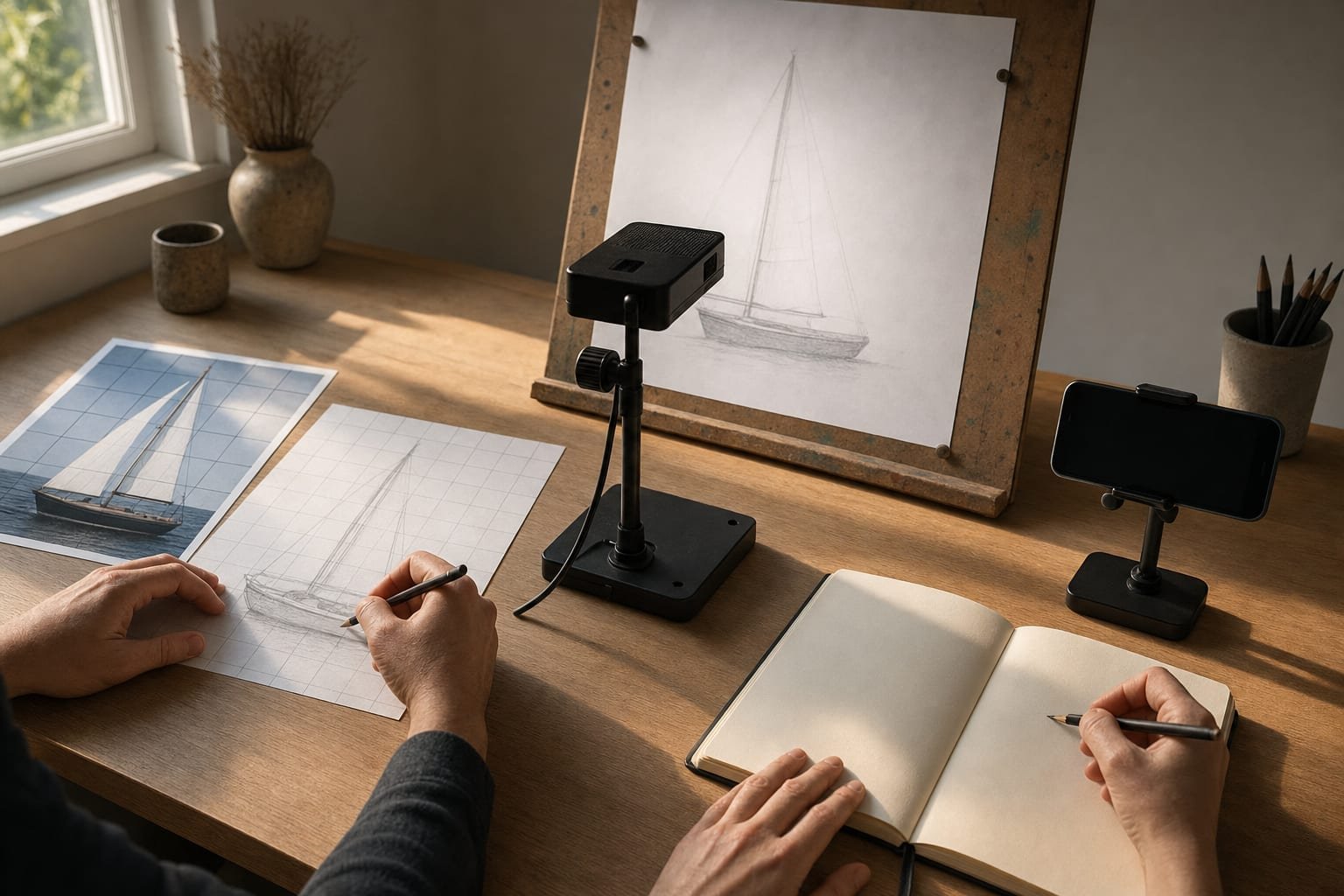
Every figurative artist eventually faces three options for transferring a reference image to canvas: the grid method (overlay matching grids on reference and canvas, copy cell by cell), projection (project the reference onto the canvas via overhead projector, opaque projector, or digital screen and trace the outlines), or tracing (lay the reference directly on or under the canvas and copy the lines). All three are valid; all three have trade-offs; none is "cheating." This guide walks through what each method actually delivers, what it costs, and when to pick which.
One of the guides behind the 82 composition overlays every visual artist should know and use.
Updated 2026-05-16 · By Sujith Puthran, Founder & Lead Developer
Contents
1. The "is it cheating?" question
The question deserves a direct answer up front. Using a grid, a projector, a lightbox, or a tracing-paper transfer is not cheating. It is a tool. The artist who uses it is doing what artists have always done — applying the best available technique to the proportional-transfer problem so they can focus their attention on what the tools cannot do for them. The rest of this guide explains what each tool does well, what each one trains, and how to combine them honestly across a working practice.
The genealogy of the "cheating" charge matters because it is recent. The 19th-century atelier system established freehand observational drawing as the master skill and treated transfer aids as appropriate only for production work. The mid-20th century romantic-virtuoso mythology — popularised by post-war art writing that idealised individual artistic genius — extended the atelier preference into a moral position. By the time most contemporary practitioners encountered the question, "freehand is honest, grids are cheating" had become a folk belief rather than an articulated position. The position dissolves under any historical examination, but the folk belief persists in art-school dorm-room debates and online forums.
1a. What each method actually is — clearing up the terms
The three terms cover overlapping techniques and people often use them interchangeably in ways that confuse the discussion.
Grid method. A rectangular grid drawn on the reference and a matching grid drawn on the destination surface. The artist transfers the contents of each source square into the corresponding destination square by hand. The source grid is a guide; the artist still draws each line. This is the technique Dürer published in 1525 and atelier traditions have taught continuously since.
Projection. An optical device (digital projector, camera obscura, opaque projector, slide projector) throws an image of the reference onto the drawing surface. The artist traces the projected outline. The projected image is a direct optical replication, and the artist's hand essentially copies what is already drawn in light.
Tracing. The reference and the drawing surface are in direct physical contact (or close enough that one is visible through the other), and the artist traces the underlying lines directly. Lightbox tracing, tracing-paper overlay, and transfer-paper carbon methods all fit this category.
The three methods sit on a spectrum from "the artist still does the proportional work" (grid) to "the artist mostly copies a presented outline" (tracing), with projection in between. The choice between them is partly about how much proportional eye-training you want to retain and partly about the practical scale and deadline of the work.
No serious figurative-art teacher today treats grid drawing, projection, or tracing as morally suspect. The "cheating" framing comes from a romantic ideal of pure freehand observational drawing that has never been universal practice — Renaissance and Baroque masters used optical aids extensively, and the 19th-century French academies built grid drawing into the standard curriculum. The Old Masters' workshops included camera obscuras, mirrors, perspective grids, and tracing devices alongside the easel.
What's "cheating" is misrepresentation: claiming a work is freehand when it's projected, or hiding the use of reference photography when the client believes the work is from life. The honesty matters more than the technique. A traced illustration disclosed as traced is professional; a traced illustration sold as freehand virtuoso work is deceptive. Tool use itself is morally neutral.
That said, the methods do differ in what skill they develop. If your goal is to become a competent freehand observational artist, the methods are not interchangeable — grid drawing trains skills projection and tracing skip. Understanding that distinction is what this guide is about.
2. The grid method — what it does well
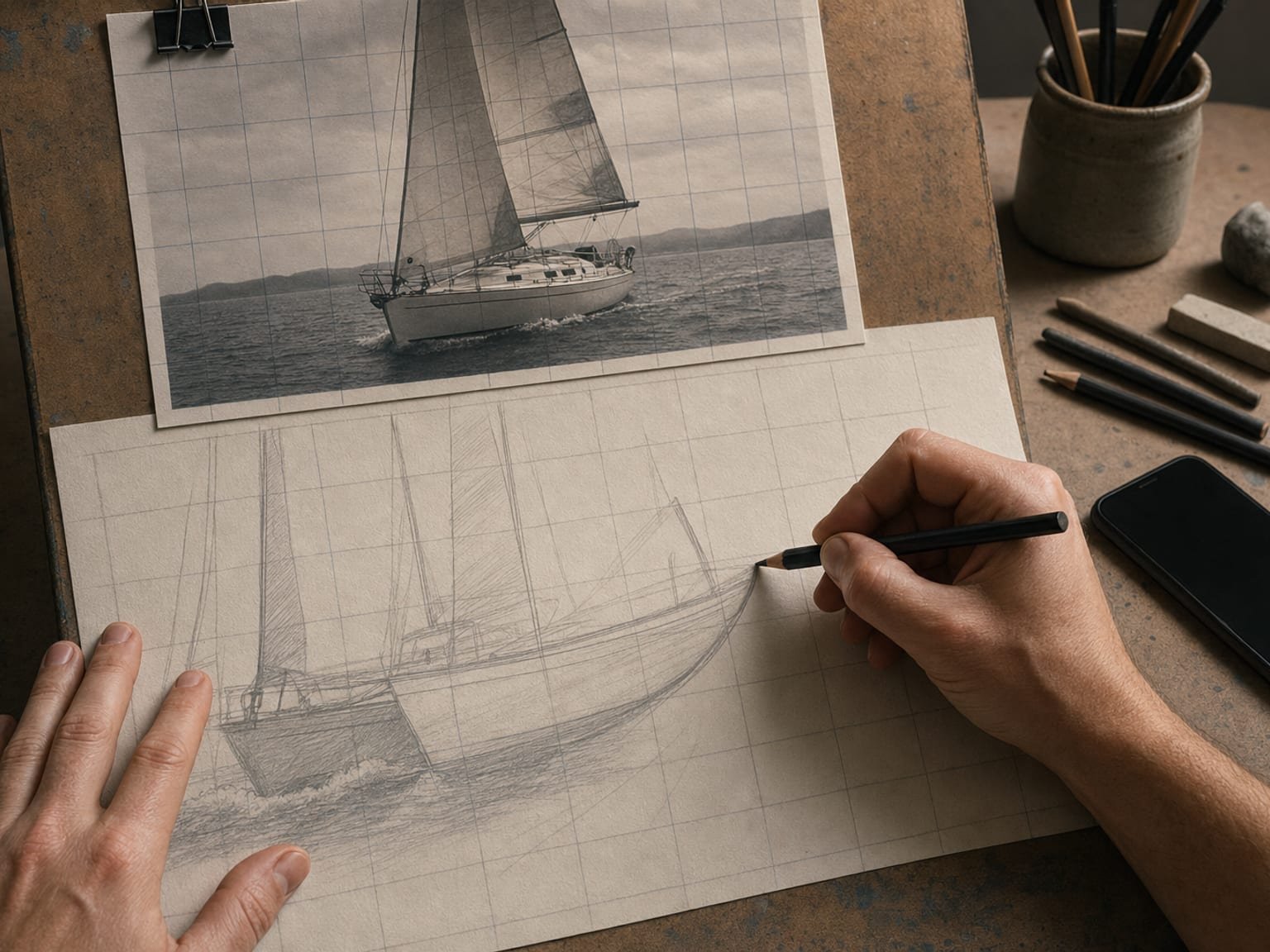
Overlay matching NxN grids on the reference and the canvas. Copy each cell's contents one at a time. Because each cell is the same proportion on both surfaces, proportional accuracy transfers automatically — the grid handles measurement so the artist handles drawing.
The grid method has been documented since at least 1435 (Alberti's De Pictura describes a "veil" — a gridded screen — used for this purpose). Dürer's Underweysung der Messung (1525) included the famous woodcut Draftsman of the Recumbent Woman showing the technique. The Renaissance "squaring up" workflow used grids to scale small studies to large finished works. Every classical-realist atelier today still teaches it in week one.
Strengths: Trains the "measuring eye" — students who work through grid drawing for months internalise proportional relationships that transfer directly into freehand observational drawing later. Works at any scale (small study to mural). No special equipment required (just printed grids on reference and canvas). The cheapest of the three methods.
Costs: Slow. A 16×16 grid transfer of a complex reference can take hours. Doesn't help with photo-distorted reference (lens warping, perspective compression) — the grid transfers the distortion faithfully. Doesn't develop edge or value skill, only proportional placement.
Tools: Grid Maker Pro for the digital overlay, or printed gridded paper plus drawn-grid canvas for traditional work.
3. Projection — what it does well
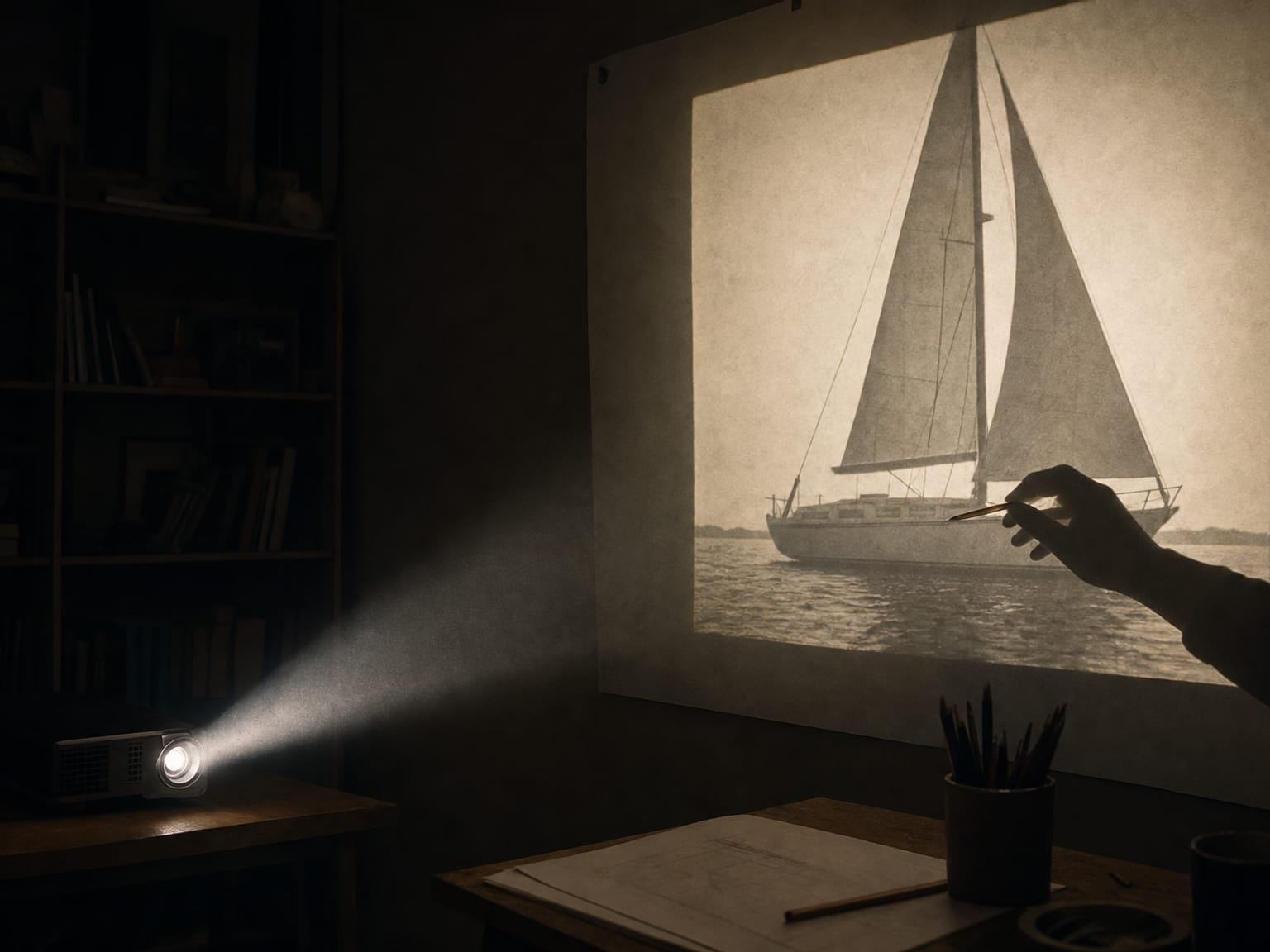
Project the reference image onto the canvas at 1:1 scale via an opaque projector, digital projector, or smart-device screen plus mirror rig. Trace the projected outlines lightly in pencil. Refine the drawing freehand from the traced base. The projected reference establishes the position and basic shape; the artist fills in everything else.
Projection has been used in commercial illustration since the early 20th century — opaque projectors (the "Lucy" / Lucida being the most famous brand) were standard equipment in advertising and editorial illustration studios from the 1930s through the 1980s. Digital projectors and tablet-mirror rigs have replaced opaque projectors in modern commercial practice, but the principle is the same.
Strengths: Fast — a complex reference can be projected and outlined in minutes rather than hours. Eliminates proportional error entirely (the projected image IS the reference at exact scale). Works well at mural scale (overhead projection can throw an image onto a wall at any size). Useful for tight commercial deadlines where the client values speed and accuracy over expressive interpretation.
Costs: Doesn't develop measuring skill at all. The artist who relies on projection often can't draw competently freehand because they've never trained the measuring eye. Requires equipment (a projector or screen-mirror rig). Lighting matters — projected images are dim, so traditional studio lighting needs to be reduced to see the projection. Doesn't help with photo distortion any more than gridding does.
Tools: Opaque projector (Artograph, Tracer Jr.), digital projector with the reference loaded as an image, or an iPad/laptop screen mirrored to a piece of glass over the canvas.
4. Tracing — what it does well
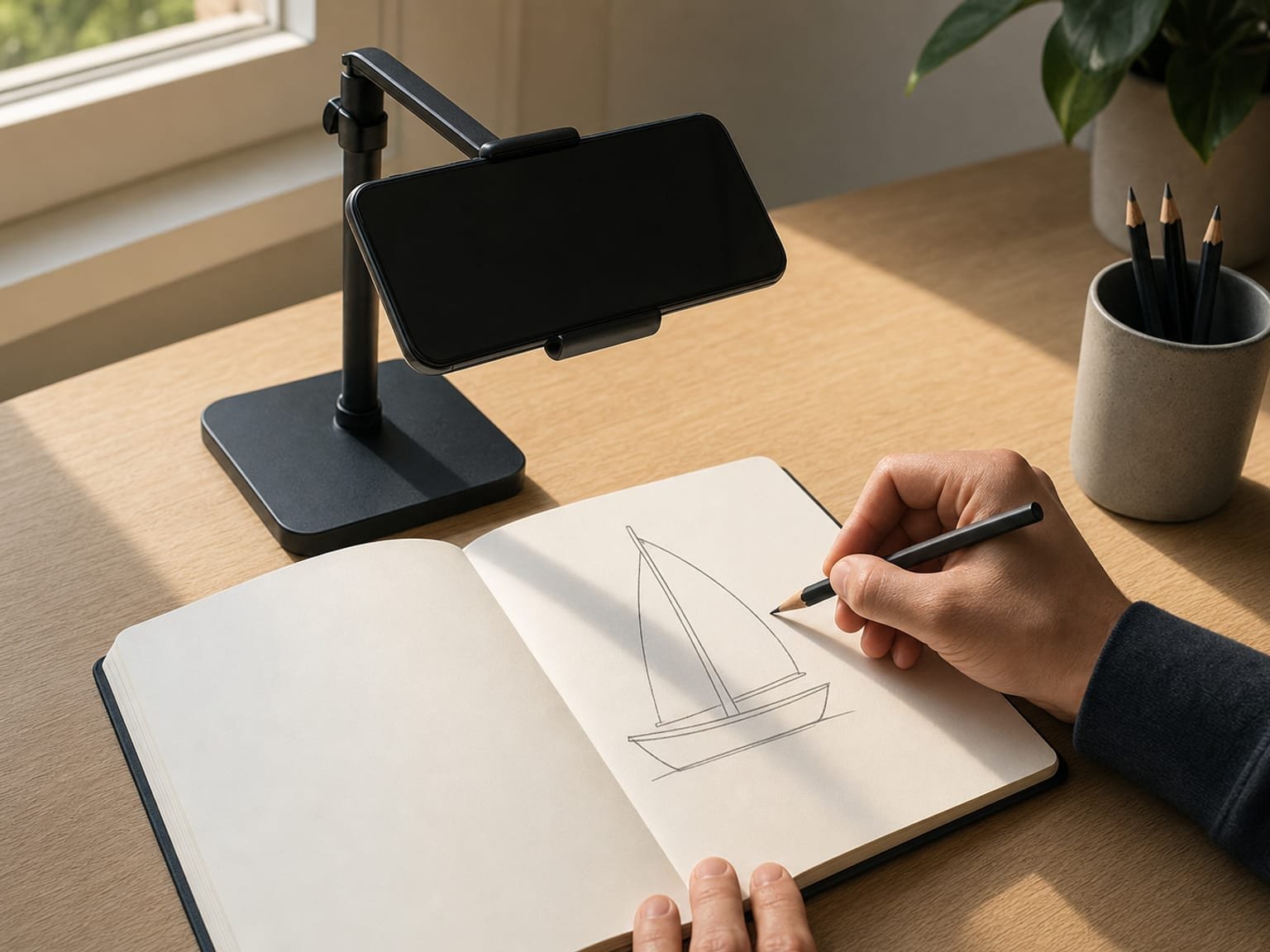
Lay the reference image directly under (or over) the canvas and copy the outlines through. Variants: tracing paper (cheap, immediate), light box (back-lit glass surface that makes the reference visible through opaque paper), and graphite transfer paper or carbon paper (a coated sheet placed between reference and surface that transfers the reference outlines as pressure marks). Modern variant: tracing from a tablet screen propped behind a translucent canvas.
Tracing has the longest continuous history of the three methods — pre-modern artists used tracing extensively whenever the reference was the same scale as the working surface. The use of tracing in classical art is well documented; Vermeer, Caravaggio, and many others almost certainly traced specific elements of their compositions. Modern commercial illustration uses tracing routinely.
Strengths: Fastest of the three methods. Most accurate at 1:1 scale (the outlines transfer exactly). Trivial to learn and apply. Useful for technical illustration where line accuracy matters more than expressive interpretation. Works at any scale up to the reference's printable size (4×6 photo to 4×6 canvas; A4 print to A4 canvas).
Costs: Constrained to reference scale — can't scale up to mural-size work without an intermediate step. Like projection, doesn't develop measuring or proportional skill. Reference distortion transfers exactly (the photo's perspective compression or lens warping ends up in the finished work).
Tools: Tracing paper, light box (Huion and Artograph make affordable models), carbon paper, or a translucent canvas over a screen.
5. What each method trains (and doesn't)
The critical difference between the three methods is what they develop in the artist over time.
Grid method trains: Proportional measurement (the "measuring eye"), patience, observational discipline, understanding of part-to-whole relationships. Six months of daily grid drawing produces noticeable improvement in freehand observational drawing because the measuring skill transfers directly. The grid is, in this sense, a teaching tool first and a transfer tool second.
Projection trains: Line confidence (you're drawing lines that already exist, so there's no fear of placement error), composition adaptation (you can adjust the projected image's size and position before tracing), and some edge skill (you have to decide how strongly to trace each line). Doesn't develop measuring; doesn't develop value or shading (the projection only shows outlines).
Tracing trains: Line quality and edge variation. A skilled tracer doesn't slavishly follow the underlying line; they make decisions about line weight, edge softness, and which details to include. This trains an aspect of finished drawing that grid and projection don't really touch.
The methods aren't mutually exclusive in terms of skill development — a complete figurative artist usually has competence in all three plus pure freehand observational drawing. But during training, the choice of method affects which skills develop. If you're trying to become a competent freehand artist and you projection-trace everything, you're slowing your own development. So when people ask whether the grid method builds drawing skill, the honest answer is: yes, more than projection or tracing, because it is the only one of the three that exercises freehand drawing skill through repeated hand-measured proportional judgement.
6. Decision guide: which method when
Use the grid method when: you're training (anywhere in your first 10,000 hours), you're working from a reference at a different scale than your canvas, you're doing observational work where proportional accuracy matters, you want to develop the measuring eye for later freehand work.
Use projection when: you have a tight commercial deadline, you're working at mural scale, the reference is the composition (no interpretation needed, just transfer), you've already trained your measuring eye and the work is downstream of that skill.
Use tracing when: the reference is the same scale as the canvas, line accuracy matters more than measuring practice, you're producing technical illustration where the reference is dimensionally exact (engineering drawings, blueprints, scientific illustration).
Use freehand observational drawing when: you're working from life (the model or scene is in front of you), you're training the measuring eye through pure observation, you're producing work whose expressive content depends on visible artistic interpretation rather than reference-precise accuracy.
5. Time-and-scale comparison — how long each method takes
Practical decision-making between the three methods comes down to time, scale, and the artist's training goal. A short comparison for a typical portrait reference at A3 (~30 × 42 cm) destination size:
- Freehand observational. 90-180 minutes for a careful proportional layout, depending on the artist's measuring eye. Develops the eye but at the highest time cost. Standard atelier-training expectation.
- Grid method. 30-60 minutes for the layout phase (gridding both surfaces, transferring square by square). Develops proportional measurement at modest cost. Standard self-portrait-class expectation.
- Projection. 10-20 minutes for setup and tracing once the projector is positioned. Develops nothing about proportion. Standard commercial-illustration deadline expectation.
- Tracing. 5-15 minutes for direct tracing if reference is already at final size. Develops nothing about proportion. Standard same-size transfer expectation.
Triple the times above for mural-scale work (1-3 m destination), and the methods reorder: freehand becomes effectively impossible at scale, grid becomes slow but useful, projection becomes the standard, tracing becomes impractical unless the reference can be printed at full size. This is why mural and large-scale work is dominated by projection regardless of any "is it cheating" considerations — the alternatives don't work at the scale.
5a. The grid method — step-by-step practical setup
The grid method is the most documented of the three transfer techniques but the one beginners most often set up wrong. The classical setup, as taught in atelier and self-portrait traditions:
- Choose your grid spacing. The rule of thumb: grid squares should be small enough that any one square contains only a small amount of detail, but large enough that you have at most 20-40 squares across the longer dimension of the reference. For a typical portrait reference at 20 × 25 cm, 2.5 cm squares produce an 8 × 10 grid — manageable. For a complex multi-figure reference, smaller squares (1.5 cm or 1 cm) at 13-20 across the longer dimension.
- Mark the grid on the reference. If you can't draw on the original, photocopy or print at full size and grid the copy. If you're working digitally (Grid Maker Pro's grid overlay applied to a reference photo), the grid appears as a visible overlay you can toggle on and off without modifying the source image.
- Build a matching grid on the drawing surface. The destination grid must use the same number of squares as the source — but the squares can be larger or smaller depending on your final size. Doubling the square size doubles the final drawing's dimensions; halving the square size halves them. This is the scaling property that makes the grid the standard method for scaling up a drawing or enlarging a drawing from a small study, and the reason the muralist's grid (the chalk-line grid snapped onto a wall) is still the cheapest way to scale a reference image to architectural size.
- Draw square by square. Pick a square on the source. Identify the contour or features in that square. Reproduce them in the corresponding destination square. The mind treats each square as an independent simple-shape drawing problem rather than as part of the larger complex problem. This is the cognitive trick that makes the method work for beginners.
- Erase the grid lines after transferring. The grid is scaffolding. The finished drawing should not show it. Use a kneaded eraser to lift the grid lines gently without disturbing the transferred drawing.
The most common mistake is using grids that are too coarse — 4 × 5 grids for a complex portrait, where each square contains too much detail for the per-square cognitive simplification to help. The second most common mistake is rushing the transfer phase. The grid method is faster than freehand observational drawing but it is not fast; budget an hour for a careful 20-square transfer.
5b. Projection — practical setup and limits
Projection covers two related techniques. The first is light-projection, where a digital projector or older slide projector throws the reference image onto the drawing surface, and the artist traces the projected outline. The second is camera obscura projection, where a small aperture in a darkened room casts the inverted image of an external scene onto a screen or surface for tracing or compositional study. Camera obscura is the historical method; light projection is the contemporary equivalent.
Light-projection setup. A small portable projector (~£100-300 for adequate resolution) sits on a stable surface, pointed at the canvas. The reference image is loaded onto a connected laptop or directly from a USB drive. Distance and angle determine the final size; testing usually requires moving the projector and re-aiming several times to fit the reference onto the canvas at the desired scale. Lighting around the canvas should be dim enough that the projected image is clearly visible but not so dark that the artist cannot see their own drawing materials.
Limits. Projection only works for clean line transfer; tonal information and colour cannot be projected usefully (the artist still has to interpret value and colour by eye). Projection cannot be re-done easily if the canvas moves between sessions — the projector position would need to be exactly recreated. And projection is brittle: a slight bump to either the projector or the canvas misaligns the image, and the artist has to re-trace from the new position rather than continuing the old transfer.
Mural-scale projection is the technique's strongest application. Murals at 3-10 m scale cannot be gridded efficiently (the grid squares would either be too large to be useful or too numerous to track); projection from a digital file gives the artist a 1:1 outline transfer in minutes that would take days by other methods.
5c. Tracing — practical setup and the lightbox
Tracing requires the source image and the drawing surface to be in the same physical place at the same time. The two most common setups are tracing paper laid directly on a print, and a lightbox under translucent paper.
Tracing-paper setup. Print or photocopy the reference at the desired final size. Lay tracing paper over it. Trace the outline with a hard pencil (HB or H) using light pressure. Lift the tracing paper. The result is a clean outline transfer ready for further work. The technique is fast (10-20 minutes for most figurative subjects) and gives perfect outline accuracy.
Lightbox setup. A lightbox is a flat translucent surface with light underneath; the reference goes on top of the lightbox, the drawing surface goes on top of the reference, and both become visible to the artist who traces the underlying image through the drawing surface. The technique works only with thin enough drawing surfaces (vellum, tracing paper, thin printer paper) — heavyweight paper blocks the light. Animators, illustrators, and tattoo-stencil makers all use lightboxes routinely.
Limits. Tracing only works at 1:1 scale. There is no scaling — the source has to be printed at the final size. For most figurative work this is the limiting factor; you need to print or photocopy the reference at the final canvas size, which means either a large-format printer or a reference image whose final size is small (under A3 / 11×17 inches). For larger work, projection is faster than the print-tile-and-assemble alternative.
7. Brief history: Vermeer, Caravaggio, and the optical-aid debate
David Hockney's Secret Knowledge (2001) and Philip Steadman's Vermeer's Camera (also 2001) argued that the great Renaissance and Baroque painters used optical aids — camera obscuras, concave mirrors, projection devices — far more extensively than art-historical orthodoxy had acknowledged. The case is strongest for Vermeer (his interior paintings show optical-projection characteristics like specific bokeh and perspective effects); plausible for Caravaggio (his sudden mid-career shift to highly photographic-looking compositions suggests new technical aids); and contested for many others.
The debate matters here because it dissolves the modern "purist" view that classical masters worked freehand and contemporary use of grids / projection / tracing is therefore degenerate. The historical record is more honest: optical aids have been part of figurative practice since at least the 15th century, used openly when the technique was respectable and quietly when it wasn't. The contemporary use of grid tools, projectors, and tracing continues a 600-year-old tradition rather than violating one.
Steadman's analysis of Vermeer's The Music Lesson reconstructs the room geometry and shows it matches camera-obscura projection geometry to within 1cm. Hockney's broader case (the "Hockney-Falco thesis") covers Bellini, Caravaggio, Velázquez, Ingres, and others — Hockney argued specifically that Ingres used the camera lucida, a prism-on-a-stand drawing aid patented in 1806 that lets the artist see the subject and the paper superimposed. Critics — notably David Stork — argue the evidence is circumstantial; the debate remains active. What's clear: from the old masters' tools to today's digital overlays, artists of all eras have used the best tools available to them, and the modern shame around "cheating" with transfer techniques is historically anomalous.
7. Famous artists who used each method openly
The "transfer aids are cheating" position is harder to defend after a quick survey of who has used these methods openly across art history.
Grid method. Albrecht Dürer published the technique in Underweysung der Messung (1525) with engravings showing the artist using a gridded glass plate to draw a foreshortened figure. The technique was taught in every European academic tradition from the 16th century onward; Ingres, Delacroix, and the entire 19th-century French academic painting tradition used gridded transfers routinely for compositional studies and final-canvas layouts. In contemporary practice, Jenny Saville, Chuck Close, and most of the photorealist tradition use gridded transfers explicitly and discuss them in interviews.
Camera obscura projection. Vermeer's use of the camera obscura is the most-discussed case in art history. Philip Steadman's Vermeer's Camera (2001) reconstructs the room geometry in The Music Lesson and other interior paintings; the geometry matches camera-obscura projection so closely that the alternative explanation (Vermeer freehanded the perspective by inhuman skill) is harder to defend than the camera-obscura hypothesis. Canaletto's Venetian view paintings show similar optical-projection characteristics, including the specific lens distortions of period camera obscuras. Joshua Reynolds, Joseph Wright of Derby, and many other 18th-century portrait painters owned camera obscuras and discussed their use in correspondence.
Tracing. The medieval and Renaissance pricked-and-pounced cartoon transfer (a tracing technique where the artist pricks small holes along the lines of a paper cartoon and brushes charcoal dust through to mark the destination surface) is documented in surviving works by Michelangelo, Raphael, and every major fresco painter of the period. The Sistine Chapel ceiling cartoons survive and show the pricking holes. Contemporary commercial illustration uses lightbox tracing routinely; the Disney animation tradition is built on lightbox-based key-frame and in-between tracing.
The pattern across art history: when the work is large-scale (frescoes, murals, ceiling paintings) or production-oriented (commercial illustration, animation, decorative arts), transfer methods are universal. When the work is small-scale individual studio painting marketed on the artist's individual virtuosity, transfer methods are used but often quietly. The reluctance to discuss transfer use openly is a marketing decision, not a craft one.
7a. Hybrid workflows — combining transfer methods with freehand work
Most working figurative artists do not use any single transfer method exclusively. The honest workflow is hybrid — using the right tool for the right phase of the work.
Layout phase — grid or projection. Get the overall proportional layout right quickly with grid or projection transfer. This is the phase where mistakes are expensive (a misplaced figure has to be redrawn from scratch) so investing the small time cost of a transfer technique pays off.
Major-form refinement — freehand observational. Once the layout is right, switch to freehand observation for the major-form refinement. Look back at the reference and refine the contours, the proportions of the head against the shoulders, the placement of features within the face. This phase develops the eye in ways the transfer phase doesn't.
Finish — freehand interpretive. The final tonal, colour, and edge-quality work is freehand interpretive — there is no transfer method that helps with these decisions, which are about the artist's vision rather than the reference's geometry. This is where the artist's voice lives.
The hybrid pattern lets the artist benefit from the speed and accuracy of transfer methods without sacrificing the eye-training of freehand work. It is also the pattern most working illustrators, portrait painters, and concept artists actually use, even when they don't articulate it.
7b. What students should practise versus what professionals should ship
The clearest way to navigate the "is it cheating?" question is to separate practice from production.
In practice — the work you do to develop your eye and your craft — minimise transfer aids. Draw from observation, build your measuring eye, work through Bargue plates, do figure-drawing sessions where time pressure forces you to develop quick proportional judgement. The whole point of practice is to develop the skills you cannot develop while using transfer aids.
In production — the work you deliver to clients or sell — use whatever combination of techniques produces the best result within the deadline and budget. Clients pay for finished work that meets the brief; they do not pay for the artist to have gone through a specific learning process. Production should benefit from the practice you have done elsewhere.
The mistake beginners often make is using transfer aids during practice (because they make the practice easier and the results more satisfying short-term) while feeling that this is the "real" way the technique should be used. It isn't. The practice has to be hard for it to develop the skills production later relies on. The professional who can draw a head freehand in 20 minutes has earned that skill through years of practice without the projector; they are entitled to use the projector for production work because the underlying skill has been developed.
7c. The special case — photo-realism and hyperrealism
Photo-realist and hyperrealist painting is a special case that bears mentioning because the genre's marketing often emphasises freehand virtuosity in ways that misrepresent the actual practice. The honest position: nearly all working photo-realists use grid or projection transfer for the layout phase, and many use grid systems for the rendering phase as well (working square-by-square through the entire painting rather than only the initial layout). Chuck Close's work was openly built around gridded transfer from photographs; Audrey Flack, Richard Estes, and contemporary photo-realists routinely use slide projection or digital projection. The freehand-only photo-realist is essentially a marketing fiction.
This is not a criticism of the genre — photo-realism's craft difficulty lies in the rendering, the colour matching, the edge handling, and the surface treatment, not in the proportional transfer. The transfer is the boring part of the work and using efficient tools for it is rational. The misrepresentation comes when the marketing emphasises virtuosity in a phase of the work where the artist actually used a tool.
8. Honest practice and disclosure
The professional standard in commercial figurative illustration is to use whatever transfer technique fits the deadline, the scale, and the project — and not to lie about which technique you used. Clients who care will ask; serious clients usually don't, because the finished work is what matters.
The professional standard in fine-art figurative work is more complicated because the market sometimes places a premium on "freehand virtuoso" work and disadvantages artists who use transfer aids. The honest path is to disclose technique when asked, to use the method that produces the best finished work, and to develop freehand skill in parallel so that "freehand" isn't a marketing claim you can't back up.
The professional standard in atelier and academic figurative work is to use grid drawing for training and to develop freehand observational competence as the long-term goal. Projection and tracing are typically discouraged during training because they don't develop the measuring eye — but they're acceptable for finished commission work after the training period.
None of the three methods is "cheating." All three are tools. The artist's skill is what interprets what each tool delivers — and across a career, the artist's skill is what makes the work worth looking at, regardless of which transfer technique got the proportions right.
Frequently asked questions
Is using a grid to draw cheating?
No. The grid method is a measuring aid, not a shortcut around the drawing itself — you still observe and reproduce every line by hand, cell by cell. It is the most skill-building of the three transfer methods because it trains the measuring eye that carries over into freehand drawing skill. Albrecht Dürer published the technique openly in 1525, and academies have taught it continuously since, so it is hard to call a 600-year-old teaching method cheating. What would be dishonest is selling traced or projected work as freehand virtuoso work; using a grid to get proportions right is not.
Do professional artists use grids and projectors?
Routinely. Chuck Close built his work around gridded transfer from photographs; Jenny Saville and much of the photorealist tradition use grids explicitly and discuss them in interviews. Projection has been standard in commercial illustration since the 1930s, and muralists rely on it because nothing else scales a reference image cleanly to wall size. The pattern across art history is consistent: large-scale and production work uses transfer methods openly, while individual studio painting marketed on virtuosity sometimes uses them quietly.
Is using a projector cheating?
No more than using a grid or tracing is cheating. All three are image-transfer techniques that handle proportional accuracy so the artist can focus on observation, value, edge quality, and craft. The "cheating" charge confuses tool use with the underlying skill that interprets what the tool delivers. Vermeer almost certainly used a camera obscura; Caravaggio likely used optical projection; the Renaissance grid method was published openly by Dürer in 1525. Tool use is not a moral failing.
Which method develops the most skill?
The grid method, because it forces you to measure proportional relationships explicitly and to reproduce them by hand. Projecting and tracing skip the proportional-measurement step entirely, so they don't develop the "measuring eye" that grid drawing trains. If your goal is freehand observational drawing competence, grid is the only one of the three that builds toward it directly. If your goal is producing finished work efficiently, all three are valid tools.
When is tracing actually appropriate?
Commercial illustration on tight deadlines, mural-scale work where freehand transfer would compound errors, technical illustration where exact line accuracy matters more than expressive interpretation, and any work where the reference image IS the composition (you're not interpreting it, you're transferring it). Tracing is problematic mainly when artists hide it while claiming the work is freehand — the honesty matters more than the technique.