Polar / radar scientific plot
Antenna gain, microphone pickup, and radar returns are all naturally functions of angle. Plotted on linear rings and evenly spaced spokes, a lobe's reach reads directly off the radius at each bearing.
A polar grid lays down concentric rings and radial spokes, locating every point by an angle and a radius instead of by horizontal and vertical position. Over that field you can drop a spiral: an Archimedean spiral whose coils sit an equal distance apart, or a logarithmic spiral whose coils grow by a constant ratio and never change shape. It is the drawing surface for two very different jobs — the scientist's radiation plot and the artist's shell — and the one place the math of spirals and the geometry of growth share a page. Here is what the overlay does, the coordinate math behind it, the verified line from Archimedes to Bernoulli's spira mirabilis, and the honest truth about the nautilus that the internet keeps getting wrong.
One of the 82 composition overlays every visual artist should know and use.
A polar grid wants a centre. Place the pole on the subject's point of rotation, then read features by their angle and distance rather than left-right and up-down.
The polar overlay draws two families at once. The first is a set of concentric rings centred on a single pole, spaced either evenly (linear) or by a constant ratio (geometric). The second is a fan of radial spokes at fixed angular steps — twelve spokes at 30° apart is the textbook polar-plot setting. Together they turn the canvas into a field of (angle, radius) cells, so a point is named by how far around and how far out it sits rather than by x and y. Ring count, spoke count, line weight, opacity, and the position of the pole are all adjustable so the grid reads over a dark photograph as cleanly as a blank sheet.
On top of that field the overlay can lay a spiral curve. An Archimedean spiral steps outward by the same amount each turn, hugging evenly spaced rings; a logarithmic spiral multiplies its radius each turn, riding geometrically spaced rings and keeping a constant pitch angle. When the ring spacing matches the spiral type, the curve threads cleanly through ring-and-spoke intersections — which is exactly the alignment you want when drafting a shell, a seed head, or a clock spring by hand.
A polar grid is the picture of polar coordinates. Every point is a pair (r, θ) — a radius out from the pole and an angle around it — converted to ordinary coordinates by x = r·cos θ and y = r·sin θ. The two spiral families differ only in how r depends on θ:
Archimedean: r = a + bθ · Logarithmic: r = a·e^(bθ)
Three facts fall out of that one difference:
The grid does the coordinate bookkeeping for you — rings carry the radius, spokes carry the angle, and the spiral mode draws the exact curve. Try it in the live tool and set the ring spacing to match your subject.
c. 225 BC — Archimedes. In his treatise On Spirals, preserved in Heath's standard edition of The Works of Archimedes, Archimedes defines and analyses the spiral that now bears his name — a point moving outward at constant speed while a ray rotates at constant angular speed, giving the even coil spacing of r = a + bθ.1
Late 17th century — Jakob Bernoulli. Bernoulli studied the logarithmic, or equiangular, spiral and was so taken with its self-similarity that he asked for it on his gravestone with the motto Eadem mutata resurgo. The number e that the curve's equation depends on has its own well-told history in Eli Maor's account.2
1917 — D'Arcy Thompson. In On Growth and Form, Thompson devoted a celebrated chapter to the equiangular spiral in shells and horns, showing that biological growth which adds material without changing proportion necessarily produces a logarithmic spiral.4 Theodore Cook's earlier survey The Curves of Life had already gathered spiral forms across nature, science, and art into one volume.3 The geometry of these curves is catalogued precisely in Lockwood, Lawrence, and Coxeter.67
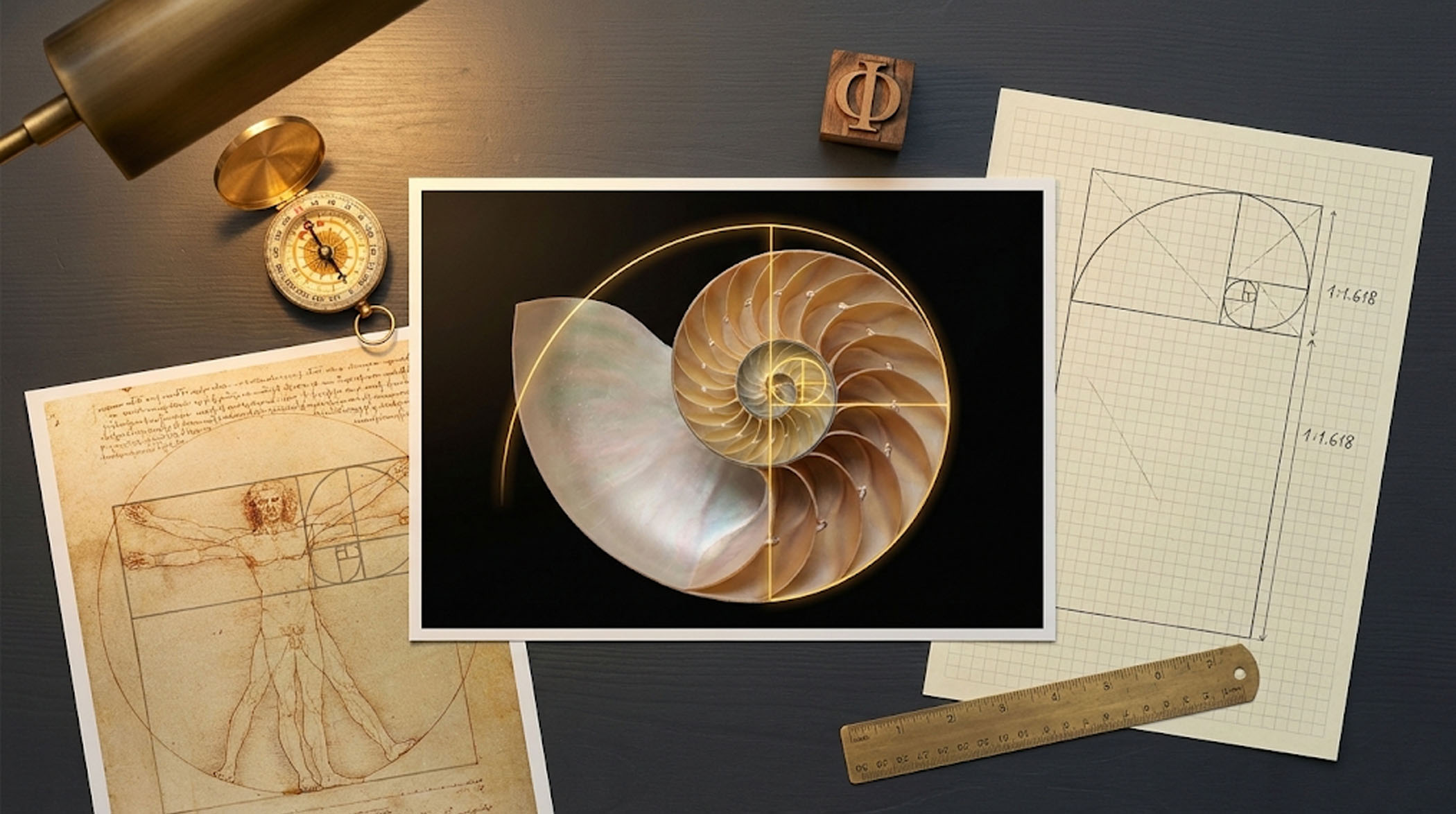
The nautilus is logarithmic but not golden. The single most repeated spiral claim — that the chambered nautilus is a golden spiral — does not survive measurement. The nautilus is a logarithmic spiral, but its growth factor is roughly 1.3 per turn, well short of φ ≈ 1.618. Mario Livio walks through the data and the myth-making in detail.5 The nautilus is logarithmic; the golden spiral is logarithmic; they are not the same curve.
"The golden spiral is everywhere" is overstated. Logarithmic self-similarity genuinely is common in nature, but a particular golden growth factor is not. Most natural spirals are logarithmic without being golden, and retrofitting a golden spiral onto a photograph usually says more about the overlay than the subject.5
Archimedean and logarithmic spirals are different and routinely confused. The two look superficially alike but obey different laws — additive versus multiplicative growth. The confusion is old: by tradition the mason who carved Bernoulli's tombstone cut an Archimedean spiral in place of the logarithmic one he had requested.2 Choosing the wrong one for a subject produces a curve that looks approximately right and reads subtly wrong.
| If you want to... | Use the polar / spiral grid | Don't use it for... | Difficulty |
|---|---|---|---|
| Plot data with rotational symmetry (radiation, radar, wind rose) | Linear rings + evenly spaced spokes give true polar-plot paper, measurable by angle and radius | Tabular or time-series data with a natural left-to-right axis (use a Cartesian grid) | Intermediate |
| Draft an even-coiled spiral (clock spring, spiral antenna) | Linear ring spacing + an Archimedean spiral keep every coil the same distance apart | Natural-growth subjects whose coils clearly widen (use logarithmic instead) | Intermediate |
| Construct a shell, horn, or galaxy arm | Geometric rings + a logarithmic spiral match self-similar growth and keep proportion | Mechanical parts needing uniform spacing (use Archimedean instead) | Advanced |
| Analyse a seed head or pinecone (phyllotaxis) | The 137.5° golden-angle packing reveals the interlocking spiral families | Subjects with no rotational centre or growth point | Advanced |
| Lay out a volute, rose window, or radial ornament | Rings and spokes constrain placement to a clean set of angular positions | Rectilinear architecture and product forms (use isometric or a square grid) | Intermediate |
Six places where a polar field or a specific spiral is demonstrably the structuring system, with the analysis to back it.
Antenna gain, microphone pickup, and radar returns are all naturally functions of angle. Plotted on linear rings and evenly spaced spokes, a lobe's reach reads directly off the radius at each bearing.
A balance-wheel hairspring and a flat spiral antenna both want constant coil spacing so the part winds and unwinds evenly. That even spacing is the visual signature of r = a + bθ.
Seeds set at the 137.5° golden angle fill the head with two opposing spiral families whose counts are consecutive Fibonacci numbers — the densest packing on a growing disc.
A record's groove is a single Archimedean spiral cut from rim to label so the stylus tracks a constant-spaced path. The even coil pitch is what lets a side hold a predictable run time.
Storm bands and spiral-galaxy arms widen as they sweep outward — logarithmic curves with a roughly constant pitch angle. They are self-similar, not evenly spaced, and almost never golden.
The Ionic volute and wrought-iron scroll are drawn spirals of long pedigree. Set on a polar grid, the carver or smith fixes the eye, the pitch, and the number of turns before committing the curve.
Most natural spirals — shells, storms, galaxies — are logarithmic, but only a curve growing by φ per quarter-turn is golden. Labelling any handsome spiral "golden" repeats a measurement error rather than describing the subject.
An Archimedean spiral on geometrically spaced rings, or a logarithmic spiral on evenly spaced rings, drifts off the intersections within a turn or two and the construction loses its alignment.
A polar grid only measures cleanly when its pole sits on the subject's true centre. Drop it on the wrong point and every ring and spoke reports the wrong angle and radius.
Buildings, books, and boxes have no rotational centre, so rings and spokes give you nothing to align to and the overlay just adds noise.
Shells, horns, seed heads, and storm systems are the polar grid's home ground. Set the pole on the growth point, switch the rings to geometric spacing, and overlay a logarithmic spiral whose factor you tune to the specimen rather than to a legend. Drawing the actual curve a subject follows — and labelling it logarithmic rather than golden — is the difference between an illustration and a decoration.
Anything indexed by direction — antenna and microphone patterns, wind and current roses, radar and sonar displays — belongs on a polar plot. Keep the rings linear so the radius stays a faithful scale, choose a spoke count that matches your bearings, and resist bending the angular axis. The grid constrains placement to a small set of canonical positions, the way a column grid does in layout.
Volutes, rosettes, ironwork scrolls, and radial borders are spirals and angular repeats by nature. Fix the eye of the scroll on the pole, decide the pitch and number of turns on the grid, then commit the curve. An Archimedean spiral gives the steady rhythm of a border; a logarithmic one gives the accelerating sweep of a carved volute.
The polar grid is the cleanest way to make the (r, θ) idea concrete: students see the radius on the rings and the angle on the spokes before they ever touch the conversion to x and y. Switching between an Archimedean and a logarithmic spiral on the same field turns the additive-versus-multiplicative distinction into something visible rather than algebraic.
"Eadem mutata resurgo — though changed, I rise again the same."
Jakob Bernoulli, the motto he chose for the logarithmic spiral, his spira mirabilis2

Illustrative composites of how the tool gets used in practice — not quotes from named individuals.
When I draw a shell I set the pole on the eye and switch to geometric rings before anything else. The deep-link reopens with the logarithmic spiral already configured, so I am drafting the real curve in seconds.
Antenna patterns live and die on the polar axis being honest. Linear rings, twelve spokes, no bending the angles — the bookmarkable URL means my whole team opens the exact same grid.
For an Ionic volute I fix the eye, set the turns, and let the Archimedean overlay carry the rhythm. Free and browser-only means I drop a photo of the carving straight onto the grid instead of redrawing it.
Drop a reference image. The polar grid applies in one click, with linear or geometric rings and an Archimedean or logarithmic spiral. Free, in your browser.
Launch Grid Maker Pro →The polar and spiral grid overlay is free here in your browser, forever — drop a reference and it applies in one click. The single job a browser can't do is put that reference onto a physical page, so the Grid Maker Pro AR app holds the image over your paper or canvas through the phone camera and lets you trace it by hand at any size. Same 82 overlays; AR tracing is the paid part.
How AR tracing works → Free web tool, free forever · AR tracing is the separate paid app