
Avalon Hill hex wargames
The hex-and-counter format that made the hexagon a game surface. Every counter moves a fixed number of equidistant cells, so terrain becomes arithmetic and the diagonal argument disappears.
A hexagonal grid tessellates the plane with regular six-sided cells in a honeycomb pattern, so every interior cell shares an edge with six equidistant neighbours — no separate, longer diagonal the way a square grid has. That single uniform adjacency is why tabletop maps abandoned squares for hexes, and the same shape's least-wall efficiency is why bees, foams, and graphene settle into it. Here is what the overlay lays down, the packing math behind it, the verified history from the three regular tilings to the hex wargame, and when a hexagonal grid earns its place over a square one.
One of the 82 composition overlays every visual artist should know and use.
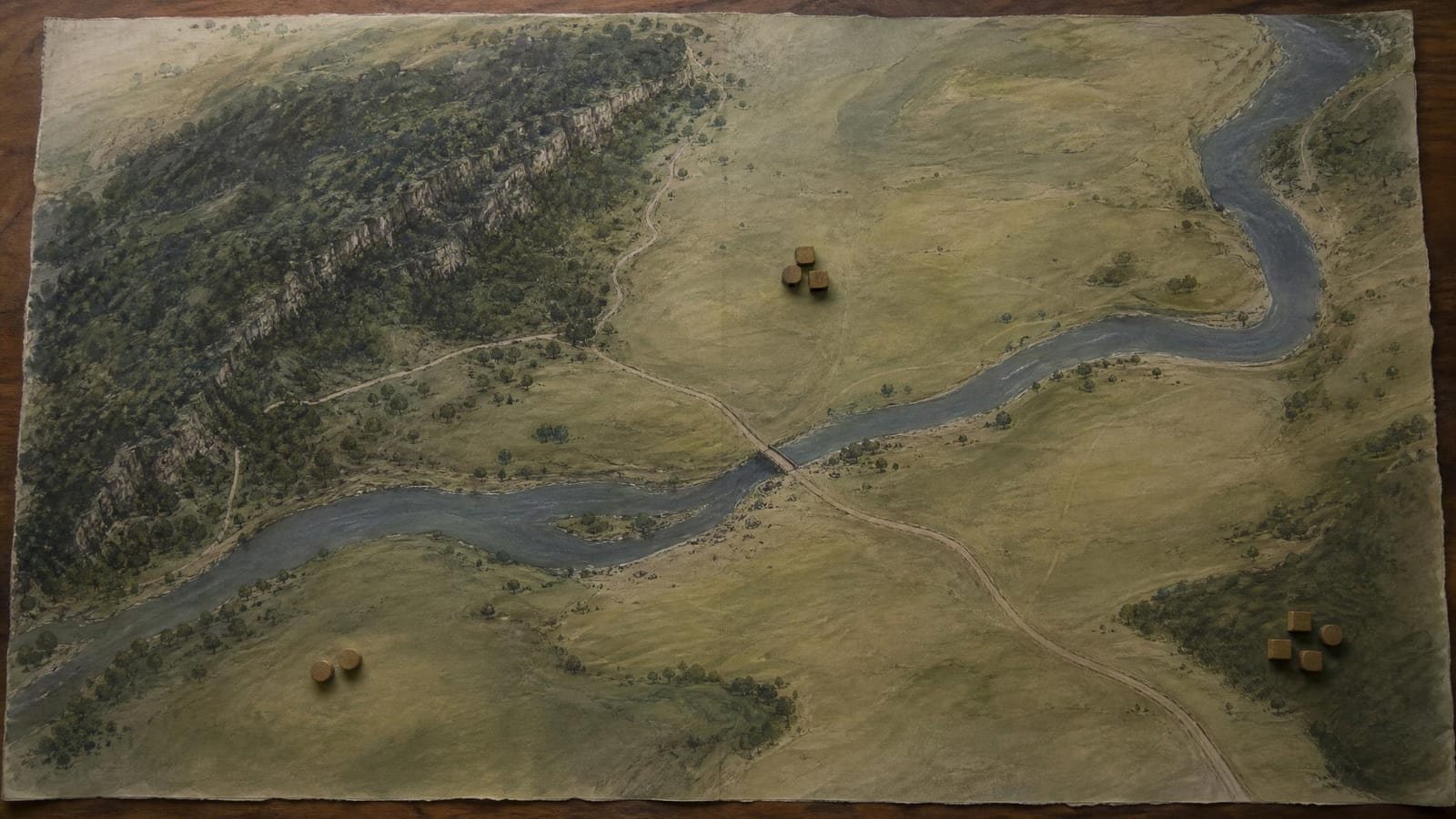
A hex map turns terrain into countable steps: each cell touches six others at the same distance, so a unit's move range is a clean ring rather than a square with cheaper edges and pricier corners.
The hexagonal overlay lays a tessellation of regular hexagons over the frame — pointy-top by default, with flat-top available. Each interior cell shares an edge with six others, and because the hexagons are regular every one of those neighbours sits at the same centre-to-centre distance. There is no second class of neighbour. Cell size, line weight, opacity, and orientation are all adjustable, so the grid reads over a dark battle map as clearly as a blank quilting sheet.
The defining property is that uniform adjacency. On a square grid a cell touches four others edge to edge and four more only at the corners, further away — the source of the awkward "is a diagonal one step or one-and-a-half" argument that every square-based game has to legislate around. The hexagon dissolves the problem: every direction is the same direction. That is why it became the surface for movement-based games, and why the same shape, read as a packing rather than a map, shows up wherever a material is minimising boundary.
Start with one regular hexagon. Its interior angle is fixed:
interior angle = 120° · three meet at every vertex (3 × 120° = 360°)
Three facts follow from that single number:
The overlay keeps the angles and spacing exact so you can count cells instead of measuring them. Try it in the live tool and one hexagon becomes your working unit.
Antiquity — the three regular tilings. That only the triangle, square, and hexagon tile the plane on their own has been known since classical geometry; Grünbaum and Shephard's Tilings and Patterns remains the modern reference that collected and systematised this body of knowledge.1 The hexagon was the one of the three that nature seemed to have chosen first.
1859 — Darwin and the bee's cell. In On the Origin of Species, Darwin devoted a long passage of the chapter on instinct to the hive-bee, arguing that the hexagonal comb is the product of natural selection economising wax rather than innate geometry. He called the comb-building instinct "the most wonderful of all known instincts," and concluded that the bee had "practically solved a recondite problem" of enclosing the most honey with the least wax.4
1917 — D'Arcy Thompson and packing. Thompson's On Growth and Form set the hexagon in a wider physical frame, treating the honeycomb and many biological patterns as outcomes of surface tension and packing under pressure rather than design — the line of argument that anticipates the foam physics later formalised by Weaire and Hutzler.35 Peter Pearce's Structure in Nature Is a Strategy for Design carried the same principle forward into architecture and product design.6
1950s — the hex wargame. The hexagonal grid became a game surface through Charles S. Roberts and the founding of Avalon Hill, whose early titles established the hex-and-counter format and made the hex map the default for conflict simulation. James Dunnigan, who designed and published hundreds of such games, documents this lineage in The Complete Wargames Handbook, explaining that hexes were adopted precisely to remove the diagonal-movement ambiguity of square boards.8 The 1995 hit Settlers of Catan later carried the hex tile into mainstream board gaming.
"The honeycomb conjecture is old folklore." The intuition is ancient and the conjecture was stated long ago, but a complete, peer-reviewed proof did not exist until Hales published it in Discrete & Computational Geometry in 2001.2 Citations that date the proof to 1999 are pointing at the arXiv preprint, not the published result.
"Hexes have no straight rows." They have clean rows in one direction only. Pointy-top hexes form tidy horizontal rows but no vertical columns; flat-top hexes form tidy columns but no horizontal rows. There is no orientation that gives both, which is the price of uniform adjacency.
"Hex coordinates are as simple as squares." They are not. The absence of a single natural (x, y) means you must choose offset, axial, or cube coordinates and convert between them, and beginners routinely mix schemes mid-map and break their own distance maths.
| If you want to... | Use hexagonal | Don't use it for... | Difficulty |
|---|---|---|---|
| Build an overland or operational game map | Six equidistant neighbours make movement and range uniform in every direction | Indoor tactical maps where walls and doors run square (use a square grid) | Beginner |
| Design a honeycomb decorative pattern or tile layout | Cells pack with no gaps and the least grout line for a given area | Rectilinear layouts that must align to a square room or page margin | Beginner |
| Plan English paper-piecing or hexie quilting | One hexagon equals one fabric piece — count cells, not millimetres | Strip-pieced or block quilts built on a square grid | Intermediate |
| Illustrate a molecular or crystalline lattice | Matches graphene, beryl, and basalt-column geometry directly | Cubic or tetragonal crystals that are not hexagonal at all | Intermediate |
| Teach packing and tiling to students | The clearest physical case of a least-perimeter, densest-circle arrangement | Lessons about diagonal symmetry, where the square reads more plainly | Advanced |
Six documented places where the hexagonal grid is demonstrably the chosen structure — in games, in nature, and in materials.
The hex-and-counter format that made the hexagon a game surface. Every counter moves a fixed number of equidistant cells, so terrain becomes arithmetic and the diagonal argument disappears.
The hex tile reaching the mainstream. Resource hexes meet three to a vertex, so a single settlement collects from three terrains at once — the corner-and-edge economy is the whole game.
Darwin's case study. Bees building in wax converge on hexagons because that shape holds the most honey for the least wall — the least-perimeter result later proven as the honeycomb conjecture.
A single sheet of carbon atoms arranged in a hexagonal lattice. The same packing logic that minimises foam-wall energy gives graphene its strength-to-weight ratio.
A two-dimensional foam relaxes toward hexagonal cells because surface tension minimises wall length — the physical demonstration of the honeycomb result, slightly distorted by real-world disorder.
Before a map is digital it is sketched on hex paper. Designers block movement zones and terrain by counting cells, which is exactly what the overlay reproduces over a reference photo or scan.
Labelling part of a map with offset coordinates and then switching to axial for movement maths is the fastest way to compute the wrong distance between two cells, because the conversions are not interchangeable by eye.
Pointy-top gives clean horizontal rows; flat-top gives clean vertical columns. Pick the one that fights your map's main travel direction and every route description becomes a diagonal description.
Interiors, buildings, and city blocks are rectilinear. Laid over a square-walled dungeon, a hex grid leaves doorways and corridors slicing awkwardly across cells and helps nobody.
In quilting, tiling, and tabletop play the hexagon equals a physical thing — a fabric piece, a ceramic tile, a movement step. Setting the spacing to whatever looks nice means the grid no longer measures what you are building.
The hexagon is the working surface of conflict simulation and overland exploration. Block terrain, zones of control, and movement allowances by counting cells, and the uniform adjacency keeps balance honest — a unit with three movement points reaches the same ring of cells whichever way it faces. Decide pointy-top versus flat-top and your coordinate scheme before laying a single tile, because both choices propagate through every rule that mentions an "adjacent hex."
English paper piecing is built on the hexagon — the grandmother's-flower-garden block is rosettes of hexies sewn edge to edge. Set one grid cell to your finished piece size so counting cells across a layout tells you exactly how many papers to cut. The overlay also lets you audition a colour arrangement over a photographed fabric pull before committing a single stitch.
Honeycomb is a perennial motif in tile, textile, and surface graphics because it packs with no gaps and reads as both organic and engineered. Use the grid to keep a repeat truly seamless — every cell edge has to meet its neighbour — and to scale a hexagonal subway-tile layout against a real wall dimension, grout line included, before ordering material.
Graphene, beryl, basalt columns, foam, and honeycomb are all the same lattice seen at different scales, which makes the hexagon a teaching gift. Overlay it on a micrograph or a photograph of the Giant's Causeway to show students that the pattern is a least-energy outcome rather than a coincidence, and pair it with the packing math to connect the picture to the proof.
"the bee... has practically solved a recondite problem, and has made her cells of the proper shape to hold the greatest possible amount of honey, with the least possible consumption of precious wax."
Charles Darwin, On the Origin of Species, John Murray (1859)4

Illustrative composites of how the tool gets used in practice — not quotes from named individuals.
When I prototype a campaign map I drop the scan onto a hex overlay and count movement ranges straight off the cells. The deep-link reopens with the orientation and spacing already set, which is the whole battle.
For teaching close-packing I overlay the hex lattice on a micrograph of foam. Students see that the cells are not drawn that way — they relax into it to minimise wall, which is the same reason graphene holds together.
A honeycomb repeat only reads as seamless if every edge meets its neighbour exactly. Setting one cell to the real tile size and checking the grout line over a photo of the wall saves a reorder every time.
Drop a reference image or start from a blank canvas. The hexagonal grid overlay applies in one click, pointy-top or flat-top. Free, in your browser.
Launch Grid Maker Pro →Hexagonal grid is free to use here and will stay that way. When the plan on screen needs to become marks on paper, the browser reaches its limit — there's no camera to register the image to your page. The Grid Maker Pro AR app adds exactly that: hold the phone over the paper and trace your reference directly, then keep working with the same overlay set.
See the AR tracing app → Free web tool, free forever · AR tracing is the separate paid app