Isometric sketch on triangle paper
The classic use. Two of the three line families carry the ground edges of a cube; verticals through the vertices give height. Every edge rides a printed line, so the form stays measurable.
A triangular grid fills the frame with equilateral triangles, built from three families of parallel lines set 60° apart. It is the lattice engineers call "triangle paper" or "isometric paper" — the same surface, depending on which lines you choose to draw along. Its vertices are the exact dual of the hexagonal grid, and its defining trait is rigidity: a triangle is the one polygon that cannot deform without snapping an edge, which is why it underpins trusses, geodesic domes, and isometric construction. Here is what the overlay does, the regular-tiling math behind it, the verified history of triangle paper and triangulation, and when the grid earns its place over a plain square.
One of the 82 composition overlays every visual artist should know and use.
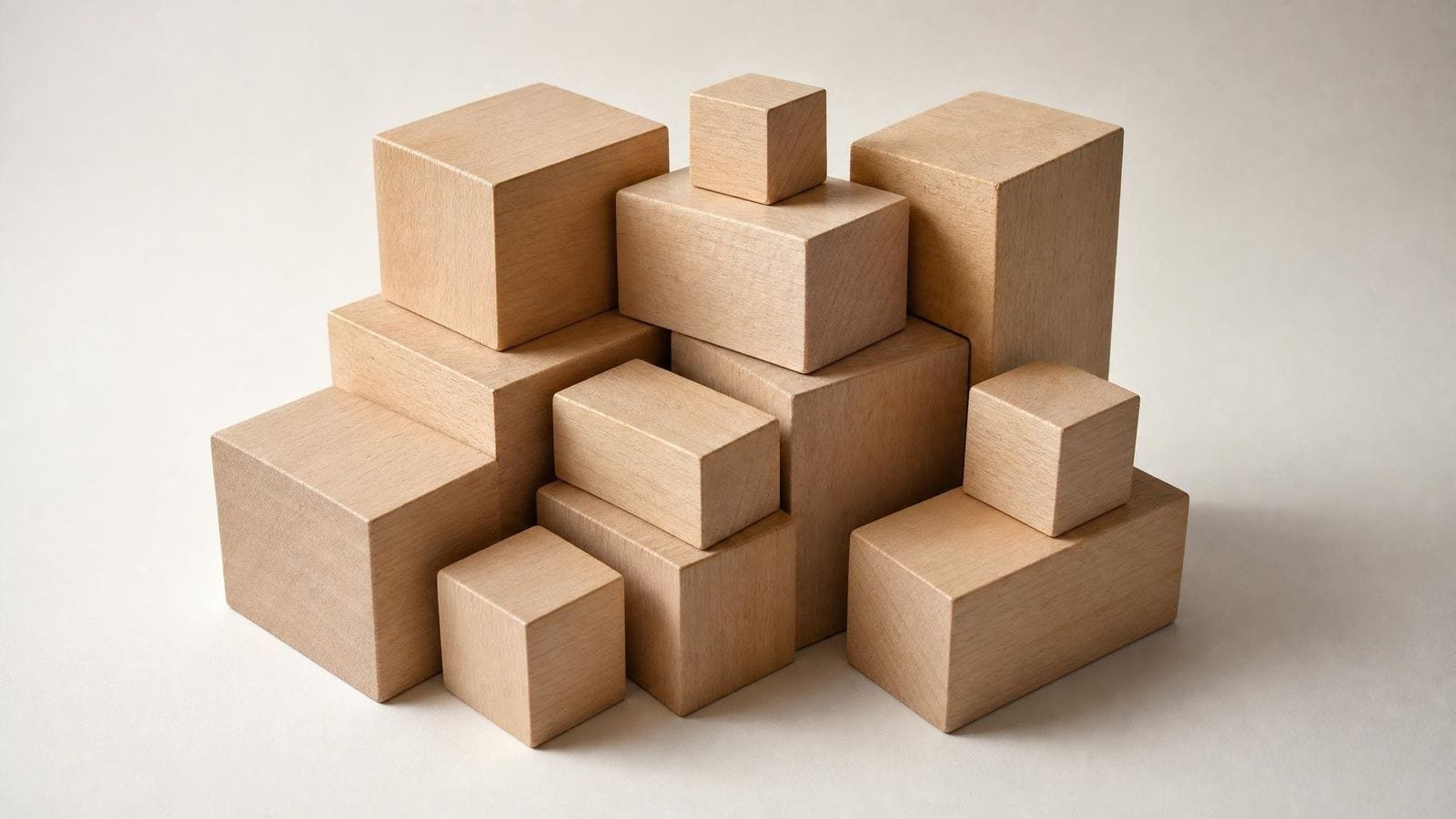
Plain stacked blocks are the cleanest test of the isometric axes: every cube shows three faces at once, so two of the three line families should ride the receding top edges while the third stays vertical. Drag the handle to see which edges align to the 60° axes.
The triangular overlay lays down three families of parallel lines, each rotated 60° from the next, so the plane fills with equilateral triangles that alternate point-up and point-down. Every interior vertex is the hub of six triangles. Cell size, line weight, and opacity are all adjustable, so the lattice reads over a dark photograph as easily as over a blank page.
The grid offers two readings at once. Follow the triangle edges and you have a tessellation guide for faceted patterns and pieced work. Follow two of the three line families as ground axes, treating vertical drops through the vertices as height, and the same lattice becomes isometric "triangle paper" — the construction surface for measurable three-dimensional sketches. Because the tiling is regular, one edge length governs the entire field: set it once and every cell measures the same unit.
A regular tiling covers the plane with copies of a single regular polygon, meeting edge-to-edge, with the polygon's interior angle dividing 360° evenly. Only three angles satisfy that:
triangle 60° (×6) · square 90° (×4) · hexagon 120° (×3) = 360°
Three facts follow from the equilateral case:
The grid handles the 60° geometry for you — every cell is pre-aligned to the three line families. Try it in the live tool and the edge length sets your working unit.
Antiquity — the regular tilings. The fact that equilateral triangles, squares, and hexagons are the only regular polygons that tile the plane was known to Greek geometers and proved formally from the angle condition. The modern, exhaustive treatment is Grünbaum and Shephard's Tilings and Patterns, which classifies the regular and semi-regular tilings and remains the reference work.1 Coxeter's Introduction to Geometry derives the same three tilings from symmetry first principles.3
1822 onward — triangle paper for isometric drawing. When William Farish read On Isometrical Perspective to the Cambridge Philosophical Society, he gave engineers a way to draw machines so dimensions survived on every axis.2 The practical surface for that work was pre-ruled triangular paper, whose three 60°-separated line directions match the three isometric axes. The method was eventually codified internationally among the axonometric projections in ISO 5456-3, and triangle-based axonometric construction remains a core skill in references such as Francis Ching's Architectural Graphics.56
Structural engineering — triangulation. The use of triangulated members to build rigid yet light structures runs from 19th-century truss bridges to Buckminster Fuller's geodesic domes, all exploiting the single geometric fact that the triangle is the only stable pin-jointed polygon.
"Triangle paper and isometric paper are different things." They are one lattice seen two ways. Triangle paper highlights the cells; isometric paper highlights the line directions you draw along. The geometry is identical — only your attention shifts.4
"A triangular grid works for any subject." It rewards rectilinear and faceted forms whose edges follow the three axes. Pushed onto a soft or curved subject it produces a stiff, faceted drawing; for organic proportion a square or thirds overlay serves better.
"Triangular and hexagonal are unrelated overlays." They are duals, related by a simple centre-to-centre swap and a 30° turn.8 Choosing between them is really a choice between edges-and-vertices work and cell-based work, not between two different geometries.
| If you want to... | Use the triangular grid | Don't use it for... | Difficulty |
|---|---|---|---|
| Sketch a measurable 3D object | Two line families serve as ground axes, verticals as height — true isometric construction | Atmospheric scenes that need real depth (use 2-point perspective) | Intermediate |
| Lay out a faceted tessellated pattern | Equilateral cells repeat seamlessly in three directions with no per-cell math | Free-flowing organic ornament with no straight edges | Beginner |
| Plan a truss or space frame | Every closed cell is a triangle, so the drawn structure reads as rigid by construction | Subjects where members must flex or pivot (a square frame is intentional there) | Advanced |
| Piece a triangle-based quilt block | Cells map directly to cut pieces — half-square and equilateral blocks plan at exact scale | Curved appliqué and free-motion work with no straight seams | Beginner |
| Diagram a triangulated mesh or dome | The lattice mirrors how a geodesic or wireframe surface is actually subdivided | Smooth surfaces shown without facets (use a plain contour drawing) | Intermediate |
Six places where equilateral triangulation is demonstrably the chosen structure.
The classic use. Two of the three line families carry the ground edges of a cube; verticals through the vertices give height. Every edge rides a printed line, so the form stays measurable.
A row of equilateral triangles spanning two supports. Each bay is a triangle, so the span holds its shape under load with the least material — triangulation made visible.
Alternating up- and down-triangles in two colours read as a single repeating field. The lattice keeps every facet identical, the foundation under many star-and-polygon ornaments.
Triangle-pieced blocks plan exactly on the grid. Each cell becomes a cut piece plus seam allowance, so a layout can be proven on paper before a single fabric cut.
Flatten a geodesic sphere to its development and the panels read as a triangular grid. Triangulation on the sphere is exactly what makes the dome rigid from slender struts.
Computer-graphics surfaces are tessellated into triangles because three points always define one flat plane. The grid is the planar analogue of how a mesh subdivides a form.
A face, a flower, a draped cloth has no edges that follow 60° lines. Snapped to the triangular grid it turns stiff and faceted, and the drawing fights the reference rather than reading it.
Because the two are duals, it is tempting to use either for either task. But triangular anchors on edges and vertices, hexagonal on cells — pick the wrong one and you are constantly converting between lines and faces.
Three line directions pack far more ink per unit area than a square grid. At fine spacing the lattice swamps the reference and every line in the drawing competes with a grid line behind it.
Sketching a frame as squares or open quadrilaterals on the grid produces a structure that would actually rack and fold — the drawing implies a mechanism, not a rigid frame.
Triangle paper is the working surface for isometric sketching of parts and assemblies, where a freehand idea has to stay dimensionally honest. The same grid doubles as a layout for triangulated structures: lay the proposed truss over the lattice, confirm every span closes into triangles, and you have verified rigidity by inspection before any calculation. Match one edge length to a convenient unit and read depth and width off the same cell.
The grid is the planning layer under the modern flat "isometric" illustration look — cities, server diagrams, faceted icons. Block forms onto two ground axes plus verticals, commit every edge to one of the three line directions, then light to a single direction. Because the tiling repeats in three ways with no convergence, a composition can be extended in any direction without re-solving a horizon.
Triangle-pieced blocks — equilateral, half-square, and the diamonds built from triangle pairs — plan precisely on the grid. Each cell is a cut piece plus seam allowance, so an entire layout can be tested on paper, the colours arranged, and the yardage estimated before fabric is cut. Set the edge to the finished triangle size and the printed plan matches the rotary cutter.
The triangular lattice supports both the axonometric quick-study and the structural diagram. It carries 30°/30° isometric massing — covered as a core skill in Ching's Architectural Graphics6 — while the same grid sketches space frames and the development drawings of triangulated shells and geodesic roofs, where triangulation is what keeps a light structure stiff.
Three line families, one angle, and a shape that cannot fold — the triangular grid is the only drawing surface that doubles as a proof of rigidity.
Grid Maker Pro studio note

Illustrative composites of how the tool gets used in practice — not quotes from named individuals.
I sketch every space frame on triangle paper before I touch the analysis software. If every bay closes into a triangle on the page, I already know it won't rack — the drawing is half the proof.
For pieced quilts I plan the whole top on the overlay first. One edge length equals my finished triangle, so what I see on screen is exactly what comes off the rotary cutter — no surprises at the ironing board.
Iso illustration lives or dies on consistent axes. The bookmarkable overlay URL reopens with the exact triangular spacing configured, so a whole icon set stays on the same lattice across sessions.
Drop a reference image. The triangular grid overlay applies in one click. Free, in your browser.
Launch Grid Maker Pro →Triangular grid is free to use here and will stay that way. When the plan on screen needs to become marks on paper, the browser reaches its limit — there's no camera to register the image to your page. The Grid Maker Pro AR app adds exactly that: hold the phone over the paper and trace your reference directly, then keep working with the same overlay set.
Meet the AR tracing app → Free web tool, free forever · AR tracing is the separate paid app