The Great Wave off Kanagawa (c. 1831)
The cresting wave curls along a spiral arc with Mount Fuji sitting near its eye. Whether Hokusai planned it or not, the overlay maps the wave's claw of foam almost exactly.
A logarithmic curve whose radius multiplies by φ ≈ 1.618 every quarter turn, drawn inside a golden rectangle. As a composition tool it is the φ grid's restless sibling: where the grid places a point, the spiral moves the eye. Here is how it's built, why the famous Nautilus example is mathematically wrong, when the spiral genuinely beats the grid, and how to land your subject on the eye of the curve rather than chasing the arc.
One of the 82 composition overlays every visual artist should know and use.
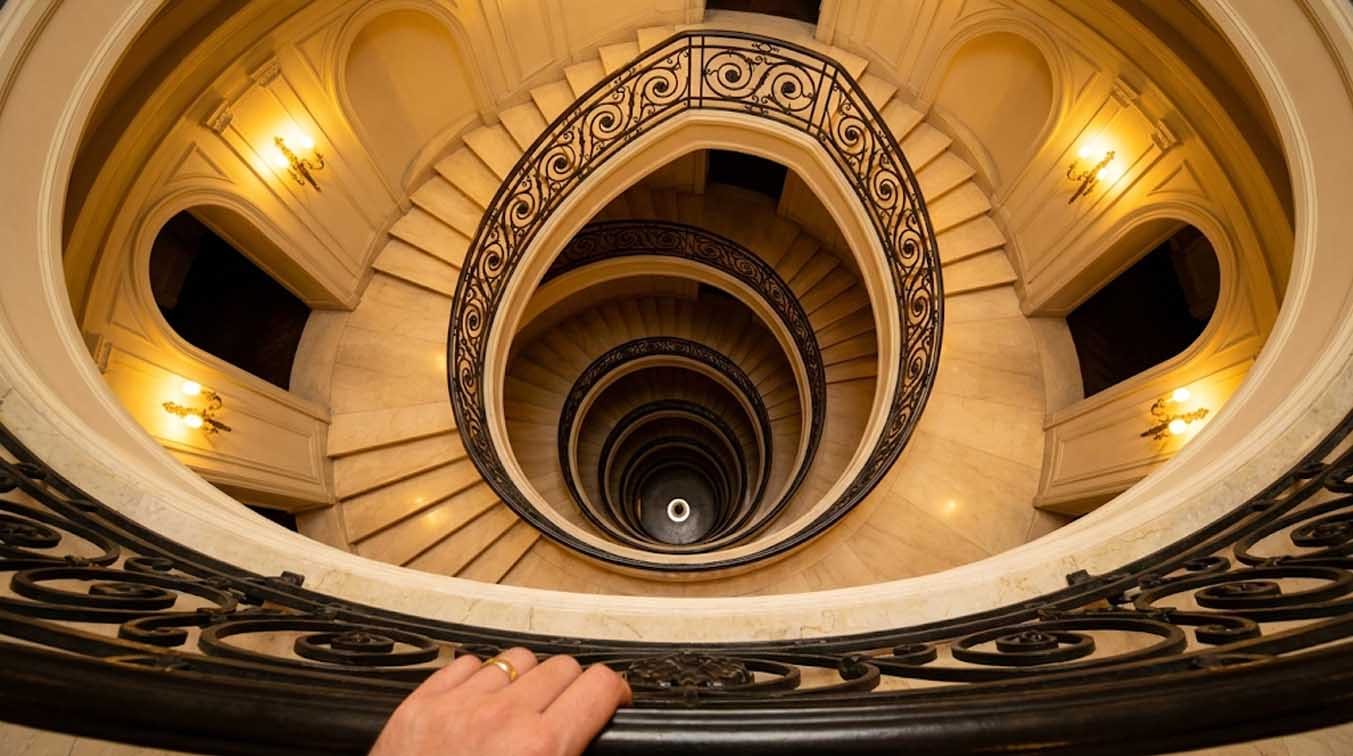
A spiral staircase is the spiral's home turf — the architectural curve and the overlay's curve coincide, with the eye of the spiral landing on the well at the centre.
The golden spiral overlay draws one continuous curve plus the construction it grows from: a golden rectangle subdivided into nested squares, with a quarter-arc swept through each. The curve starts wide at one corner and tightens toward the opposite corner, where it converges on a focal point. That convergence point — the eye of the spiral — is the recommended home for the subject's centre of action; the unwinding arc is a path for the viewer's eye to travel.
In Grid Maker Pro the spiral rotates to any of four corner orientations and flips for clockwise or counter-clockwise chirality, so it can match the direction of motion in the photograph. You can also scale it independently of the image, matching the curve to subjects that overflow or under-fill the frame.
The golden spiral is the logarithmic spiral whose radius grows by φ each quarter turn. In polar form:
r(θ) = a · φ^(2θ/π) · eye at ≈ (0.276 W, 0.276 H)
Three things follow from that definition:
The overlay computes the curve exactly for any aspect ratio. Open it in the live tool and rotate to match your subject.
1202 — Fibonacci. Leonardo of Pisa introduced the sequence 1, 1, 2, 3, 5, 8, 13… to European mathematics in Liber Abaci. Ratios of successive terms converge on φ, and a spiral built from Fibonacci-sized squares approximates the golden spiral.1
1509 — Pacioli. The golden-rectangle construction the spiral grows from is laid out in Luca Pacioli's De Divina Proportione, illustrated by Leonardo da Vinci — the text that carried φ from geometry into the studio.2
1690s — Jakob Bernoulli. Bernoulli proved the logarithmic spiral's self-similarity and was so taken with it that he asked for one carved on his Basel gravestone with the motto Eadem mutata resurgo. The mason carved an Archimedean spiral by mistake — a small monument to how easily the curve is confused.8
1914–1917 — Cook and Thompson. Theodore Cook's The Curves of Life catalogued spirals across shells, plants, and art, and D'Arcy Thompson's On Growth and Form gave the rigorous account of why shells grow as logarithmic (not necessarily golden) spirals.45
The Nautilus shell. The single most-repeated example — and it is wrong. The Nautilus is a logarithmic spiral, but its growth ratio is about 1.33 per quarter turn, not φ ≈ 1.618. Clement Falbo measured 565 specimens and found a mean nowhere near golden; a φ spiral drawn over a real shell is visibly too tight.6
Universal in galaxies and storms. Spiral galaxies and hurricanes are logarithmic, but their pitch angles scatter across a wide range and only sometimes approach φ. The pattern is real; the specific golden value is cherry-picked.
φ as the law of beauty. Adolf Zeising's 19th-century claim that the spiral governs all natural and artistic beauty was overreach, of a piece with the Parthenon and Mona Lisa myths that George Markowsky later dismantled by measurement.7 Plant phyllotaxis genuinely uses the golden angle; the universal-beauty story does not survive scrutiny.3
| If you want to... | Use the golden spiral | Don't use it for... | Difficulty |
|---|---|---|---|
| Compose a subject with real rotational flow | The curve aligns to the motion; the eye lands on the centre of action | Static, frontal, or symmetric subjects (use centre-cross or the φ grid) | Intermediate |
| Photograph an architectural spiral | Staircases and helical ramps map straight onto the overlay curve | Flat facades and grids (use rule of thirds or a φ grid) | Beginner |
| Lead the eye from a corner to a focal point | A path winding from a corner toward the eye of the spiral feels inevitable | Multi-subject scenes with competing focal points | Intermediate |
| Convey implied movement in a still image | Crouched figures, breaking waves, smoke, hair flow follow the arc | Reportage you can't recompose (use rule of thirds) | Advanced |
| Teach the link between φ and the spiral | The nested-square construction makes the φ relationship visible | Quick in-camera framing under time pressure | Advanced |
Six cases. Some are genuine golden spirals; two are the famous near-misses worth knowing.
The cresting wave curls along a spiral arc with Mount Fuji sitting near its eye. Whether Hokusai planned it or not, the overlay maps the wave's claw of foam almost exactly.
The textbook case that's mathematically false: the shell grows at ≈1.33 per quarter turn, not φ. A golden spiral laid over it is visibly too tight. Know it so you can spot the error.
Here φ is real: seeds sit at the golden angle of 137.5°, producing interlocking Fibonacci-numbered spirals (often 34 and 55). This is the honest place to point when teaching φ in nature.
A grand-design spiral galaxy whose arms are logarithmic with a pitch close to φ — close, not exact. The pattern is genuine; the precise golden value is generous rounding.
Wright's helical ramp is the architectural spiral photographers love. Shot up through the rotunda, the coiling balustrades fall along the overlay's arc.
The mathematician's memorial — and the ur-confusion. He wanted the logarithmic spiral; the mason carved an Archimedean one, which winds at constant spacing rather than growing by φ.
The seductive curve tempts you to arrange elements along it. But the arc is scaffolding for eye travel — the subject belongs at the convergence point where the spiral tightens.
The shell grows at ≈1.33, not φ. Holding it up as the golden spiral in nature is the fastest way to lose a knowledgeable audience — and it propagates the error.
Opening the overlay at its default orientation and forcing the image to fit. A spiral winding against the subject's motion fights the composition instead of supporting it.
A frontal portrait or a flat landscape has no rotational flow for the curve to ride. Imposing a spiral reads as arbitrary, and you'd have done better with a grid.
The spiral is a dynamic-composition device, useful when a piece needs implied motion — a rearing horse, a falling figure, a breaking sea. Block the gesture first, then test whether a spiral arc supports the line of action and whether the focal accent sits near the eye. Old-master dynamic compositions (Rubens, Géricault) often resolve onto spiral arcs whether or not the painter named it; the overlay is a way to check the instinct.
In fibonacci spiral photography the curve is best deployed in post, on the crop, for subjects with curl or sweep: waves, smoke, dancers, spiral staircases, curling roads. Lightroom and Photoshop both ship a fibonacci crop overlay, but it is fixed to a single chirality; compose loosely in-camera, then try the spiral against the φ grid and the rule of thirds and keep whichever uses the scene's leading lines to land the focal point most naturally. Nature and wildlife photographers reach for it on shells, ferns, and flocking birds; most other genres default to thirds.
The spiral organises eye-flow in posters and key art that need a clear entry point and a sense of momentum. Album covers, film posters, and editorial openers use it to sweep the reader from a corner into the headline or hero. Used sparingly — most layouts want the calmer φ grid or a 12-column system — it adds energy to a single dominant image.
Beyond photographing helical ramps, the logarithmic spiral informs spiral stairs, auditorium rake, and shell structures where a self-similar curve distributes load and sightlines elegantly. The overlay is a quick way to test whether a proposed ramp or stair reads as a smooth growth curve or breaks rhythm partway round.
"It may be used as a symbol, either of fortitude and constancy in adversity, or of the human body, which after all its changes, even after death, will be restored to its exact and perfect self."
Jakob Bernoulli, on the spira mirabilis, as recounted in Maor, e: The Story of a Number (1994)8

Illustrative composites of how the tool gets used in practice — not quotes from named individuals.
For a curling wave or a crouched figure the spiral is the right tool. The deep-link reopens with the exact overlay configured — no clicking through menus mid-session.
I keep three Grid Maker Pro tabs open during any project — spiral, φ grid, thirds — to compare crops. The bookmarkable URLs make this workflow possible.
Free and browser-only is the right shape for this kind of tool. Lower friction means I actually use it, not save it for special occasions.
Drop a reference image. The Golden Spiral overlay applies in one click. Free, in your browser.
Launch Grid Maker Pro →You can use the Golden spiral overlay here for nothing, today and always. What a browser still can't do is get the picture itself onto paper — that needs a camera. The Grid Maker Pro AR app floats your reference over the real page through your phone so you trace the outlines straight onto the surface, then build on them with the same overlays you use here.
Get the AR tracing app → Free web tool, free forever · AR tracing is the separate paid app