The Ambassadors (1533)
The foreground smear resolves into a skull viewed from the lower-left edge — the canonical oblique anamorphosis.
Anamorphic perspective is the art of the single viewpoint. You draw an image deliberately stretched and distorted across a surface so that, from one exact position, the foreshortening cancels and the picture snaps into a convincing — often three-dimensional — view. It is the engine behind 3D pavement art, giant floor murals, and the hidden skull in Holbein's The Ambassadors. The overlay builds the foreshortened transfer grid that makes the distortion buildable by hand.
One of the 82 composition overlays every visual artist should know and use.
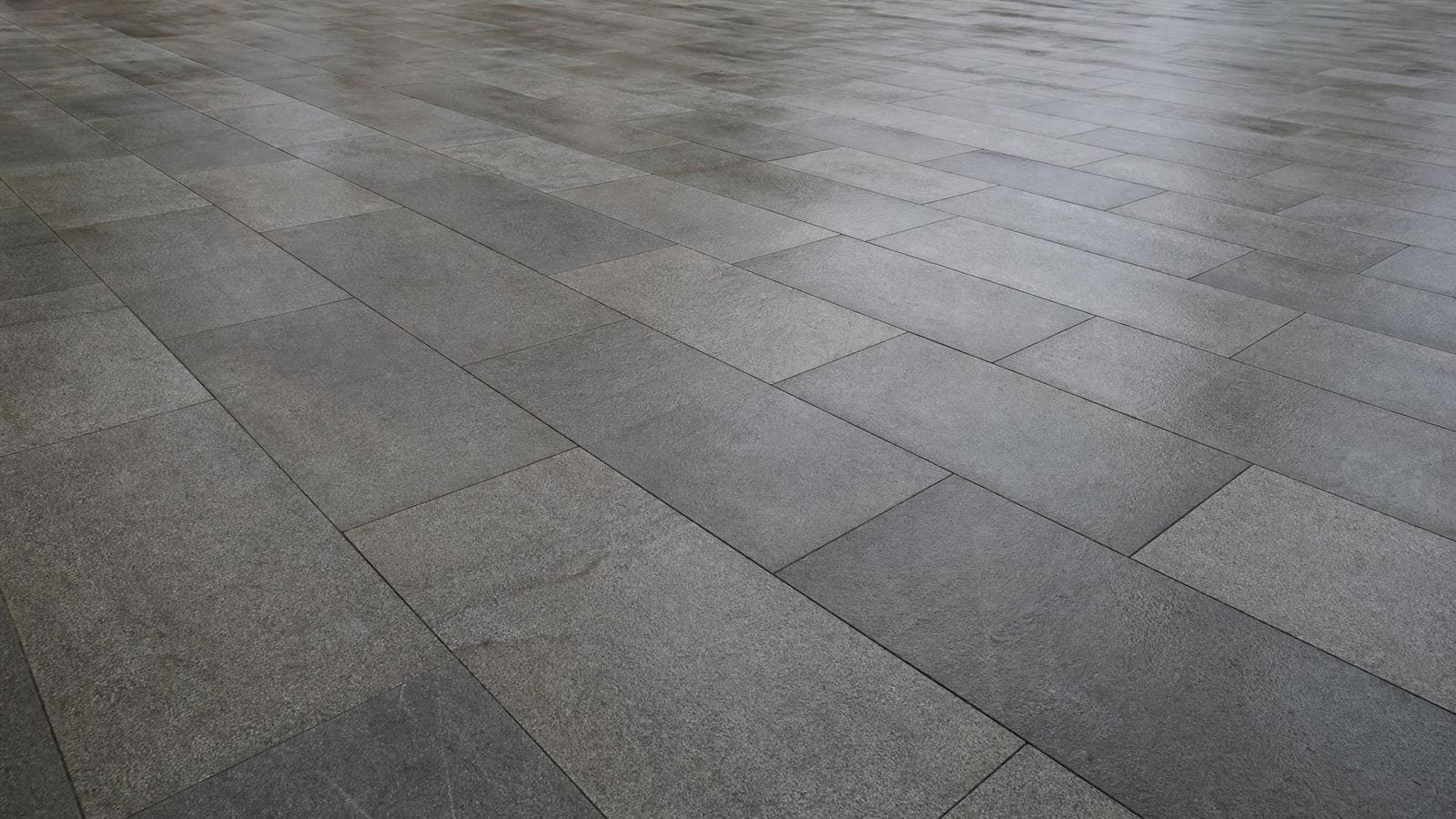
The marker at the top is the viewing point. The trapezoid is the drawing surface seen in foreshortening — cells near the viewer stay compact, far cells stretch, so the painted image reads correctly only from that spot.
The overlay shows the foreshortened transfer grid: a regular grid over your source image mapped onto the stretched grid you actually draw. The marked point at the top is the design viewpoint — the single eye position the whole projection is built for. The trapezoid is the drawing surface (a pavement, a wall-and-floor join, a long hall) seen from that viewpoint, so the grid cells closest to the viewer stay nearly square while the far cells elongate dramatically.
That stretched grid is the entire trick. Where an ordinary perspective overlay helps you draw a scene in correct perspective, the anamorphic grid helps you draw a scene deliberately wrong — distorted exactly enough that the viewer's own perspective, from the design point, undoes the distortion. Copy each square of the source into its matching stretched cell and the illusion builds itself; the geometry, not freehand guessing, carries the foreshortening.
Anamorphosis is a projection from a single eye point E onto an oblique plane. A point on the upright source image is projected along the ray from E until it meets the drawing surface:
surface point = E + t · (image point − E), t set by the surface plane
Three consequences shape every anamorphic piece:
The live overlay builds the foreshortened grid for your viewing geometry so the transfer stays a copying task, not a calculation.
Anamorphosis is one of the better-documented perspective techniques, because it grew directly out of Renaissance perspective theory. Leonardo da Vinci produced the earliest known European anamorphic drawing — an elongated eye — in the Codex Atlanticus around 1485.1 The technique was then formalised in the seventeenth century: Jean-François Niceron's La perspective curieuse (1638) and Thaumaturgus opticus (1646) gave the grid-projection methods for constructing both oblique and mirror anamorphoses, and remain the foundational treatises.2 The most celebrated single work is Hans Holbein the Younger's The Ambassadors (1533, National Gallery, London), whose foreground smear resolves into a skull from the lower-left.3 The standard modern history is Jurgis Baltrušaitis's Anamorphic Art, which traces the form from the Renaissance through mirror anamorphoses to the present.4 The underlying optics sit squarely within the linear-perspective tradition codified by Alberti and analysed by Martin Kemp in The Science of Art.5
The contemporary explosion of 3D pavement art is real but recent, and it is worth being precise about it. Kurt Wenner developed and named a form he calls "3D illusionistic" or anamorphic pavement art in the 1980s, adapting classical projection to the standing street viewer with a camera.6 The street-painting (madonnari) tradition it draws on is centuries old, but the specific single-camera 3D illusion is a late-twentieth-century development, powered as much by the smartphone photograph as by the drawing itself. The honest framing: the geometry is Renaissance, the optics are settled, but the viral pavement-art form is modern — and its real medium is often the photograph, not the pavement.
| If you want to... | Use anamorphic | Don't use it for... | Difficulty |
|---|---|---|---|
| Make 3D pavement or floor art | Build the foreshortened grid for a standing camera viewpoint | Work meant to be seen from many angles (use normal perspective) | Advanced |
| Create a single-viewpoint mural illusion | Wrap an image across a wall-and-floor join so it reads whole from one spot | Flat decorative murals (no viewpoint dependence needed) | Advanced |
| Hide an image that resolves at an oblique angle | Holbein-style oblique anamorphosis for a concealed motif | Images that must be legible head-on (defeats the point) | Advanced |
| Stage a photo-first installation | Design to the camera position; the photo is the deliverable | Sculptural or in-the-round work (use real 3D form) | Intermediate |
| Teach how perspective projection works | The exaggerated stretch makes the single-viewpoint principle visible | Everyday scene drawing (use 1- or 2-point perspective) | Intermediate |
Six anamorphic works and applications, from the sixteenth century to the pavement.
The foreground smear resolves into a skull viewed from the lower-left edge — the canonical oblique anamorphosis.
The earliest known European anamorphosis — an elongated eye that corrects when viewed from the side.
The treatise that turned anamorphosis into a repeatable grid method — the direct ancestor of this overlay.
A painted hole or canyon that appears to drop into the pavement from the marked standing viewpoint.
An image split across the wall-floor join that reassembles into one continuous scene from the design point.
A smeared ring of image that resolves in the surface of a polished cylinder placed at its centre — Niceron's other method.
Starting to draw before deciding the exact eye position and height means the projection has no defined target, and the illusion never quite resolves.
Building for the naked eye when the piece will be shared as a photo leads to disappointment — binocular vision reveals the flat surface that a single lens hides.
A shallow viewing angle stretches the far cells far more than beginners expect, so a grid that is too coarse loses all the detail at the top of the piece.
This is the technique's main home. Pavement and mural artists fix a camera at the viewing point, build the foreshortened grid, and transfer the design cell by cell, checking through the lens as they go. The exaggerated stretch toward the far end is planned, not improvised, and a finer grid where cells elongate keeps detail intact. The finished photograph from the marked spot is usually the work that travels.
Anamorphic installations are designed around the camera, so photographers are collaborators rather than documentarians. The single-lens, single-position constraint that defines the illusion is exactly a camera's view, which is why the photograph sells the effect more completely than standing there with two eyes. Locking focal length and height to the design viewpoint is the whole job.
Brand activations and experiential installations use anamorphosis for floor and atrium pieces that resolve at a branded photo spot, engineering a shareable image. The same projection logic now drives "forced-perspective" 3D billboard content, where a scene built for one virtual camera appears to leap out of a corner LED screen.
Anamorphosis is a vivid way to teach that linear perspective is a projection from a single point. Because the distortion is so extreme and the "correct" view so specific, students can see, rather than merely accept, that an ordinary perspective drawing is just the mild case of the same single-viewpoint geometry.
"Anamorphosis is perspective taken to its logical extreme: a construction so wedded to one point of view that it dissolves into chaos from every other. It is the secret history of perspective turned inside out."
Jurgis Baltrušaitis, Anamorphic Art (1977)4
Illustrative composites of how the tool gets used in practice — not quotes from named individuals.
I mark the camera spot first, always. The grid does the foreshortening — my job is just to copy each cell faithfully and check through the lens.
For brand activations the photo is the product. We design straight to the camera position and the floor piece only has to work for that one frame.
Free and browser-only is the right shape for this kind of tool. Lower friction means I actually use it, not save it for special occasions.
Drop a reference image. The anamorphic projection grid applies in one click. Free, in your browser.
Launch Grid Maker Pro →Everything on this page — the Anamorphic perspective overlay overlay included — stays free in the browser. The leap from a screen overlay to a drawn line on paper is the one step the web can't bridge. The Grid Maker Pro AR app does it: your photo is held over the paper through the phone camera so you trace it by hand, at sketchbook size or wall size, with all 82 overlays alongside.
See the AR tracing app → Free web tool, free forever · AR tracing is the separate paid app