
Holy Trinity (c. 1427)
The first painting to apply Brunelleschi's system rigorously. The coffered barrel vault recedes to one vanishing point at the viewer's eye level, opening a convincing chapel in a flat wall.
The simplest linear perspective: a horizon line, a single vanishing point, and a fan of edges converging on it. Everything receding into depth aims at that one point; horizontals stay horizontal and verticals stay vertical. It is the system Brunelleschi demonstrated and Alberti wrote down — the entry to drawing space, and, for symmetric straight-on subjects, the right professional choice. Here is what the overlay does, the spacing math, when one point beats two, and how it runs from Masaccio to Kubrick.
One of the 82 composition overlays every visual artist should know and use.
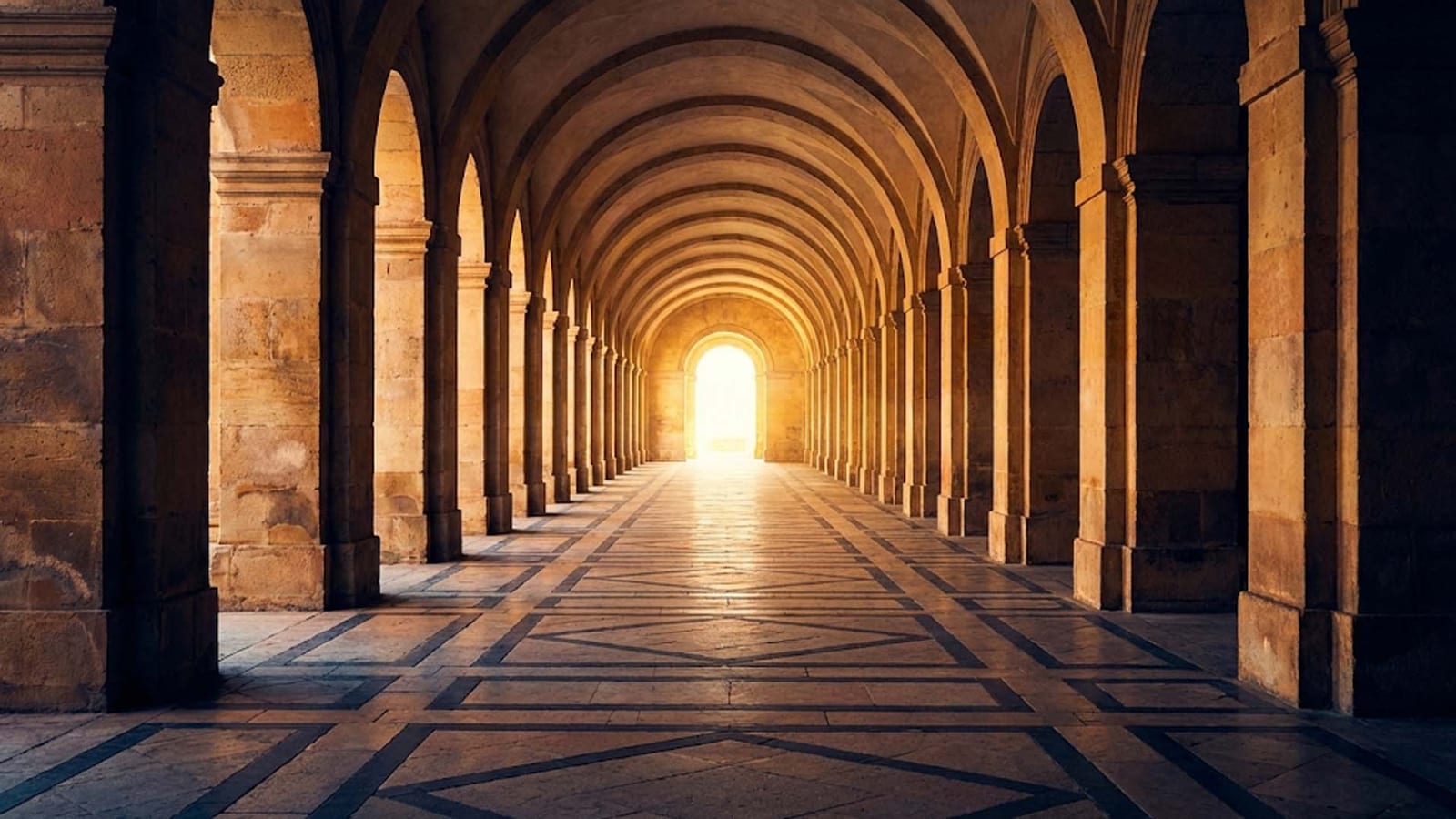
A facade or corridor shot head-on sends every depth edge to one point. Drag the handle to check whether the building's true vanishing point sits where you would compose it — if it drifts, the camera wasn't quite square.
The one-point overlay draws three things: a horizontal horizon line at eye level, a single draggable vanishing point on it, and a fan of orthogonals radiating from the VP to the edges of the frame. Drag the vanishing point anywhere along the horizon and the fan rebuilds in real time, so you can test where the recession should concentrate.
In use, the rule is simple: any edge that travels away from you is ruled to the vanishing point; anything horizontal in the scene stays horizontal, anything vertical stays vertical. Only the depth dimension converges. A faint pair of transversals on the overlay hints at how a tiled floor would foreshorten as it recedes toward the horizon.
One-point perspective is a projection from a single eye point through a picture plane. An object of true depth z, seen from viewing distance d, projects to a fraction of its frontal size:
apparent size = true size × d / (d + z)
Three consequences drive every construction:
The overlay handles the convergence; you place the VP and read the spacing off the diagonal. Open it in the live tool and drag the vanishing point to compose.
c. 1413 — Brunelleschi. Filippo Brunelleschi demonstrated geometric perspective in Florence with two now-lost panels — one of the Baptistery viewed from the Duomo doorway, seen through a peephole against a mirror so the painted and real buildings could be compared. The event is recorded in Antonio Manetti's contemporary biography.2
1435 — Alberti. Leon Battista Alberti's De Pictura was the first written account, turning Brunelleschi's demonstration into a teachable construction — the costruzione legittima — that any painter could execute with ruler and string.1 Within a generation the system had transformed European painting, a shift charted in Samuel Edgerton's The Renaissance Rediscovery of Linear Perspective.3
1470s — Piero della Francesca. The painter-mathematician's treatise De Prospectiva Pingendi worked the geometry out rigorously, with constructions for complex solids in space — the bridge from Alberti's recipe to a full theory, later set in its scientific context by Martin Kemp's The Science of Art.84
"It's just a beginner's grid." One-point is taught first because it is simplest, but it is the correct system for symmetric straight-on subjects. Treating it as merely a stepping-stone misses why naves, corridors, and stage sets are genuinely one-point.
"Perspective shows the world as the eye sees it." Only approximately. Erwin Panofsky argued in Perspective as Symbolic Form that linear perspective is a historically specific convention, not a neutral transcription — the eye is spherical, the picture plane is flat, and the match is a useful fiction.6
"The Renaissance invented seeing in depth." Pictorial depth existed long before 1413; what Brunelleschi added was a measurable construction, as John White detailed in The Birth and Rebirth of Pictorial Space. Antiquity had convincing recession without a single mathematical vanishing point.7
| If you want to... | Use one-point | Don't use it for... | Difficulty |
|---|---|---|---|
| Draw a hallway, road, or train track head-on | The single central VP matches the subject's real symmetry | A building seen from a corner (use 2-point) | Beginner |
| Compose a formal interior — nave, corridor, throne room | Centred one-point reads as order and ceremony | Casual, angled interiors that should feel lived-in | Beginner |
| Lay out a stage or film set for a central audience | Renders the space exactly as the seated viewer sees it | Roaming-camera sequences with shifting angles | Intermediate |
| Teach the basics of pictorial depth | The simplest construction — one VP, one rule | Dramatic upward views of tall structures (use 3-point) | Beginner |
| Build a measurable tiled floor | Distance-point method spaces transversals correctly | Technical drawings that must stay to scale (use isometric) | Advanced |
Six works built on a single central vanishing point — from the first rigorous use to the cinema.
The first painting to apply Brunelleschi's system rigorously. The coffered barrel vault recedes to one vanishing point at the viewer's eye level, opening a convincing chapel in a flat wall.
Every coffer and wall hanging converges on the vanishing point set directly behind Christ's head — perspective itself made to point at the subject.
The barrel-vaulted hall recedes to a vanishing point between Plato and Aristotle, so the architecture itself frames and elevates the two central philosophers.
The vast paved piazza is a textbook distance-point floor, its tiles foreshortening evenly to a central VP behind the domed temple.
Kubrick's signature: the camera dead-centre, walls racing to a single point. The symmetry reads as control and unease in equal measure.
Modern one-point as authored style — facades and interiors shot head-on, the vanishing point dead-centre, every frame composed like a diagram.
In one-point only the depth edges converge. Tilting the verticals or slanting the frontal horizontals toward the vanishing point quietly turns the drawing into a botched two- or three-point.
Drawing receding tiles or fence posts at equal intervals. Real depth compresses as d/(d+z), so equal spacing looks like the floor is tilting up toward the viewer.
A building seen from a corner has two sets of receding edges and needs two vanishing points. Jamming it into one-point flattens one face unnaturally.
Dropping the horizon at the middle of the frame regardless of viewpoint. The horizon is the eye level — a worm's-eye or bird's-eye view demands a very low or very high line.
One-point is the cleanest way to build an interior or a receding street and to aim the composition. Set the vanishing point on the subject you want to crown — Leonardo put it behind Christ's head, Raphael between his philosophers — and the architecture itself becomes a frame. Block the orthogonals first, then space the depth with a distance point so a tiled floor reads true.
Central one-point framing signals order, scale, and often menace. Kubrick's corridors and Steadicam push-ins live on a dead-centre vanishing point; overlay the grid on a frame grab to check the camera is truly square — a degree off and the symmetry curdles. Use it deliberately, because the formality is unmistakable on screen.
One-point is the fast establishing shot: a corridor, a hangar, a canyon road heading to the horizon. Lay the VP early, rough the big orthogonals for the architecture, then break the monotony with off-axis props that don't obey the single point. An off-centre VP keeps the receding logic while adding the cinematic tension of film-noir interiors.
The interior one-point view is the classic presentation drawing for a nave, atrium, or gallery — it shows the space as a visitor will actually experience it walking in along the axis. Set the horizon at standing eye level and the vanishing point on the focal end (altar, window wall) to communicate the spatial intent at a glance.
"A painting is the intersection of a visual pyramid at a given distance, with a fixed centre and a defined position of light, represented by art with lines and colours on a given surface."
Leon Battista Alberti, De Pictura (1435)1

Illustrative composites of how the tool gets used in practice — not quotes from named individuals.
For an interior establishing shot I set the vanishing point on the subject first. The deep-link reopens with the exact overlay configured — no clicking through menus mid-session.
I keep three Grid Maker Pro tabs open during any project — one per overlay I'm comparing. The bookmarkable URLs make this workflow possible.
Free and browser-only is the right shape for this kind of tool. Lower friction means I actually use it, not save it for special occasions.
Drop a reference image. The 1-Point Perspective overlay applies in one click. Free, in your browser.
Launch Grid Maker Pro →The One-point perspective overlay is free here in your browser, forever — drop a reference and it applies in one click. The single job a browser can't do is put that reference onto a physical page, so the Grid Maker Pro AR app holds the image over your paper or canvas through the phone camera and lets you trace it by hand at any size. Same 82 overlays; AR tracing is the paid part.
How AR tracing works → Free web tool, free forever · AR tracing is the separate paid app