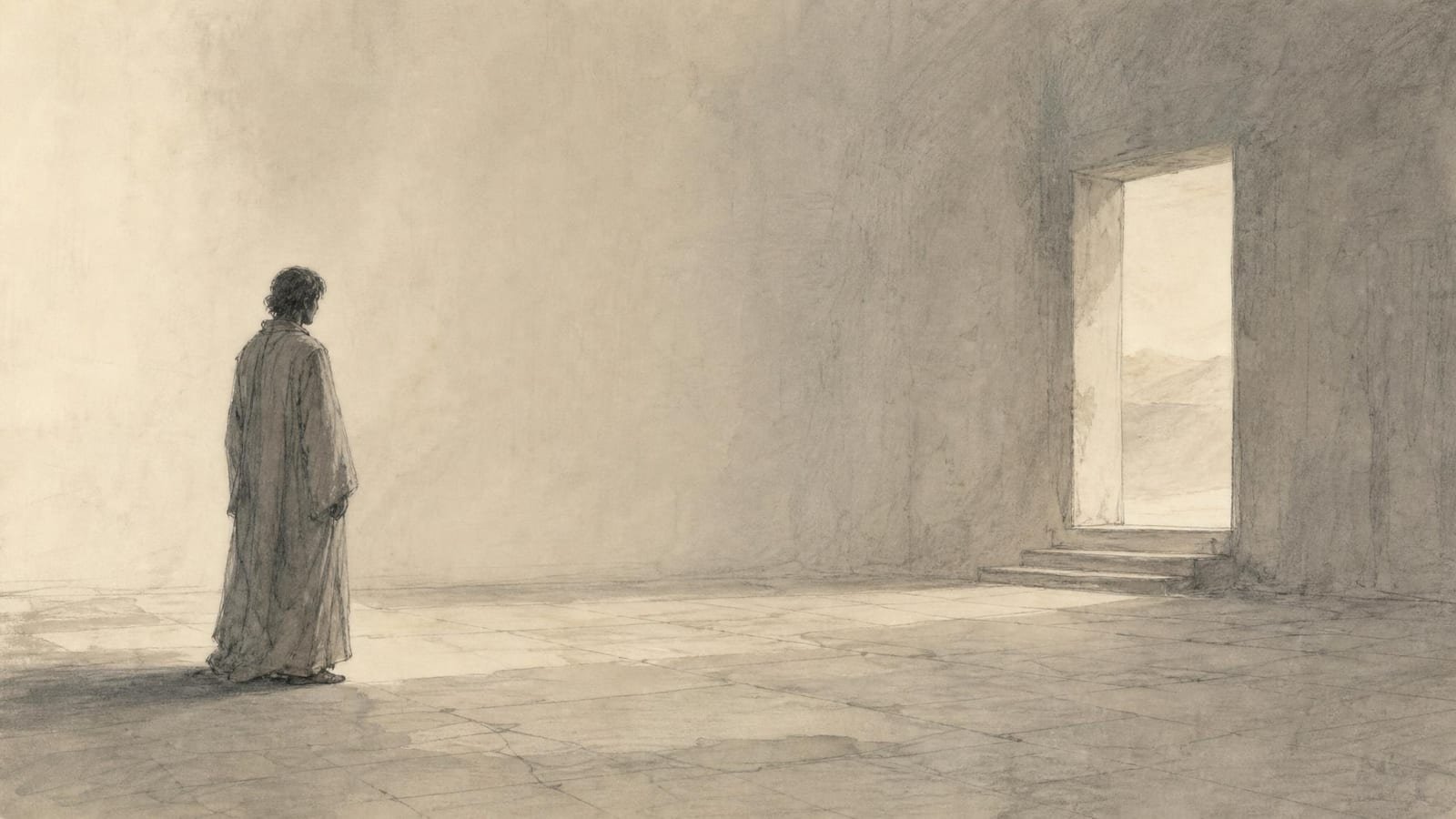
Disney-era animation board
The original use: sequential frames pinned in order so the team could read a film's continuity before a single cel was painted.
A storyboard is a film read as a row of fixed frames. Tile a sequence of identically proportioned panels at the picture's true aspect ratio, give each one caption space and a pair of safe-area guides, and a director can walk the whole shot order before a camera moves. The grid does one quiet job that everything else depends on: it keeps every frame the real camera ratio, so the composition you draw is the composition that ships. Here is what the overlay draws, the maths of ratios and safe areas, the history from the Disney board to modern pre-visualisation, and how to use it.
One of the 82 composition overlays every visual artist should know and use.
A standard 16:9 board tiles identical frames in reading order, each with its action-safe and title-safe guides nested inside and a caption strip beneath.
The overlay draws a frame sequence — a row or grid of identical panels, each locked to the aspect ratio you choose: 16:9, 2.39:1 scope, 4:3, square, or vertical 9:16. Inside every frame sit two faint nested rectangles: the action-safe boundary at roughly ninety per cent of the frame and the title-safe boundary at roughly eighty per cent. Beneath each frame is a caption strip for the shot number, shot type, duration, and a line of dialogue or action. The point is uniformity: every panel is the same proportion as the camera's real frame, so a sequence reads as a continuous film rather than a set of mismatched sketches.
What the grid buys you is honest blocking. When the frame on the page is the true delivery ratio, the headroom you leave, the lead room you give a moving subject, and the edge an actor exits all transfer straight to the shoot. Draw on a 16:9 panel for a 2.39:1 picture and the blocking lies — the wide composition you imagined is cropped to something narrower the moment it reaches the timeline. As an overlay the grid is also a check: lay it over a rough page and any frame that has drifted off ratio, or any caption that has crept into the title-safe margin, shows up at a glance.
One practical refinement matters. A storyboard is read in sequence, so reading order is part of the structure, not an afterthought. The overlay lays the frames left to right and top to bottom, the order a director's eye expects, and keeps the gutters between them even so nothing competes for the next glance. Set the frame count per page and the ratio, and the grid scales the frames and safe areas to match, so the board you draw at sketch size stays faithful when it prints or exports.
A frame is defined by its aspect ratio, and the safe areas are simple percentages of that frame:
16:9 = 1.78 · 2.39:1 scope · 4:3 = 1.33 · 1:1 · 9:16 vertical
action-safe ≈ 90% of frame · title-safe ≈ 80% of frame
page = N frames + even gutters + caption strips
Pick the ratio first: it sets the width-to-height of every panel, and 16:9 (1.78), anamorphic scope (2.39:1), and the older 4:3 (1.33) cover most delivery.3 The action-safe and title-safe rectangles are then drawn concentric to the frame at about ninety and eighty per cent, the proportions the broadcast recommended practice settles on so action and text survive overscan and platform cropping.7 The page itself is just arithmetic: N frames of a fixed ratio, laid out in reading order with even gutters and a caption strip per frame.1 None of this is hard to compute; the value of the overlay is that it holds the ratio exactly so the blocking you draw in pre-production is the blocking you get on the day.2
The Disney board. The storyboard was developed at the Walt Disney studio in the early 1930s, where Webb Smith is usually credited with the breakthrough of pinning sequential sketches to a board so the team could walk through a film's continuity before committing it to animation. By the time of the studio's first feature the method was standard, and pre-visualising a sequence in framed drawings became the foundation of animation production.5
Adoption across live action and advertising. The practice spread from animation to live-action film and then to commercial production, where a board became the document that sold an idea to a client before a shoot. Daniel Arijon's Grammar of the Film Language codified the visual conventions — shot sizes, screen direction, and continuity — that a board has to honour to read as a coherent sequence.4 Joseph Mascelli's earlier Five C's of Cinematography set out the same grammar of composition, continuity, and cutting that a frame on a board stands in for.6
The formalisation. The board became a teachable craft through dedicated texts: Steven Katz's Film Directing Shot by Shot tied storyboarding to the larger problem of visualising from concept to screen,2 John Hart's The Art of the Storyboard treated the board as the filmmaker's introduction to the discipline,1 and Marcia Begleiter's From Word to Image walked the board through the whole filmmaking process.5 Seen from the wider design-grid tradition, the board is itself a grid-discipline document — a repeated module sized to a fixed proportion — of the kind Timothy Samara surveys in Making and Breaking the Grid.8
A board is a plan, not a guarantee. The boarded shot is an intention; weather, performance, and the realities of the set all change it. Bruce Block's work on the visual story treats the board as one tool for controlling visual structure across a film, not a contract the finished picture must obey.3
Over-detailed boards waste effort. Lavishing finished drawings on shots that are likely to change burns time that the production rarely has. Many directors board only the shots that genuinely need designing in advance and leave straightforward coverage to the day.
The frame ratio must match delivery. If the panel ratio does not equal the final format, the blocking on the board is misleading — a composition drawn for one frame is cropped to another, and the board stops telling the truth about what the audience will see.
| If you want to... | Use the storyboard grid | Don't use it for... | Difficulty |
|---|---|---|---|
| Plan a shot sequence before the shoot | Frames in reading order at the true ratio show the whole flow | A single hero still that needs no sequence | Beginner |
| Design complex action or visual-effects shots | Boarding the difficult shots settles blocking in advance | Simple coverage a DP can frame on the day | Intermediate |
| Pitch a commercial or sequence to a client | A clean board sells the idea before any expense | A finished cut that no longer needs a plan | Beginner |
| Keep broadcast text and action inside the cut | Action-safe and title-safe guides protect the edges | Pure cinema with no overscan concern at all | Intermediate |
| Board a vertical clip for a social platform | A 9:16 frame with the platform safe area drawn in | Reusing a 16:9 board for a vertical deliverable | Advanced |
Six contexts. The studio and broadcast uses are documented practice; the readings are analysis.
The original use: sequential frames pinned in order so the team could read a film's continuity before a single cel was painted.
Wide frames where the extra width is the composition — boarding at 16:9 here would crop the very thing the format exists for.
One large frame per beat, drawn to be photographed and cut to a timing track so the client sees the spot move before the shoot.
Two matched 16:9 frames hold screen direction across the cut, so a conversation reads without the audience losing who faces whom.
Tall frames with the platform safe area marked top and bottom, where interface elements would otherwise cover the action.
A small frame paired with shot-list fields — type, lens, move, duration — so the visual plan and the logistics sit on one sheet.
Drawing on a 16:9 frame for a 2.39:1 or 9:16 deliverable makes the blocking lie: the composition is cropped the moment it reaches the timeline, and the board no longer describes the film.
Placing key action at the very edge or running captions to the frame border risks losing them to overscan on older displays or to platform interface elements.
Finishing every frame to a high polish, including the simple coverage, spends days the production does not have on decisions the set will overturn anyway.
If a character faces right in one frame and right again in the reverse, the two shots fight; the audience reads it as both characters looking the same way rather than at each other.
The frame grid is the storyboard artist's working surface. Set the delivery ratio, fix the frames-per-page, and sketch the sequence in reading order so the director reads pacing as well as composition. Keep the action-safe and title-safe guides on while you draw, indicate camera moves with arrows inside the frame rather than as separate notes, and annotate each panel with shot number, type, and duration so the board doubles as a working document the whole crew can follow.
In animation the board is closer to the finished film than anywhere else: the storyboard becomes the animatic, and the animatic sets the timing the animators work to. Board to the true frame ratio, hold continuity and screen direction across cuts, and treat the caption strip's duration field as the first pass at the edit. Because animation has no second take, the time spent settling a sequence on the grid is repaid many times over downstream.
Vertical platforms reward planning the frame around the interface. Board at 9:16 with the platform safe area drawn in, because captions sit along the bottom and account elements along the top, and the usable region is smaller than the raw clip. Centre the action, leave room top and bottom for the interface, and storyboard the cutdowns separately rather than cropping a horizontal master — a clip composed for 16:9 rarely survives the squeeze to vertical.
Directors use the board to decide, in advance, the shots worth deciding in advance — and to leave the rest to the set. The grid is also a teaching tool: lay it over a finished sequence and a student sees how shot size, screen direction, and pacing are planned rather than improvised. In both cases the discipline is the same as the comic page next door — establish a clear sequence, then spend the deliberate break where it counts.
Fix the frame to the ratio the audience will actually watch, and the storyboard stops being a wish and starts being a plan — every shot you draw is a shot you can shoot.
Grid Maker Pro editorial

Illustrative composites of how the tool gets used in practice — not quotes from named individuals.
I lock the delivery ratio before I draw a single frame. A board in the wrong shape is worse than no board — it sells the director a composition the camera can never give them.
In animation the board is the film. The duration field under each frame is my first edit, and the timing I settle on the grid is the timing the whole crew animates to.
For vertical spots I board with the interface drawn in. Half my first drafts failed because the action sat exactly where the caption bar lands on a phone.
Pick your delivery ratio, set the frames per page, and board the sequence at the true camera frame. Free, in your browser.
Launch Grid Maker Pro →You can use the storyboard frame grid overlay here for nothing, today and always. What a browser still can't do is get the picture itself onto paper — that needs a camera. The Grid Maker Pro AR app floats your reference over the real page through your phone so you trace the outlines straight onto the surface, then build on them with the same overlays you use here.
Get the AR tracing app → Free web tool, free forever · AR tracing is the separate paid app