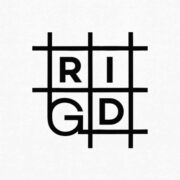
Constructing a logo on a grid
A 2-session design unit for high school. Students discover that the cleanest logos are not drawn freehand but constructed — built from circles, a grid, and a few guides so their proportions are deliberate and repeatable. Then they learn the secret designers rarely say aloud: the math has to be quietly broken so the mark looks right to the eye.
This lesson plan draws on the 82 composition overlays every visual artist should know and use.
Learning objectives
By the end of the unit, students will:
- Explain why a constructed logo is more consistent and reproducible than a freehand one
- Build a simple mark from a grid, circles, and geometric guides
- Apply optical corrections — overshoot and weight adjustments — so shapes look balanced
- Test a logo at small and large sizes and simplify where detail fails
- Critique a mark for proportion, balance, and clarity
Standards alignment
- VA:Cr1.2.HSIaShape an artistic investigation of an aspect of present-day life using a contemporary practice of art or design.
- VA:Cr3.1.HSIaApply relevant criteria from traditional and contemporary cultural contexts to examine, reflect on, and plan revisions for works of art and design in progress.
- VA:Re8.1.HSIaInterpret an artwork or collection of works, supported by relevant and sufficient evidence found in the work and its various contexts.
Materials
- Internet-connected device per student to study the logo-construction overlay and build the mark
- A compass, ruler, and grid or graph paper for the construction
- Pencils, a fine black pen, and an eraser; optional design app or vector tool
- A short brief — a name or initial and one idea the mark should suggest
- Printed examples of constructed logos with their guide circles visible
Lesson sequence
Building a mark from geometry
45 minutesShow a famous logo with its construction grid revealed — circles and lines under the final shape. Ask "Was this drawn by hand or built?" The reveal lands: the cleanest marks are engineered. A grid is what lets a logo be redrawn identically at any size, forever.
- (4 min) Students pick a simple subject — an initial, or a basic icon like a leaf, a bird, or a mountain — that can be reduced to a few clean shapes.
- (5 min) They open the logo-construction overlay and study how circles and a grid set the curves and proportions of an existing mark.
- (14 min) On grid paper, students draw construction guides first — a bounding box, a few circles for curves, lines for stems — then trace the mark on top so every curve has a center and every edge a coordinate.
- (5 min) They strip the mark down: remove any line that is not doing a job. A logo must survive being tiny, so simplicity is built in now.
- (2 min) Students keep a copy with the guides showing and a clean copy without, to compare tomorrow.
- How did building from guides change the way your shapes related to each other?
- What did you remove to simplify the mark, and did it get stronger?
- Why does a logo need to survive being printed the size of a thumbnail?
Refining and applying optical corrections
45 minutesShow a circle and a square drawn to the same height side by side. Most students say the circle looks smaller. It is the same height — but the eye shrinks round shapes. This is why designers make circles slightly larger than the math says: today's twist is that perfect geometry can look wrong.
- (8 min) Optical corrections: students overshoot round and pointed parts slightly past the guides so they read the same size as flat parts, and check that stroke weights look even rather than measure even.
- (10 min) They redraw the mark with corrections, comparing it to the strictly geometric version. The corrected one looks more balanced even though it is less mathematically pure.
- (8 min) Scale test: students draw the logo at thumbnail size and at large size. Anything that breaks small gets simplified.
- (4 min) They produce a final clean black version with no guides, ready to use.
- Where did you have to break the geometry to make the mark look right?
- What happened to your logo at thumbnail size, and how did you fix it?
- Why might a designer trust their eye over the measurement?
Point students to the logo construction overlay page and the golden ratio plan to explore proportion in marks. For moving the logo onto a physical sign, see the logo-to-sign transfer plan. For transferring a pattern onto timber, see the wood-burning transfer plan.
Assessment rubric
4-point scale per criterion:
| Criterion | 4 — Mastery | 3 — Proficient | 2 — Developing | 1 — Beginning |
|---|---|---|---|---|
| Geometric construction | Mark fully built on guides and reproducible | Mostly constructed | Partly constructed | Drawn freehand |
| Optical correction | Corrections applied so shapes read balanced | Some corrections applied | Aware but inconsistent | No corrections |
| Simplicity & scale | Clean and legible at any size | Mostly works at size | Breaks small | Too complex to read |
| Concept | Mark clearly suggests its idea | Idea mostly comes through | Idea unclear | No clear concept |
Extensions
- Responsive logo: Students design a full mark and a simplified version for tiny sizes, like an app icon or favicon.
- Cross-disciplinary (geometry): Use compass-and-straightedge construction to build the guides, connecting design to classical geometry.
- Differentiation: Students who need support build a monogram from one letter; advanced students integrate the golden ratio into the proportions.
- Design history: Research a famous identity system and how its grid kept the logo consistent across decades and media.
More lesson plans: browse all. Want this plan customized for your curriculum? Email us.