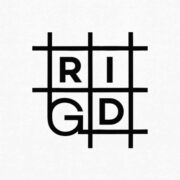
Striped wordmark
An IBM-style striped letterform whose bar weight and gap are set by one repeating module, so the wordmark reads as engineered rather than drawn.
A refined mark is rarely eyeballed all the way. Underneath the finished logo sits a quiet scaffold of concentric circles, tangent lines, and 45° axes that ties every curve to a shared centre and every straight to a known angle. The construction grid is what lets a mark shrink to a favicon and grow to a billboard without losing its proportions, and it is the spec that lets any production team redraw it identically. Here is what the overlay draws, the real maths of ratio-based construction, the corporate-identity history, the golden-ratio myth worth retiring, and when the grid actually helps.
One of the 82 composition overlays every visual artist should know and use.

A wordmark sits on a single baseline with the cap-height and x-height drawn as construction circles, so every letter's curve relates to the same radii.
The overlay draws a construction sheet — the heart of any logo grid system: a stack of concentric circles centred on the mark, a cross of horizontal and vertical axes through that centre, a pair of 45° diagonals, and the tangent lines where a straight element is meant to meet a curve. It is not a drawing of the mark — it is the geometry the mark is meant to obey, the scaffold against which you check that the inner curve shares a radius with the outer, that a stroke aligns to an axis, and that a corner sits where two guides cross.
The point of all that geometry is rational relationship. When the radii of a mark's curves are whole multiples of one unit module, the parts of the mark relate to each other by ratio rather than by accident, and the eye reads that relatedness as deliberate.4 Grid Maker Pro lets you set the number of circles, the radius spacing (linear integer steps or golden-ratio steps), and the angular subdivision, so the circle grid for logos matches the mark you are actually building rather than a generic compass rose.
As an overlay the sheet does two jobs. While you draw, it is a guide: refine the rough until every curve passes through, or is tangent to, a line. Afterwards it is a reproduction spec — the construction is the description that lets any production team redraw the mark identically at any size, which is why it lives in the brand manual.6 Both uses are legitimate; the only error is pretending a sheet drawn afterwards was the route the design actually took.
Construction is ratio, not measurement. Pick a unit module u and let every circle radius be a multiple of it:
radii = u, 2u, 3u, 4u … (or golden steps: u, φu, φ²u)
axes at 0°, 45°, 90°, 135° through the centre
tangent: straight meets curve where it touches one circle
The single rule is that no curve floats free: each shares a centre or a radius with a construction circle, and each straight runs along an axis or a tangent.4 When that holds, the parts of the mark relate by simple ratio and the geometry gives you a redraw spec for any size — the mark is defined by its construction parameters, not by a particular pixel measurement.5 One honest caveat belongs here: many famous "golden ratio" construction breakdowns are rationalisations laid over a finished mark, not the geometry it was drawn from. Kimberly Elam's analysis is careful to separate genuine geometric construction from the retrofitted phi spiral, and the discipline is worth keeping even when the phi story is dropped.4
The compass-and-straightedge lineage. Geometric mark-making predates modernism by centuries — heraldic devices, guild marks, and early printers' marks were laid out with compass and rule, and the Renaissance interest in proportion fed directly into the design of trademarks. Per Mollerup's taxonomy of marks places the constructed geometric mark within this long history of identification by symbol.3
The corporate-identity era. The construction sheet became a standard artefact in the mid-twentieth-century identity programmes, where Paul Rand's marks for IBM, UPS, ABC, and later NeXT were delivered with documentation that fixed the mark's geometry for reproduction.1 Rand's deeper insistence — that a logo's value comes from what it represents rather than from the cleverness of its drawing — frames why the construction is a means, not the message.2 Alina Wheeler's account of the identity process treats the construction grid as the bridge between a designed mark and its consistent rollout across every application.6
Negative space as documented intent. Lindon Leader's 1994 FedEx wordmark is a well-documented case where the arrow formed in the gap between the E and the x was shaped on purpose by the geometry of the surrounding letters — the construction defines the void as deliberately as the marks.6
The grid often follows the mark. Many published construction sheets are drawn after the fact to document and rationalise a mark for the brand manual. Rand himself frequently drew freehand and reconstructed the geometry afterwards. That is fine — until the documentation is sold as the design method.
The golden-ratio claim is usually retrofitted. The widely shared image of the Apple mark resolving into a golden spiral is an overlay after the fact, not the documented construction; designer Rob Janoff has said the 1977 apple was not built from the golden ratio. Timothy Samara's work on grids is candid that geometric systems serve the work and can be broken — the grid is a servant of the mark, never the reverse.7
| If you want to... | Use the construction grid | Don't use it for... | Difficulty |
|---|---|---|---|
| Refine a sketch into a precise vector | Circles and tangents tie every curve to a shared geometry | A warm, hand-drawn script you want to keep human | Intermediate |
| Make a mark scale from favicon to billboard | A ratio spec reproduces the mark identically at any size | A one-off illustration with no reuse requirement | Intermediate |
| Build a radial badge or seal | Concentric circles and axes guarantee rotational symmetry | An asymmetric, gestural mark that resists a centre | Beginner |
| Document a mark in a brand manual | The construction is the redraw spec future teams follow | A logo still mid-concept and likely to change | Intermediate |
| Shape negative space deliberately | The same circles define the gaps as much as the shapes | Marks where the void is incidental, not load-bearing | Advanced |
Six contexts. The documented identities are real cases; the readings are analysis, and a myth is labelled where one is in play.
An IBM-style striped letterform whose bar weight and gap are set by one repeating module, so the wordmark reads as engineered rather than drawn.
A two-letter monogram whose strokes share radii with concentric circles, so the initials lock together instead of merely sitting side by side.
The arrow in the gap between E and x is shaped by the letters' geometry on purpose — a documented case of constructing the void, not just the shapes.
A bar crossing concentric rings — the construction fixes where the bar meets the circle and keeps the proportion intact at every size on the network.
A ring of repeating elements on a shared radius. The 45° axes set the rotational steps so the seal is symmetric about its centre.
A pictorial symbol assembled from arcs that each belong to a construction circle, so a casual-looking shape is in fact built on rational geometry.
Reaching for circles and axes before there is a concept produces a mark that is geometrically tidy and says nothing. The construction can refine an idea but cannot supply one.
When every element visibly snaps to a grid line, the mark reads as cold and mechanical. Total geometric obedience is not the same as good design.
The eye does not read the measured centre as the visual centre, so a perfectly centred element can look low or off. Mathematics is not perception.
Laying a phi spiral over a finished mark and claiming it as the construction is design theatre. It misleads clients and students about how the mark was actually made.
Treat the construction grid as a refinement and reproduction tool rather than an ideation one. Once a sketch is settled, drop the concentric circles behind it and adjust until each curve shares a radius and each straight runs along an axis or tangent. Then optically correct by eye and redraw the geometry so the sheet still reproduces what you see. The discipline is what lets a mark survive being shrunk to a favicon without turning to mush.
The construction grid is the part of the brand manual that keeps a mark consistent across decades and across every vendor who will ever reproduce it. Specify the mark by its construction parameters, not by a single exported file, so a sign-maker, a web team, and a printer all redraw the same geometry. Wheeler's process treats this documentation as the bridge between a designed mark and a reliable rollout — that is exactly what the grid buys.
Icon work lives or dies at small sizes, so the construction grid matters even more than it does for a wordmark. Build each icon on a shared circle-and-axis system so a family of icons feels like one set rather than a collection, and so strokes land on consistent positions when the icon is rendered at sixteen or twenty-four pixels. The same tangent logic that aligns a logo's curves keeps an icon's corners crisp on the pixel grid, and the letterform discipline behind a good wordmark is the same one that governs type.8
The construction grid teaches a transferable habit: relate the parts of a design to one another by ratio instead of placing them by feel. Overlay the grid on a documented mark to see how its curves share radii, then rebuild a simple symbol where every arc belongs to a construction circle. Teaching the honest caveats alongside — that grids often follow the mark, that the golden-ratio story is usually retrofitted — is as valuable as teaching the geometry itself.
"A logo derives its meaning from the quality of the thing it symbolizes, not the other way around."
Paul Rand, A Designer's Art (1985)1

Illustrative composites of how the tool gets used in practice — not quotes from named individuals.
I never start on the grid. I sketch until a mark feels alive, then bring in the circles to tighten it. The geometry is the editor, not the author.
The construction sheet is for the brand manual. If a sign-maker in another city can redraw the mark from my circles, I have done my job.
I tell students the truth: most golden-ratio overlays come after the mark. Document the geometry you actually used and skip the spiral theatre.
Drop a sketch, set your circles and axes, and refine the mark until every curve relates to the geometry. Free, in your browser.
Launch Grid Maker Pro →Logo construction grid is free to use here and will stay that way. When the plan on screen needs to become marks on paper, the browser reaches its limit — there's no camera to register the image to your page. The Grid Maker Pro AR app adds exactly that: hold the phone over the paper and trace your reference directly, then keep working with the same overlay set.
Get the AR tracing app → Free web tool, free forever · AR tracing is the separate paid app