
The 35mm film frame (24×36)
Barnack's doubled cine frame is exactly 3:2. The negative that defined a century of photography is the 1.5 rectangle made physical.
The rectangle you already shoot in. Where Root 2, Root 3, Root 5, and phi are irrational numbers that need careful construction, 1.5 is simply 3:2 — the proportion of 35mm film, the default sensor of every full-frame and APS-C camera, and standard print sizes. It is the rational outlier in Hambidge's dynamic-symmetry family, and it hides a quiet surprise: on a 3:2 frame, the dynamic-symmetry reciprocals land exactly on the rule of thirds. Compose by one and you have composed by both. Here is the math, the Leica history behind the format, and how 1.5 bridges two composition traditions.
One of the 82 composition overlays every visual artist should know and use.
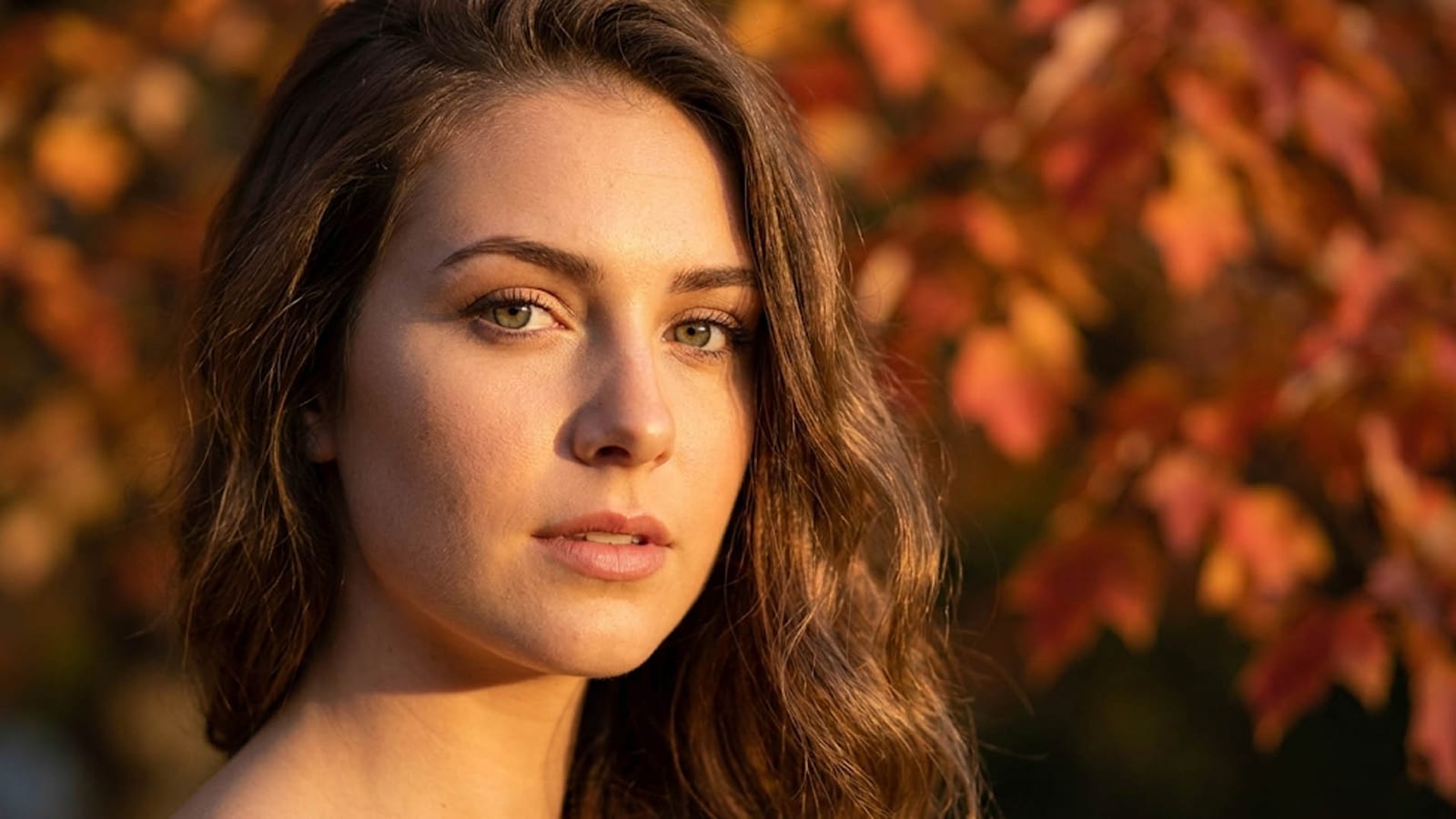
On a 3:2 portrait the eye lands on the upper thirds intersection — which is also where the dynamic-symmetry reciprocal crosses the diagonal. The two systems mark the same four points, so you only have to decide once.
The 1.5 overlay draws the diagonals of the 3:2 frame, the reciprocals dropped perpendicular to them from the opposite corners, and the trisection lines at the thirds. On this aspect — and only on this aspect — the reciprocal verticals fall exactly on the trisection verticals, so the four crossing points are simultaneously the dynamic-symmetry "eyes" and the rule-of-thirds intersections.
That coincidence is the overlay's whole story. On a 16:9 or 4:3 canvas the reciprocals and the thirds separate; on 3:2 they merge — which is the heart of the 3:2 vs 4:3 composition difference. A photograph composed by the rule of thirds in 3:2 is therefore already composed by dynamic symmetry, which makes 1.5 the natural bridge between the casual photographer's mental model and the atelier painter's construction. Because every full-frame sensor and most APS-C sensors output 3:2 directly, the 3:2 composition grid you see here is the same DSLR aspect ratio you already shoot.
1.5 is 3:2, the simplest non-trivial rational rectangle after the square and the double square. Its diagonal and reciprocal generate the thirds:
diagonal angle = arctan(2/3) ≈ 33.69° → reciprocals meet at x = ⅓, ⅔
Three facts make 1.5 the friendly member of the family:
For most photographers the practical consequence is that you need no separate decision: the file is already 3:2, and the thirds you reach for are the dynamic-symmetry construction. Try it in the live tool — the armature draws on any 3:2 image directly.
1913 — Barnack's Leica. The 3:2 format owes its dominance to one engineering decision. Oskar Barnack, working at Ernst Leitz in Wetzlar, built the first compact 35mm still camera (the Ur-Leica) around 1913. Cine film ran vertically with an 18×24mm frame; Barnack ran the film horizontally and doubled the frame to 24×36mm — exactly 3:2 — for a larger negative.1
1925 — the Leica I. The camera went on sale at the Leipzig Spring Fair in 1925 and made 35mm the dominant still-photography format. Every later 35mm SLR kept the 24×36mm frame, codified in the 135-film standard.18 When digital arrived in the 1990s, full-frame and APS-C sensors kept 3:2 for continuity with the existing lens and print culture.
The rule-of-thirds lineage. The phrase "rule of thirds" dates to John Thomas Smith's Remarks on Rural Scenery (1797), which proposed dividing a composition by thirds.3 On the 3:2 frame this nineteenth-century rule and Hambidge's twentieth-century dynamic symmetry land on the same lines — a convergence Michael Freeman's composition writing treats as the practical backbone of photographic framing.4
The dynamic-symmetry placement. Hambidge included 1.5 among his rectangles as a static, rational alternative to the root rectangles, a concession to artists who wanted simpler proportions.2 Later proportion analysts situate it within the broader family of design rectangles.57
"3:2 is the golden ratio." The most common confusion. 3:2 is 1.5; the golden ratio is about 1.618. Side by side a phi rectangle is visibly longer. 3:2 is a clean rational proportion with its own Leica history, not a golden one — though it is sometimes offered as a Fibonacci approximation (2 and 3 are consecutive Fibonacci numbers).
"The rule of thirds is a law of perception." It is a useful heuristic, not a perceptual law, and its tidy coincidence with dynamic symmetry holds only on 3:2. Mario Livio and others have shown how much "golden" and "thirds" mythology rests on retrofitting rather than evidence; the honest claim for 1.5 is the geometric coincidence, not a deep law of seeing.
"Barnack chose 3:2 for its beauty." He chose it for resolution — doubling the cine frame gave a bigger negative on available film. The proportion's ubiquity is an accident of film stock and good engineering, not a deliberate aesthetic selection.
| If you want to... | Use the 1.5 rectangle | Don't use it for... | Difficulty |
|---|---|---|---|
| Compose any full-frame or APS-C photograph | The file is already 3:2 — the armature applies with no crop | Square or 4:3 formats (different aspect) | Beginner |
| Bridge the rule of thirds and dynamic symmetry | The two systems coincide here, so it is the natural teaching entry point | 16:9 or 4:3, where the two systems diverge | Beginner |
| Print at 4×6, 6×9, or 8×12 | These print sizes are 3:2, so the composition survives to print uncropped | Square Instagram or 5×7 prints (crop required) | Beginner |
| Lay out a 6×9 or 8×12 editorial page | The trim is 3:2; the trisection grid organises the spread cleanly | A-format pages (use Root 2) | Intermediate |
| Teach dynamic symmetry to photographers | Start from the proportion they already shoot and the grid they already use | Demonstrating irrational root geometry (use Root 5) | Beginner |
Six places the 3:2 proportion does demonstrable, documented work.
Barnack's doubled cine frame is exactly 3:2. The negative that defined a century of photography is the 1.5 rectangle made physical.
The camera that made 35mm the standard. Its 24×36mm frame fixed 3:2 as the default proportion of the photographic century.
Full-frame and APS-C sensors kept 3:2 when photography went digital, so the file you shoot today is still the 1.5 rectangle.
The common print sizes are 3:2, so a frame composed full-frame prints with nothing cropped — composition intact from sensor to paper.
Cartier-Bresson shot the uncropped 3:2 Leica frame, composing on intuition to the thirds — the 1.5 rectangle as a working philosophy.
Draw the diagonals and reciprocals (solid) and the thirds (dashed): on 3:2 they fall on the same verticals. The unique convergence of the two systems.
The reciprocals-equal-thirds property is specific to 3:2. Carry it over to a 16:9 video frame or a 4:3 crop and the dynamic-symmetry construction no longer lands on the thirds.
1.5 and 1.618 are close enough to blur in casual talk but visibly different in a layout. Treating them as the same proportion produces compositions that miss the golden geometry they claim to use.
Because 3:2 is comfortable and matches the camera, it is easy to treat it as the only proportion. That leaves the golden and root-rectangle compositions — which 1.5 is meant to be a gateway to — unused.
1.5 is the rational, approachable canvas in the dynamic-symmetry family — the one whose subdivisions terminate cleanly into halves, thirds, and quarters without irrational geometry. Painters use it as the entry point to Hambidge's system: build a composition on the diagonal-and-reciprocal armature and the focal points land on the thirds, a placement most artists already trust. From there the move to phi and the root rectangles becomes a deliberate choice rather than a leap into the unfamiliar.
This is the photographer's home proportion. The camera already produces 3:2, so the armature applies with no crop, and because the reciprocals coincide with the thirds, the grid you reach for is also the dynamic-symmetry construction. The practical workflow is to compose to the thirds in-camera, then confirm placement on the overlay in post — knowing the composition will print uncropped at 4×6 or 8×12. For anyone learning composition seriously, 1.5 is where dynamic symmetry stops being abstract.
The 3:2 frame organises photo-led layouts, editorial pages at 6×9 trim, and any design that has to hold full-frame imagery without cropping. The trisection grid is a reliable scaffold for placing a hero image and its captions, and because the proportion matches the photographer's file, designers and photographers can hand work back and forth without re-cropping. It is the proportion of the photograph as a design element.
Less central than the root rectangles for proportional systems, but 1.5 is the working aspect for presentation photography and rendered views, which are almost always 3:2. Laying out a board of 3:2 images on the trisection grid keeps the set consistent. The 3:4 rectangle produced by bisecting a 3:2 frame is also a useful portrait module for stacked detail views within a landscape board.
"Composition must be one of our constant preoccupations, but at the moment of shooting it can stem only from our intuition, for we are out to capture the fugitive moment."
Henri Cartier-Bresson, The Decisive Moment (1952)6
Illustrative composites of how the tool gets used in practice — not quotes from named individuals.
I shot thirds for years before I knew it was dynamic symmetry. On a 3:2 frame they're the same lines — the overlay just gave it a name.
Full-frame in, 8×12 out, nothing cropped. Composing on the 1.5 grid means what I see in the viewfinder is what prints.
Free and browser-only means I teach the thirds-equals-dynamic-symmetry idea to a class on whatever laptop is in the room.
Drop a reference image. The 1.5 armature applies in one click. Free, in your browser.
Launch Grid Maker Pro →1.5 rectangle (3:2) is free to use here and will stay that way. When the plan on screen needs to become marks on paper, the browser reaches its limit — there's no camera to register the image to your page. The Grid Maker Pro AR app adds exactly that: hold the phone over the paper and trace your reference directly, then keep working with the same overlay set.
Get the AR tracing app → Free web tool, free forever · AR tracing is the separate paid app