The Conversion of Saint Paul (1601)
The fallen Paul and the horse's bulk are organised on a corner-to-corner diagonal — Baroque drama built on exactly the axis Westhoff would later name.
Draw both corner-to-corner diagonals and place the important detail along them — not on the thirds. That is the whole of Dutch photographer Edwin Westhoff's 2007 system: a line, not a point, as the anchor. It is the youngest composition rule in common teaching and the most openly contested. Here is what the overlay shows, the geometry behind it, the honest case for and against the claim that it beats the rule of thirds, and how it runs from Caravaggio's drama to street photography.
One of the 82 composition overlays every visual artist should know and use.
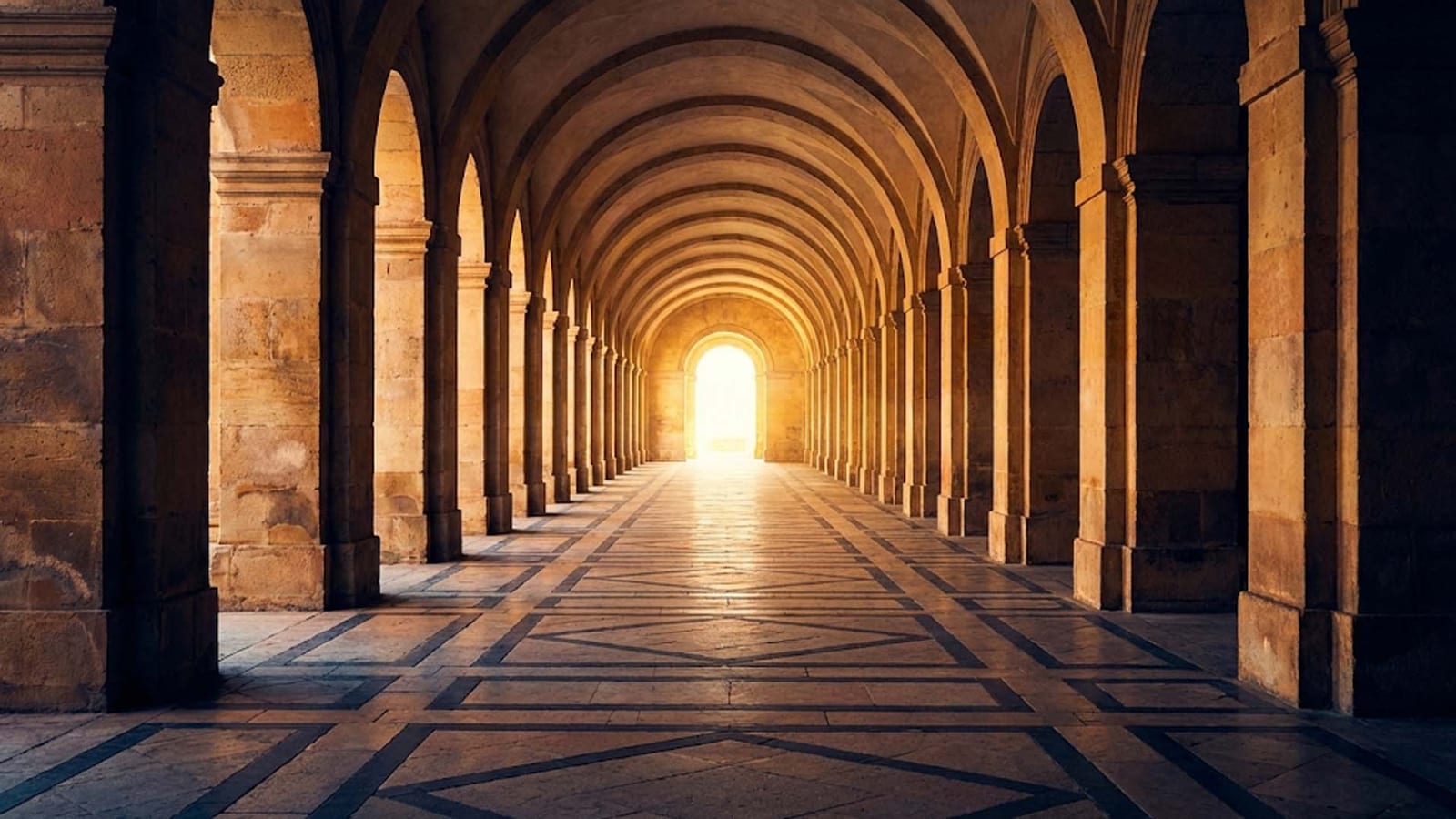
Architectural leading lines often ride a diagonal straight into a corner. Drag the handle to see whether the dominant edge of this facade lands on the line — if it does, the frame resolves without a thirds grid.
The Diagonal Method overlay draws two lines: top-left to bottom-right, and top-right to bottom-left. They cross at the geometric centre and split the frame into four equal triangles. Westhoff's rule is that compelling compositions tend to have important detail — a subject's edge, a horizon, a leading line — running along one or both of these diagonals.
The diagonal method vs rule of thirds question is, at root, structural. Thirds marks four discrete points of interest for focal placement; the Diagonal Method marks two continuous corner-to-corner lines along which any point can anchor a subject. That makes it the more natural tool for elongated subjects — a streak of rain, a road into the distance, a railway line — where a single point would be the wrong kind of anchor.
The two diagonals of a rectangle of width w and height h have slopes that depend only on the aspect ratio:
slope = ± h / w · 45° only when w = h (square)
Three points worth holding onto:
The overlay draws the diagonals for whatever crop you load. Open it in the live tool and align the dominant line.
Diagonals are old; the method is new. Composing along bisecting diagonals predates photography by centuries — Caravaggio drove Baroque drama down them, the falling rider of The Conversion of Saint Paul (1601) cutting a diagonal across the canvas, a strategy Walter Friedlaender documented in his Caravaggio studies.4 The diagonal has long been understood as the most dynamic axis of a frame, a point Rudolf Arnheim grounded in perceptual psychology in Art and Visual Perception.3
2007 — Edwin Westhoff. The contemporary Dutch photographer published The Diagonal Method as an explicit critique of the rule of thirds, arguing from a study of photographs and paintings that key detail lands on the bisecting diagonals more reliably than on the thirds intersections.1 It is the youngest system in common teaching, and now sits beside the golden ratio and rule of fifths in many composition curricula, including general references such as Michael Freeman's The Photographer's Eye.5
The eye-movement backdrop. The method is often justified by the way the eye sweeps a frame. The foundational data here is Alfred Yarbus's Eye Movements and Vision, which recorded the saccadic paths viewers trace across images — real research, though Westhoff's specific link to it is interpretation rather than Yarbus's own claim.7
"It is proven to beat the rule of thirds." This is the contested part. Westhoff's evidence — a curated set of admired images — is not a controlled study, the ranking method is not rigorously published, and the diagonal pattern could partly reflect how photographers already compose after years of training. Bert Krages and other composition writers treat it as a useful heuristic, not a settled law.6
"It only works on squares." Westhoff's original work used square frames, but the construction generalises to any aspect ratio; the diagonals simply track the frame's own proportions.
"It is a modern invention." Only the name and system are modern. Photographers from Henri Cartier-Bresson to Lee Friedlander built rigorously diagonal frames long before 2007, as their monographs show.8
| If you want to... | Use the Diagonal Method | Don't use it for... | Difficulty |
|---|---|---|---|
| Compose a road, river, or path receding into the frame | The line rides a diagonal and resolves the image | Discrete single subjects with no linear element (use thirds) | Beginner |
| Carry implied motion or direction | Diagonals align with the line of action a grid can't | Static, symmetric subjects (use centre-cross) | Intermediate |
| Build tension or unease (noir, conflict, editorial) | The diagonal structure carries emotional weight | Calm, balanced, formal compositions | Intermediate |
| Shoot fast on the street | Two lines are easier to hold in mind than four points | Considered studio work where thirds or φ suffice | Beginner |
| Diagnose why an image "feels right" | Overlay it and a key edge often turns out to sit on a diagonal | Multi-subject scenes with competing anchors | Advanced |
Six works — most predating Westhoff's name for the idea — where bisecting diagonals carry the composition.
The fallen Paul and the horse's bulk are organised on a corner-to-corner diagonal — Baroque drama built on exactly the axis Westhoff would later name.
Two great diagonals — the pyramid of survivors rising to the waving figure, the mast leaning against it — give the canvas its surging, desperate momentum.
The leaping figure and his reflection sit on a diagonal sweep; Cartier-Bresson's "geometry" was diagonal long before the method had a name.
Krasker's canted, diagonal framing won the cinematography Oscar — tilted streets and shadows on the diagonal turning postwar Vienna uneasy.
Friedlander built dense frames where signs, poles, and reflections lock onto crossing diagonals — a body of work that reads as the method avant la lettre.
The overlay shown throughout this page — two diagonals, two focal points where they meet the centre lines — distilled from his survey of admired images into a teachable rule.
A formal portrait, a head-on building, a calm reflection has no implied motion for a diagonal to ride. Imposing the method makes the composition feel arbitrarily tilted.
The baroque diagonal and the golden triangle use off-centre, ratio-derived axes — not the simple corner-to-corner lines of this method.
Using only one diagonal and forgetting the crossing point. Subjects placed at the cross read as centred-yet-dynamic; the second diagonal often holds the answering accent.
Citing it as scientifically established that diagonals beat thirds. The evidence is suggestive, not conclusive, and overstating it invites easy rebuttal.
The bisecting diagonal is the Baroque painter's engine of drama, from Caravaggio's tumbling figures to Rubens's surging hunts. Block the line of action first and let the principal forms ride one diagonal while a secondary mass answers on the other. The crossing point is a strong place for the dramatic accent — centred enough to dominate, dynamic enough to avoid stiffness.
This is a street and reportage tool above all: two lines are faster to hold mid-shot than four intersection points, and roads, gazes, and leaning figures fall onto them naturally. In post, overlay the diagonals against the thirds and keep whichever the subject actually wants. Many photographers find the method explains the frames that "worked" when thirds didn't.
Diagonal framing reads as tension and instability, which is why noir and thrillers lean on it — Krasker's canted Vienna in The Third Man being the textbook case. Compose the dominant lines of the set or blocking to a diagonal for unease; level back to horizontals and verticals when the scene needs to settle.
In layout and key art the diagonal injects movement into otherwise grid-bound work — a hero image cropped so its dominant edge runs corner to corner energises a poster or cover. Use it sparingly against an underlying column grid: the diagonal is the accent that breaks the orthogonal calm, not the structure of the whole page.
"When a photograph really works, the principal detail almost always lies on a diagonal running corner to corner — far more reliably than on the thirds we were all taught to use."
Edwin Westhoff, summarising The Diagonal Method (2007)1
Illustrative composites of how the tool gets used in practice — not quotes from named individuals.
I block the line of action on the diagonal before anything else. The deep-link reopens with the exact overlay configured — no clicking through menus mid-session.
I keep three Grid Maker Pro tabs open during any project — one per overlay I'm comparing. The bookmarkable URLs make this workflow possible.
On the street I shoot almost everything to the diagonals — two lines are faster to hold than four points. Free and browser-only means I actually use it.
Drop a reference image. The Diagonal Method overlay applies in one click. Free, in your browser.
Launch Grid Maker Pro →You can use the Diagonal Method overlay here for nothing, today and always. What a browser still can't do is get the picture itself onto paper — that needs a camera. The Grid Maker Pro AR app floats your reference over the real page through your phone so you trace the outlines straight onto the surface, then build on them with the same overlays you use here.
Get the AR tracing app → Free web tool, free forever · AR tracing is the separate paid app