Renaissance fresco cartoon
A small modello squared up to a wall-proportioned cartoon, then pounced onto wet plaster — the rectangular grid's defining use.
Most canvases are not square, and the rectangular grid is the version of the grid-method that admits it. By choosing N columns and M rows to suit the proportion of your surface, you keep the cells even on a 3:2 panel, a 16:9 banner, or a two-storey wall — no cropping required. It is the grid behind every fresco cartoon and every squared-up mural in history. Here is how to choose N and M, where the technique comes from, and when the rectangular grid beats its square sibling.
One of the 82 composition overlays every visual artist should know and use.
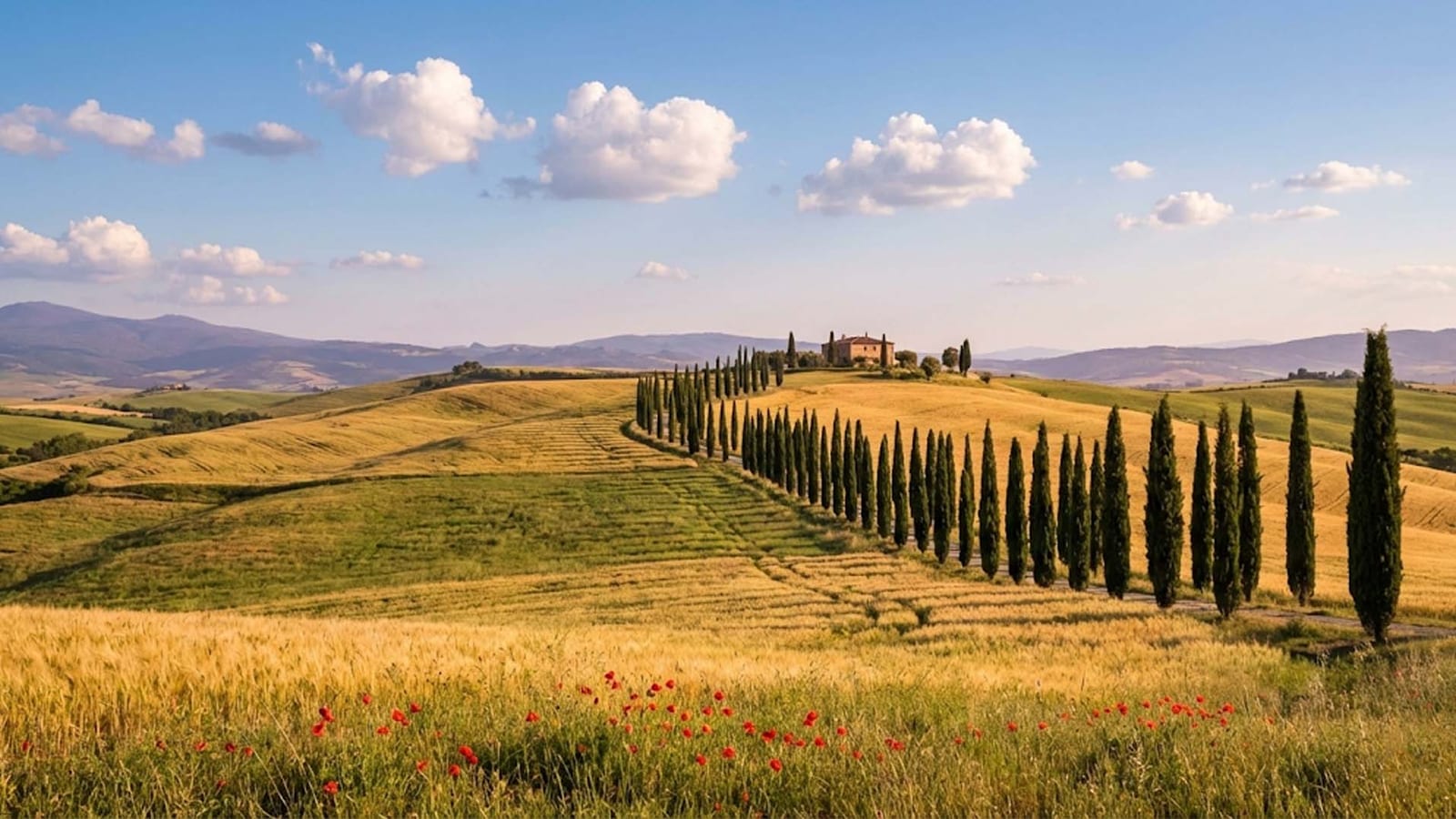
On a wide 16:9 landscape, a 6×4 grid keeps the cells nearly square so each holds a comparable slice of the scene — the horizon and the major masses transfer to a banner-shaped canvas without distortion.
The rectangular grid overlay divides the frame into N columns by M rows of congruent rectangular cells. Unlike the square grid, N and M are chosen independently so the cells can be made even on a non-square surface — a 3:2 photo, a 16:9 banner, a tall portrait panel. The working method is otherwise identical to the square grid: the reference and the canvas carry the same N×M, and you copy cell by cell.
In Grid Maker Pro you set columns and rows separately, so you can dial the cells to near-square on any aspect ratio, or — deliberately — let them stretch for a controlled anamorphic transfer. This is how you scale a reference photo to canvas with a grid when the two are different sizes: the same columns and rows on both surfaces hold the proportion as you scale up the reference. Lines export as PDF or SVG to print over a photograph, snap onto a wall, or chalk up for a mural.
The rectangular grid generalises proportional transfer to two independent counts — columns and rows set separately. For congruent cells to come out square on a surface of width W and height H, so that each cell maps at 1:1 proportion between reference and canvas, the column and row counts satisfy:
N / M = W / H → even cells when N : M = aspect ratio
That single relationship drives the three practical decisions:
When reference and canvas share an aspect ratio and you want true squares, the square grid is the simpler choice. The rectangular grid is for everything else. Set N and M in the live tool.
c. 1400 — workshop transfer. Cennino Cennini's Il Libro dell'Arte records the late-medieval transfer techniques — pouncing and tracing — that squaring-up would later feed.5 The rectangular grid is the scaling stage that sits in front of these transfer methods.
1435 — Alberti's proportional plane. De Pictura establishes the principle that a view can be fixed onto a measured plane divided into cells — the conceptual basis for transferring at any size, square or not.6
Renaissance fresco cartoons. This is the rectangular grid's true home. A small modello was squared up to a full-size cartoon matched to the wall's proportion, then transferred to wet plaster by pouncing or incision. Carmen Bambach's Drawing and Painting in the Italian Renaissance Workshop documents the squaring, pricking, and pouncing sequence in exhaustive detail across Florentine and Roman practice.2 Giorgio Vasari's Lives (1568) describes cartoons squared for enlargement onto walls and ceilings as standard procedure.1
1525 — Dürer's measured transfer. Dürer's Underweysung der Messung formalised gridded transfer in print; his draughtsman devices apply equally to rectangular fields, not only square ones.3
Material technique. Daniel Varney Thompson's The Materials and Techniques of Medieval Painting and Ralph Mayer's Artist's Handbook both treat squaring-up and enlargement as core studio operations, documenting how the grid scales a design to its final support.48 Robert Beverly Hale's anatomy-and-proportion teaching at the Art Students League kept the squared-transfer method alive into the modern atelier.7
"A rectangular grid distorts the image." Only if you deliberately mismatch the aspect ratios. With N:M matched to the canvas, the cells are even and the transfer is undistorted — the rectangular grid is the more faithful tool for non-square work, not less.
"Squaring-up is a beginner shortcut." The opposite. The most ambitious works in Western art — ceiling frescoes, altarpieces, mural cycles — depended on squaring a small study up to architectural scale. It is a professional enlargement method, not a training crutch.
"You need a perfectly even grid." Even cells are convenient, not mandatory. Deliberately uneven cells give controlled anamorphic stretch, and that is a feature for fitting a reference to an awkward panel.
| If you want to... | Use the rectangular grid | Don't use it for... | Difficulty |
|---|---|---|---|
| Transfer onto a non-square canvas | N:M matched to the aspect keeps cells even — no cropping needed | Reference and canvas both square at the same ratio (square grid is simpler) | Beginner |
| Enlarge a small study to a mural | Scale-free squaring-up — a palm study to a wall in proportion | Tiny adjustments on an existing drawing (work freehand) | Intermediate |
| Fit a photo onto an awkward panel ratio | Controlled anamorphic stretch via a deliberate aspect mismatch | Work that must keep exact undistorted proportion (match aspects first) | Advanced |
| Reduce a large reference to plate size | The method runs in reverse — large reference, small canvas, same N×M | Subjects where you want to compose fresh, not copy | Beginner |
| Transfer a 16:9 or panoramic scene | Wide N, shorter M keeps cells square on a long format | Square-format studies (use N×N) | Beginner |
Six places where N×M squaring-up onto a non-square surface is the documented method.
A small modello squared up to a wall-proportioned cartoon, then pounced onto wet plaster — the rectangular grid's defining use.
Wide, shallow ceiling fields demanded a grid matched to their elongated proportion — a textbook rectangular squaring problem.
Sign painters and theatre scenic artists square small layouts up to banner and backdrop proportions, matching N×M to the panel.
A large specimen brought down to plate proportion by running the same N×M grid in reverse — enlargement's mirror image.
A vertical canvas wants more rows than columns — N:M of 4:6 keeps the cells square so a standing figure transfers cleanly.
Same N×M, different aspects — the image stretches evenly to fit an awkward panel while staying in consistent relative proportion.
Picking a column and row count at random produces tall, skinny or wide, squat cells on your canvas, each holding an awkward amount of image and slowing the copy.
Using the same N×M on a reference and a canvas with different aspect ratios stretches the image — fine if intended, a distortion if not noticed.
At wall scale a small error in chalking the grid compounds across metres — a grid that is a degree off square throws the whole enlargement out.
A coarse grid that works on a sketchbook leaves each wall-sized cell holding so much image that freehand error creeps back in at scale.
The rectangular grid is the enlargement engine of large-scale painting. A small approved study is gridded with N×M cells matched to the wall's proportion, the same count is snapped onto the wall at full size, and the image is built up cell by cell. Because the method is scale-free, the wall can be many times the study and still land in proportion — exactly how fresco cartoons were squared up for centuries, and how contemporary muralists still work.
Most paintings are on non-square supports, so most grid transfers are rectangular even when artists call them "square." Choosing N:M to suit a 3:2 or 4:5 canvas keeps the cells even and the transfer faithful, without cropping the reference to a square first. For studio painters it is simply the default transfer grid, with the square grid as the special case when the surface happens to be square.
Sign writers, billboard painters, and theatrical scenic artists live by squaring-up. A small layout is gridded to the banner or backdrop proportion and enlarged to architectural size, often with deliberately stretched cells to fit an awkward format. The rectangular grid's ability to match any aspect — and to stretch on purpose — is exactly the trade's requirement.
Learning to choose N and M for a given canvas is the small step from the square grid to working practice. Students who understand that the cell count, not the cell shape, carries the proportion can transfer onto any format and can run the method in reverse to reduce a large reference. It also makes the idea of controlled distortion concrete — a first encounter with anamorphic thinking.
"If you wish to acquire a good and perfect mastery... take pains and pleasure in constantly copying the best things which you can find done by the hand of great masters."
Cennino Cennini, Il Libro dell'Arte (c. 1400)5
Illustrative composites of how the tool gets used in practice — not quotes from named individuals.
A palm-sized study, the same cell count chalked across forty feet of wall. The grid is the only reason the proportions survive that jump.
I almost never grid square. The canvas decides the ratio, I set the columns and rows to match, and the cells come out even.
On a backdrop I'll stretch the cells on purpose. The figure has to read from the back row, not match a photograph.
Drop a reference image. Set columns and rows to match your canvas. Free, in your browser.
Launch Grid Maker Pro →Everything on this page — the Rectangular grid overlay included — stays free in the browser. The leap from a screen overlay to a drawn line on paper is the one step the web can't bridge. The Grid Maker Pro AR app does it: your photo is held over the paper through the phone camera so you trace it by hand, at sketchbook size or wall size, with all 82 overlays alongside.
Get the AR tracing app → Free web tool, free forever · AR tracing is the separate paid app