Raphael, School of Athens
Transferred from a full-size cartoon by spolvero — squaring-up's ancestor at monumental scale.
A mural is painted up close, where you can never see the whole image at once — so the proportions have to be guaranteed before the brush touches the wall. The mural-scaling grid does that. Set a ratio — 1:4 for a canvas, 1:10 for a room, 1:20 for a building side — put a labelled grid on the small sketch, chalk the same grid on the wall at the larger scale, and copy it one cell at a time. It is the same squaring-up the Renaissance fresco painters used to transfer their cartoons, the method behind the School of Athens and the Sistine ceiling, still standard for muralists, sign painters and scenic artists. Here is the math of the ratio, the verified history, and how to scale up cleanly.
One of the 82 composition overlays every visual artist should know and use.
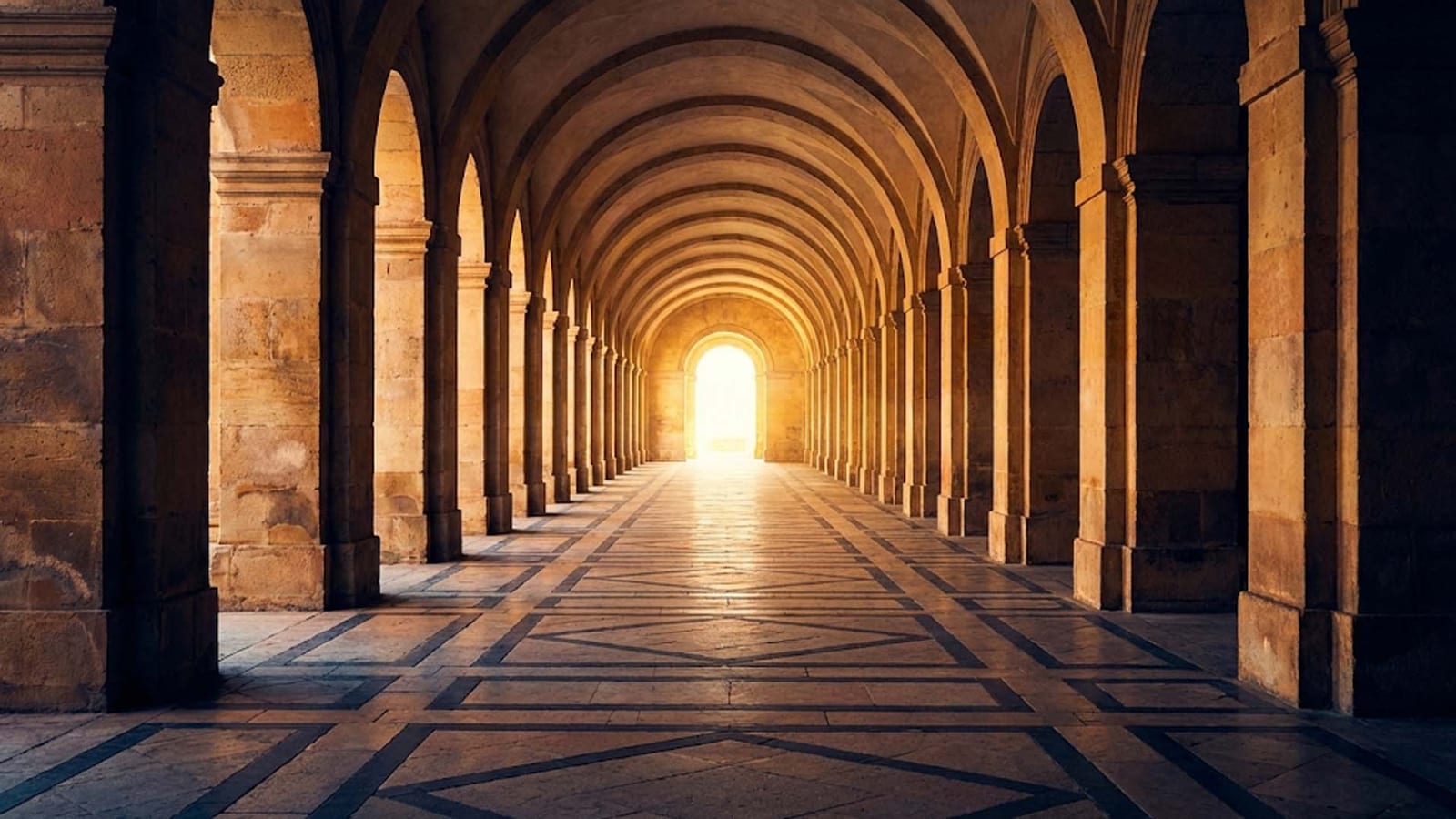
The labelled cells are the whole trick: cell C2 on this small reference holds exactly what cell C2 on the wall must hold, ten or twenty times larger. You copy one labelled cell at a time and the proportions scale with it.
The mural-scaling overlay draws a labelled cell grid on the small reference — column letters A, B, C across the top, row numbers down the side — and lets you set the ratio at which that grid will be replicated on the wall. It is the proportional-transfer grid tuned for large scale-ups — the same squared-up grid tradition the Bargue academic course built its training on7 — with custom non-square cell ratios, presets for common wall and canvas dimensions, and tile-printing or coordinate output for laying the grid out at full size.
The labels carry the method. Cell C2 on the reference corresponds to cell C2 on the wall, ten or twenty times larger, so you copy the design cell by cell without ever needing to see the whole surface. To grid a wall for a mural you replicate the same labelled cells at full scale — snap them with a chalk line so they stay square — and transfer the design one cell at a time. The grid guarantees the mural matches the sketch even though the painter is working inches from a wall that is metres across — which is exactly the problem mural painting has always had to solve.
Squaring-up is the grid method with one extra parameter — the scale ratio between the source cell and the destination cell. The mural grid ratio calculation is a single multiplication: each grid square on the sketch becomes a cell that many times larger on the wall, so enlarging artwork with a grid never needs you to re-judge proportions by eye.
wall size = sketch size × ratio (1:10 → a 6 in sketch becomes a 5 ft mural)
The grid is scaffolding only; it is erased or painted over in the finished work. Try it in the live tool — set the ratio and the labelled grid populates, ready to print or to chalk up at scale.
c. 1400 — Cennini. Cennino Cennini's Il Libro dell'Arte describes the workshop methods of squaring and transferring a design to a larger surface, among the earliest written accounts of the technique that underlies mural scaling.1
1508–12 — the fresco cartoon. Raphael's School of Athens (1509–11) and Michelangelo's Sistine Chapel ceiling (1508–12) were transferred from full-size cartoons by spolvero — perforating the cartoon's contours and dusting charcoal through the holes onto wet plaster. Carmen Bambach's study of the Renaissance workshop documents the cartoon-and-transfer practice in detail.23
16th century — Vasari. Giorgio Vasari's Lives of the Artists records the fresco and transfer methods of the painters he chronicled, a primary source for how the great wall paintings were scaled and executed.4
20th century — the Mexican muralists. Diego Rivera, José Clemente Orozco and David Alfaro Siqueiros carried large-scale proportional transfer into modern public muralism, and sign painters, scenic artists and contemporary street artists use variants of the same squaring-up today.56
"The masters painted murals freehand from imagination." Largely a romance. The great frescoes were transferred from carefully prepared full-size cartoons by spolvero or incision; the freehand legend understates the meticulous geometric preparation behind them.
"A projector makes the grid obsolete." A projector is fast but ties you to power, darkness and a fixed viewing angle, and it distorts on uneven walls. The grid is slower but needs nothing, works in daylight on any surface, and is still the professional fallback.
"Bigger ratio, better mural." No. The ratio is chosen for the working scale, not for ambition; too large a ratio gives wall cells bigger than you can comfortably control, and the transfer accuracy suffers.
| If you want to... | Use mural scaling | Don't use it for... | Difficulty |
|---|---|---|---|
| Scale a sketch onto a wall | The labelled grid at a set ratio keeps proportions exact at any size | Small paper-to-paper copies (use the plain transfer grid) | Beginner |
| Paint where you can't see the whole image | Cell-by-cell transfer guarantees the design close up | Easel work you can view whole (no scale-up needed) | Beginner |
| Work on an uneven or outdoor wall | The grid needs no power, darkness or projector and tolerates rough surfaces | Perfectly flat studio walls where a projector is quicker | Intermediate |
| Enlarge a value study to a finished canvas | A 1:2–1:4 ratio scales the study up with proportions intact | Loose alla-prima work where exactness isn't wanted | Beginner |
| Plan a commission before committing paint | Verify the gridded design on the sketch, where fixes are cheap | Quick informal pieces with no client risk | Intermediate |
Six places squaring-up does demonstrable work — from the fresco scaffold to the spray can.
Transferred from a full-size cartoon by spolvero — squaring-up's ancestor at monumental scale.
Cartoon-and-transfer on a vast curved vault, the painter inches from a surface metres across.
20th-century public murals scaled from studies onto vast walls by the same proportional transfer.
Scenic artists and sign painters square up lettering and imagery onto cloth and board at large ratios.
A gridded sketch chalked onto a building keeps a spray-painted piece in proportion across a whole wall.
Same labelled cells, ten times larger: the proportions hold while the whole design scales to the wall.
Chalking the large cells by eye lets them drift out of square, and at mural ratios that drift becomes a visibly distorted design across the wall.
Discovering a proportional error after paint is on the wall is expensive; the error was cheap to fix on the sketch.
Pushing the ratio so high that each wall cell is bigger than your reach makes cell-by-cell transfer unwieldy and the accuracy suffers.
Squaring-up is how a study becomes a wall. Plan the composition small, grid it, set the ratio for the wall, snap the matching grid in chalk and paint cell by cell — the design stays accurate even though you work inches from a surface metres across. It is the direct descendant of the fresco cartoon, now usually paired with a digital colour mock-up so proportional errors are caught on the sketch where they are cheap to fix.
The same method enlarges a value study to a finished canvas. A 1:2 to 1:4 ratio scales the small study up with its proportions intact, so the decisions made in the quick study survive at exhibition size, the disciplined enlargement the classic drawing manuals describe.8 It is the reliable way to commit a thumbnail's composition to a large canvas without re-judging every relationship freehand at the new scale.
Lettering and imagery on signage, theatre backdrops and trade-show scenery have always been squared up from a small layout. The grid keeps letter spacing and proportions true across a board or cloth far larger than the eye can take in at once, and it works on rough or seamed surfaces where a projector would distort. Tile-print the wall grid or snap it with a chalk line and transfer the layout cell by cell.
Mural scaling is a vivid lesson in proportion: students grid a small drawing, choose a ratio and reproduce it many times larger on paper taped across a wall, discovering for themselves that the proportions survive while the size changes. It connects the classroom grid method to the history of the great frescoes, and a class can collaborate cell by cell on a single large piece.
"Take a small sheet of paper and set down your scene; then rule it across in squares, and rule the wall in the same number of squares, and you may carry it over true to any size you please."
Cennino Cennini, Il Libro dell'Arte (c. 1400), on squaring a design1
Illustrative composites of how the tool gets used in practice — not quotes from named individuals.
Grid the study, set the ratio, snap the wall with a chalk line. I'm inches from a thirty-foot wall and the proportions never lie.
For a big commission I scale the value study up one to four. Every decision I made small survives at gallery size.
Free and browser-only means I check the gridded plan on any machine before a drop of paint goes on a wall I can't take back.
Drop a sketch. Set the ratio and the labelled grid is ready to chalk up at wall scale. Free, in your browser.
Launch Grid Maker Pro →Mural scaling grid is free to use here and will stay that way. When the plan on screen needs to become marks on paper, the browser reaches its limit — there's no camera to register the image to your page. The Grid Maker Pro AR app adds exactly that: hold the phone over the paper and trace your reference directly, then keep working with the same overlay set.
Meet the AR tracing app → Free web tool, free forever · AR tracing is the separate paid app